A mind-expanding endeavor, the set
features 99 mostly comic rarities produced from 1898 to 1926, gleaned from
archives and libraries across the globe. It is a triumph of scholarship.” —
Manohla Dargis, The New York
Times
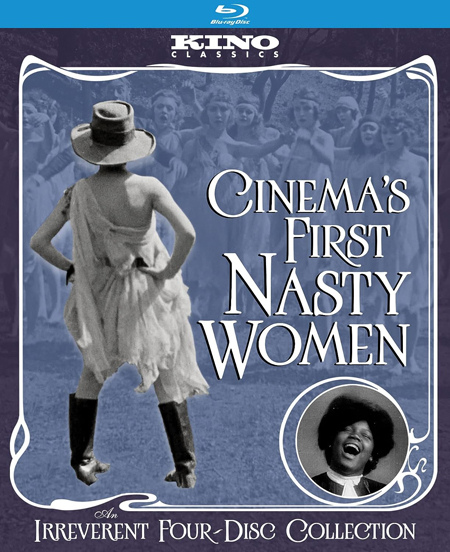
"Cinema’s First Nasty Women
is a game-changer for teaching film history."
-- Catherine Russell, Cineaste
Magazine
"As an entertainment, it’s a
hoot. So much fun! As a look back at the film industry before women creators
were reined in, it’s an historical resource. For anyone who is interested in
early cinema, this disc set is a real treat!"
-- Audrey Kupferberg,
WAMC Northeast Public Radio
"An abundance of low-down female
slapstick anarchy....It's old-school film history turned inside out." --
Michael Atkinson, Sight and Sound
"We need to celebrate this
amazing, labor of love, four Blu-ray package - also hoping for future editions!
It has our strongest recommendation."
-- Gary Tooze, DVDBeaver
Fresh
off its win at the Cinema
Ritrovato DVD Awards, Cinema's
First Nasty Women -- a four-disc set showcasing more than
fourteen hours of rarely-seen silent films about feminist protest, slapstick
rebellion, and suggestive gender play -- has continued to garner critical
praise and inspire innovative repertory programming. This collection is a
celebration of the unknown but indelible women whose rebellious energy and
creative labor helped establish the international silent film industry. Their
work deserves to be enjoyed and remembered today.
Eat
your heart out Barbenheimer! With recent discussions about the power of
popular media to challenge gender norms, subvert lazy stereotypes, and incite
riotous experimentation, now is the perfect time to rediscover these
irreverent, uproarious, and astonishing works from more than a century ago. The
performers in these films paved the way for feminist comedy and gender activism
today. Their wild antics offer uncanny images for navigating the unresolvable
crises and unrealized potentials of our own times. Feast your eyes on Cinema's
First Nasty Women!
These
women organize labor strikes, bake (and weaponize) inedible desserts, explode
out of chimneys, electrocute the police force, and assume a range of identities
that gleefully dismantle traditional gender norms and sexual constraints.
The
films span a variety of genres including slapstick comedy, genteel farce, the
trick film, cowboy melodrama, and adventure thriller, and spotlight performers
and characters like Bertha Regustus, Minnie Devereaux (Cheyenne and Arapaho),
Lillian St. Cyr (Ho-Chunk), Léontine, Little Chrysia, and Edna “Billy” Foster.
Cinema’s
First Nasty Women
includes 99 European and American silent films, produced from 1898 to 1926,
sourced from thirteen international film archives and libraries, with all-new
musical scores, video introductions, commentary tracks, and a lavishly illustrated
booklet by leading scholars and artists, including Shelley Stamp, Jane Gaines,
Jennifer Bean, Mariann Lewinsky, Susan Stryker, Arigon Starr (Kickapoo), Kyla
Wazana Tompkins, Yiman Wang, and Liza Black (Cherokee).
Curated
by Maggie Hennefeld, Laura Horak, and Elif Rongen-Kaynakçi, and produced for
video by Bret Wood, Cinema’s First Nasty Women is a partnership of Kino
Lorber, Le Giornate del Cinema Muto, Women Film Pioneers Project, Eye
Filmmuseum, FIC-Silente, and Carleton University.
CINEMA'S FIRST NASTY
WOMEN
Four-Disc Collection (1898-1926)
Region Free
Directors: various
Cast: Florence Turner, Little Chrysia,
Texas Guinan, Fay Tincher,
Gene Gauntier, Mabel Taliaferro,
Bertha Regustus, Sarah Duhamel,
Evelyn Greeley, Laura Bayley, Edna
"Billy" Foster, Tsuru Aoki, Léontine
Total Running Time: 875 minutes
Countries: Denmark, France, Italy,
Netherlands, Sweden, U.K., U.S.
Genres: Comedy, Action, Drama,
Melodrama, Silent, Slapstick, Western
Technically speaking, OSS 117 secret agent Hubert
Bonisseur de La Bath is not a James
Bond knock off.The creation of wildly
prolific French author Jean Bruce, the first literary adventure of the spy arrived
in 1949 with the publication of Tu parles d'une ingénue (Ici OSS 117).This
would pre-date the April 1953 publication of the first Ian Fleming James Bond
novel, Casino Royale, by nearly four years.In the years following the publication of that
first 007 thriller to his last in 1965, Fleming would deliver an impressive thirteen
James Bond novels and nine short stories.
In contrast, Jean Bruce would
publish no fewer (and possibly more) than eighty-eight to ninety OSS 117
pulp-adventures between 1949 and March of 1963, the month and year of his
passing. It’s difficult to determine how many of Bruce’s novels were of his
composition alone. His widow, Josette – and later a teaming of the Bruce’s son
and daughter – would continue the pulp series into the early 1990s. So determined
bibliophiles will have their work cut out for them if they wish to track down
all of the 250+ published OSS 117 novels.
If OSS 117 beat James Bond to
the stalls of book-sellers, he also managed to beat him to the cinema
screen.Two OSS 117 films were released
throughout Western Europe and foreign markets in 1957 and 1960: OSS 117 n'est pas mort (OSS 117 is not Dead)
andLe bal des espions
(Danger in the Middle East).The latter title,
interestingly, does not feature “Hubert Bonisseur de La Bath.”Though based on one of Bruce’s OSS 117
novels, a messy rights-issue prevented the filmmakers to use the central
character’s moniker.These earliest
films, produced as routine crime dramas by differing production companies (and
featuring different actors in the title role), came and went without attention
nor fanfare.
But in 1963 Bruce’s OSS 117 character was resurrected as
a cinematic property following the success of Terence’s Young’s Dr. No, the first James Bond screen
adventure.The spy pictures comprising
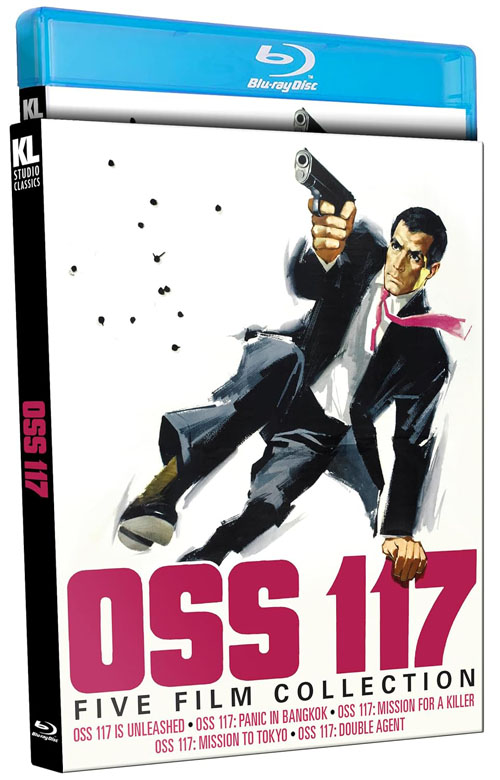
Kino Lorber’s OSS 117 Five Film
Collection are tailored as pastiches of the popular James Bond adventures
of the 1960s.This new Blu ray set
features the entirety of OSS 117 film thrillers produced 1963 through 1968
during the height of Bondmania.And,
just as the Eon series offered a trio of actors to portray James Bond
(1962-1973), the OSS series would likewise present three in the role of Colonel
Hubert Bonisseur de La Bath.Each actor
would bring some aspect of their own personalities to their characterizations.
Of course, the name Hubert Bonisseur de La Bath is a bit
of a Franco-linguistic mouthful to market successfully overseas.So, throughout the five films the character usually
assumes an Anglo-friendly alias which helps move things along a bit more
smoothly: he alternately assumes – among others - such covert surnames as
Landon, Barton, Delcroix, Wilson and Mulligan.It certainly makes his character’s many “personal” on-screen introductions
easier for all involved.
The Kino set starts off chronologically with 1963’s OSS 117 is Unleashed (original title OSS 117 se déchaîne).Like the four films to follow, the series
were all Franco-Italia co-productions and distributed by Gaumont Films.Unlike those four, OSS 117 is Unleashed is filmed in black-and-white.The monochrome photography is not really an
issue.But cinemagoers were certainly cheated
of enjoying the beautiful beaches and Cliffside scenery of the village of
Bonifacio (off the Corsican strait) in vibrant color.
In OSS 117 is
Unleashed our hero (American actor Kerwin Mathews, best known to American
audiences for his roles in Ray Harryhausen’s special-effect laden epics The 7th Voyage of Sinbad (1958) and The 3 Worlds of Gulliver (1960), is sent
to Corsica to investigate the suspicious death of a fellow agent.We’re told, suspiciously, there’s been, “lots
of accidents among agents near Bonifacio.”A preamble to the film, culled mostly of cold war era newsreel footage,
alerts that an unspecified enemy is working towards “neutralizing” free-world atomic
submarine movements in the area. With
conspirators tagged with such names as “Sacha” and “Boris,” we can reasonably
assume its east-of-the-Iron Curtain intelligence agents behind the plot.
Initially posing as a relative of the recently targeted
and now deceased CIA frogman (and later as a Lloyds of London insurance adjustor),
Mathews must dispatch and/or fend off a series of enemy agents and perhaps a duplicitous
woman.In due course, he survives a poisoning,
several (well-choreographed) hand-to-hand combat sequences and even a submerged
spear-gun and knifing frogman attack.The latter occurs while he’s search of a mysterious submerged
subterranean grotto.The base is outfitted
(as one might expect) with high-tech equipment and a detection system designed
to bring about “the end of atomic submarines.”The secreted grotto is also equipped with a built-in self-destruct
button… always handy, just in case.This
is all definitely Bond-on-a budget style filmmaking.Of course, the idea of covertly tracking atomic
submarines movements brings to mind the storyline of the far-more-lavishly
staged The Spy Who Loved Me (1977).
As far as I can determine, OSS 117 is Unleashed was never released theatrically in the
U.S.But Mathews’ second (and final) outing
as OSS 117, Panic in Bangkok (Banco à Bangkok pour OSS 117) (1964) would
have a belated release in the U.S. (as Shadow
of Evil) in December of 1966.Regardless,
Shadow of Evil was not exhibited as a
primary attraction in the U.S. market.It most often appeared as the under bill to Christopher Lee in The Brides of Fu Manchu or (more
sensibly) to Montgomery Clift’s political suspense-thriller The Defector.
In Panic in Bangkok,
Mathews is dispatched to Thailand to, once again, investigate the assassination
of a fellow agent.The murdered CIA operative
had been investigating a possible correlation between anti-cholera vaccines
produced by Bangkok’s Hogby Laboratories to an outbreak of a deadly plague in
India.The trail leads Mathews to
suspect a certain mysterious Dr. Sinn (Robert Hossein) is somehow involved.Unlike the previous film which lacked a singular
villain with a foreboding presence (ala Dr. No), the filmmakers offer
cinemagoers a more exotic adversary in Dr. Sinn.
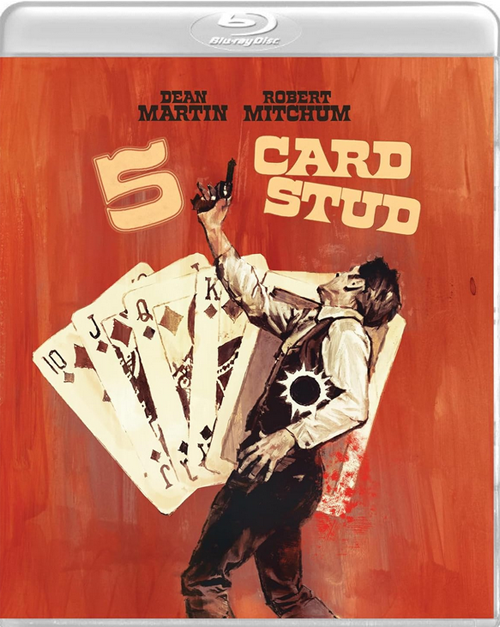
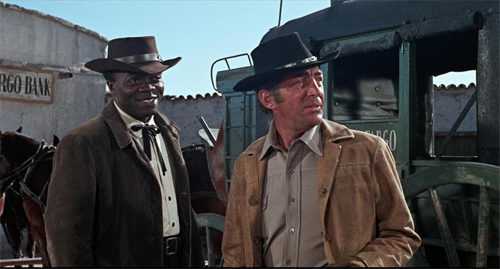
Vinegar Syndrome has released a special edition of the 1968 whodunnit Western "5 Card Stud". It's an unusual title for the company, which generally specializes in releasing first rate special editions of obscure cult films and vintage erotica. The film was a follow-up project between veteran producer Hal Wallis and director Henry Hathaway, who had great success with their 1965 Western "The Sons of Katie Elder" which top-lined John Wayne and Dean Martin, who were reunited six years after co-starring in Howard Hawks' classic "Rio Bravo". "Stud" is by no means a classic, but it is a highly entertaining, offbeat entry in the genre, combining traditional Western elements with the novel idea of incorporating a plot concerning serial murders. Martin plays a character with a Hollywoodish name, Van Morgan. He's a professional gambler who finances his life and travels by dressing up like a dude and finding great success in the gambling parlors of Denver. In between games, he leads a low-key life in a small town of Ricon, Colorado, which is attracting miners intent on finding gold that is rumored to in the surrounding area. When the film opens, he is embroiled in a hard-fought game of poker with local men that extends well into the night. When one of the players is revealed to be cheating, the hot-headed Nick Evers (Roddy McDowell) overreacts and gets the other men to join him in tying up the culprit, riding him out by a nearby bridge to lynch him. Van attempts to stop the hanging, but Nick knocks him out with the butt of his pistol. Not much is done about the crime, since Nick is the son of beloved local cattle baron Sig Evers (Denver Pyle), a widower who runs the ranch with Nick and his sister Nora (Katherine Justice), who are both heirs to the cattle ranch. Nora clearly is smitten by Van, who is reluctant to formally court her, given the fact that she is a decent woman and he lives a somewhat indecent lifestyle. Things kick into gear when one-by-one the men who participated in the fateful poker game are murdered.
The plot is yet another example of Agatha Christie's classic suspense novel "Ten Little Indians" having influenced films of every type of genre. However, the script by the estimable Marguerite Roberts (who would collaborate with Wallis and Hathaway the next year for the triumphant "True Grit") gives the movie an unusual angle for a Western. Roberts had adapted a little-known novel titled "Glory Gulch" by Ray Gaulden and by all accounts took liberties to improve the story substantially. The movie comes to life with the introduction of the film's most dynamic character, the Reverend Rudd (Robert Mitchum), a gunslinging preacher who arrives out of nowhere to open the town's first chapel, determined to bring God into the lives of the town's hedonistic inhabitants. Rudd is a preacher in the fire-and-brimstone tradition. He's outwardly polite but also displays a healthy dose of cynicism. When one of the murders occurs in the chapel, he teams with Van to find the culprit as each of the poker players become increasingly paranoid that they might be the next victim.
The whodunnit aspect of the script is done away with when the identity of the killer is revealed well before the climax. The villain's identity won't come as a shock to any astute viewer, but it's an awful lot of fun watching the clues unravel. Martin was criticized by some reviewers for sleepwalking through his part, but it's an unfair criticism. He gives a perfectly fine performance even if he is upstaged by Mitchum in the meatier and more interesting role. Inger Stevens, in one of her final screen roles before tragically committing suicide at age 35, appears as Lily, a local madame who moves into town with her "girls" and opens a bordello disguised as an upscale tonsorial parlor, which results in some amusing dialogue and sight gags. Van finds himself torn between good girl Nora and the exotic bad girl Lily. The film boasts a marvelous cast of beloved character actors, some of whom only have bit roles. In addition to Denver Pyle, you can relish the presence of Yaphet Kotto, who is excellent in an early career performance. Other participants include John Anderson, Ruth Springford, Roy Jenson,Whit Bissell and Hope Summers, who was a regular on "The Andy Griffith Show". The only off-key note is provided by the miscast Roddy McDowell, who plays a villain in traditional Roddy McDowell style, with a quasi-English accent and an erudite manner that doesn't fit his role as a hard scrabbled cattle rancher. Hathaway's direction is spot-on and the film also offers a quirky musical score by Maurice Jarre that seems to emulate the music found in the Sergio Leone Westerns. We even get to hear Dino warble the catchy title song.
The Vinegar Syndrome release is highly impressive, having been newly scanned and restored in 4K from its original camera negative. Aside from a blurry few seconds in the opening poker game the rest of transfer is excellent. The sleeve has very creative artwork by Tony Stella that seems to pay tribute to the Italian movie poster designs of the era. (There is also reversible sleeve artwork that shows the stars.) There's a 16-page, amply illustrated collector's booklet with an excellent and informative essay by film historian Jim Healy, who astutely points out elements of the film noir genre that are interwoven in the movie. Historian Lizzie Francke provides an excellent video essay about the dramatic life and career of Marguerite Roberts, who managed to rebound after being blacklisted during the dark days of McCarthyism. Film critic Walter Chaw provides a video essay that is devoted entirely to the life and career of Henry Hathaway, and states the obvious: he was always underrated. There is also an impressive commentary track by film book author and Cinema Retro columnist Brian Hannan, who provides plenty of very interesting insights into the making of the film and the Western genre of the 1960s. (He points out that "5 Card Stud" was quite successful at the boxoffice.) As side note, Hannan also runs the addictive blog "The Magnificent 60s".
I don't know if there will be more films of this type released by Vinegar Syndrome, but I hope this isn't an aberration and that there will be more to follow, especially if they are presented in such a fine manner.
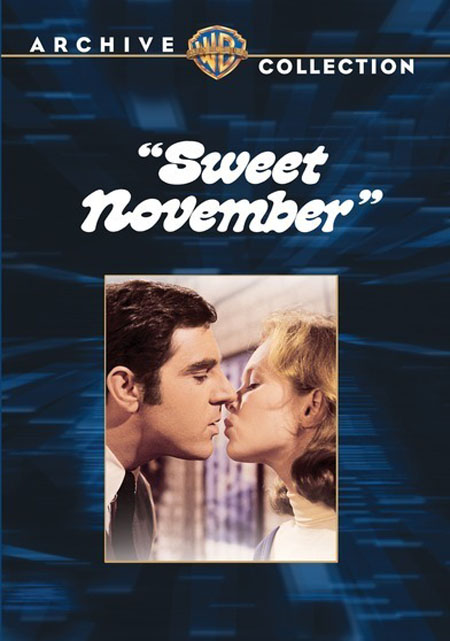
"Sweet November", released in 1968, came and went without generating
much enthusiasm from critics or the public. Produced the estimable team
of Jerry Gershwin and Elliott Kastner, who would go on to make "Where
Eagles Dare", the film is a romantic comedy set in Brooklyn Heights,
just across the river from Manhattan decades before the area was deemed
to be hip. Anthony Newley is Charlie Blake, a stuffy British import to
Gotham who is the workaholic president of a company that manufactures
cardboard boxes. You know the type: no time for love or laughs and just
perfect to be taught a life lesson by the right girl, who, in this case,
happens to be Sara Deever (Sandy Dennis), a 23 year-old independent
young woman who meets cute with Charlie while they both are taking a
test to renew their driver's licenses. As in all such scenarios, the
small talk is awkward and Charlie finds Sara to be wacky and annoying-
before discovering that her bizarre conversations are somewhat
intoxicating. Before long, they are pals and Sara brings him to her
apartment. She explains she's an artist who has found a way to act as a
de facto repair woman for other apartment dwellers, thus supplementing
her income. She also has unusual living arrangements. Every month, she
"adopts" a new man with emotional needs who gets to live with her for a
full month, during which time she serves as an amateur psychiatrist who
documents the progress (or lack there of) in bringing the temporary man
of the house to a better status than she found him in. At the end of
every month, the male tenant must leave to make room for his
replacement. Sara can discern that Charlie is an uptight nerd who is
also frustrated poet at heart. She convinces him to be her tenant for
November. Since Charlie owns his company, he's able to take the time
off, which serves as a reminder of nice things were before E- mails and
text messages came to rule the lives of executives.
Sara's modest flat provides some amusing sight gags: her bed is
located on a shaky platform accessible only by a even shakier ladder.
However, the perks of being her "Tenant of the Month" are that you don't
have to pay rent and you get to sleep with her, though the sexual
aspect of the relationship is only hinted at. Charlie finds Sara to be a
handful in terms of personality quirks. She has an opinion on
everything and likes to play "Mother Hen", advising her tenants about
how to improve their lives. Gradually, Charlie becomes intoxicated by
her innocence and good nature. She's Holly Golightly on steroids, as she
inspires him to explore his creative impulses, shed his business attire
and dress in the currently mod styles. Sara introduces Charlie to her
best friend, Alonzo (nicely played by Theodore Bikel), an artist and
local activist who serves as a father figure to her. Before long,
Charlie is madly in love with Sara and dreads the day when his eventual
departure will have to occur in order to accommodate her next tenant.
Until this point, "Sweet November" plays out like a sitcom of the era,
albeit with some nice footage of Brooklyn. Director Robert Ellis Miller
often encourages his stars to overplay the "cutesy" elements of their
characters. Sara is almost pretentiously quirky and Charlie displays a
fey personality and habits that were mostly associated with
stereotypical gay characters of the era. However, Herman Raucher's
script takes a somber turn in the last third of the film as Charlie
desperately convinces himself that Sara loves him as much as he loves
her. A dramatic twist is introduced that leads to a genuinely touching,
if unexpected finale. As the script grows darker, the two leads have
more to work with. Dennis brings a sensitivity to her performance as the
ultimate liberated woman and Newley (who generally displays more ham
than your local supermarket) eventually reigns in his comedic mannerisms
and redeems himself by making Charlie a more sympathetic figure.
"Sweet November" has all the trappings of a stage play that was
adapted to a film. In fact, it is not, although one can easily see it
translated into a theater production, as most of the scenes take place
in an apartment. The script was considered to be a hot property back in
the day and Audrey Hepburn was said to have been interested in starring
in the film. It enjoyed a prestigious opening at Radio City Music Hall
but critics were dismissive of the movie, though the influential New
York Times almost begrudgingly acknowledged a positive recommendation.
The film quickly disappeared until 2001 when it was remade starring
Keanu Reeves and Charlize Theron, though that film failed at the
boxoffice as well. Despite its unenviable legacy, "Sweet November" is a
touching film that will probably please most retro movie lovers. It is
currently available as a region-free DVD through the Warner Archive.
CLICK HERE TO ORDER FROM THE CINEMA RETRO MOVIE STORE
In
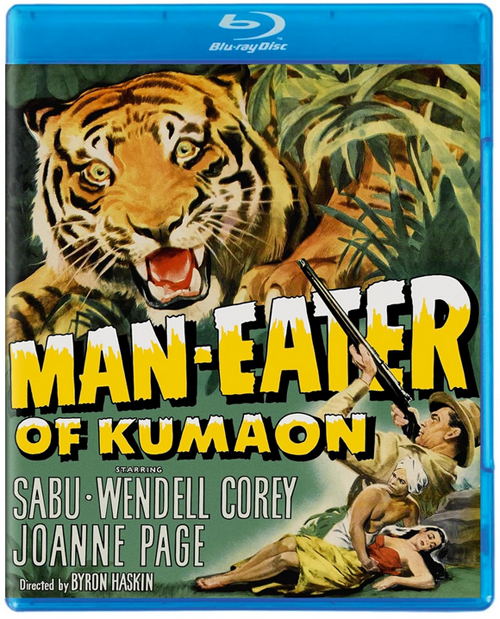
“Man-Eater of Kumaon,” a 1948 feature now available on Blu-ray from Kino Lorber
Studio Classics, Dr. John Collins (Wendell Corey) undertakes an ill-fated
big-game hunt in the distant land of the movie’s title—an actual region of
India in the Himalayan foothills, not a fantasy world orbiting somewhere
between planets Coruscant and Dune as the exotic name might suggest nowadays.Stalking a tiger in the underbrush, Collins
inflicts an agonizing but not fatal injury as his bullet severs one of the
tiger’s toes.His Indian guides warn
that the wounded tiger will begin attacking and killing humans, and they urge
him to finish what he started.But the
American doesn’t
feel particularly responsible for the villagers now at the mercy of the
carnivore.In his case, it’s less a
matter of Western chauvinism than a general lack of empathy for other people
whatever their ethnicity, a shortcoming that cost him his marriage back in the
States.
After
recovering from an onset of malaria, Collins plans to try his luck inSumatra next.But the tiger has already begun its depredations, and on his way to
Delhi, the hunter encounters a little boy, Panwah, orphaned by the big
cat.Collins conveys the child to a
nearby village, where he is taken in by a young couple, Narain (Sabu) and Lali
(Joanne Page), whom the American befriends.In part, we infer, he becomes close to the loving couple because they
remind him of what he lost back home when his wife divorced him.Still, he resists the idea that, having
turned the tiger into a killer of humans, it’s up to him to restore peace and
security by finishing the job—until the attacks become personal when Lali is
badly mauled while saving Panwah.
“Man-Eater
of Kumaon” was loosely based on a best-selling memoir by big-game hunter Jim
Corbett, who in real life was neither an American nor a disenchanted
physician.This wasn’t the first or last
instance of filmmakers purchasing a popular book, keeping the title for name
recognition, and throwing out most everything else.Unlike many books and films that have
glorified big-game hunting as a macho rite of passage, the dilemma facing John
Collins is a crisis of conscience, not a challenge to his ability to secure a
trophy head.Still, animal-rights
advocates and conservationists are likely to be disturbed by scenes of the
hunter pointing his rifle at the tiger whatever the context.Now, laws would require that the cat be
tranquillised as the first resort and relocated to another habitat away from
humans, not killed.Aside from Sabu, all
the Indians in the story are portrayed by non-Indian actors, a practice that
wouldn’t begin to change for another ten years, when Kamala Devi and I.S Johar
appeared in prominent supporting roles in another movie about ferocious
felines, “Harry Black and the Tiger” (1958).Arguing that studios should have been more inclusive in the 1940s is a
little like contending that Ford’s Theatre should have had metal detectors in
1865.Nevertheless, it’s still a hurdle
for many viewers today, accustomed as we’ve become to the routine presence of
Indian and Indian-American actors in contemporary TV shows and movies, although
critically beloved classics like “Gunga Din” and “Black Narcissus” often seem
to get a pass in this regard.
Well
acted by the always dependable Wendell Corey and capably directed by Byron
Haskin (better known to Sci-Fi enthusiasts for 1953’s “The War of the Worlds”
and six episodes of “The Outer Limits” in 1963-64), “Man-Eater of Kumaon” shows
to good advantage in the new Blu-ray from Kino Lorber.The movie was filmed in black and white by
acclaimed cinematographer William C. Mellor, a choice that may have been
necessitated by the budgetary logistics of incorporating old B&W stock
footage into new shots of a tiger prowling through a backlot jungle set, but it
serves a dramatic purpose too.Mellor’s
glistening daytime shots and hi-def, misty nocturnal compositions underscore a
Film Noir quality in the plot, as fate manoeuvres John Collins into an
initially reluctant, then fiercely resigned showdown with the hostile force of
nature represented by the rogue tiger.Special features on the Blu-ray include several trailers for other
jungle movies and Wendell Corey pictures available from Kino Lorber, a
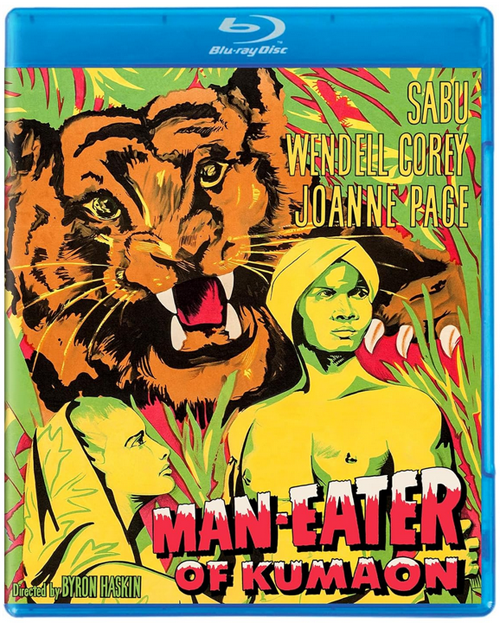
spirited audio commentary by David Del Valle and Dan Marino and reversible sleeve artwork.
Cinema Retro has received the following press release from Blue Underground:
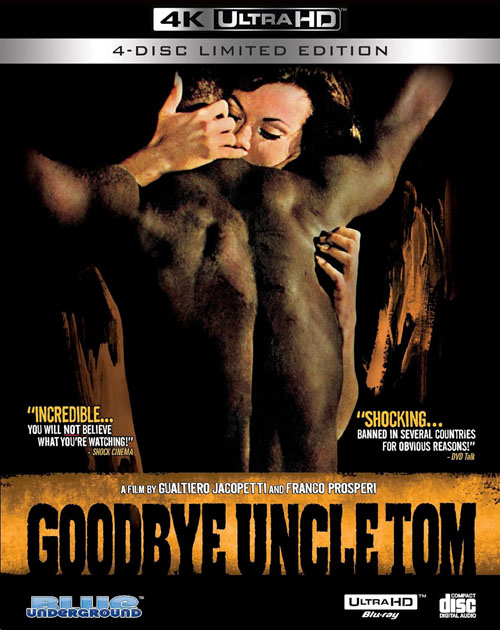
On April 23rd, Blue Underground releases Goodbye
Uncle Tom, one of the most graphic and notorious films ever made, on
Limited Edition 4K UHD and Blu-Ray.
Originally released in 1971, Goodbye Uncle Tom is
an Italian mondo-docudrama based on true events about the rise and revolt of
slavery in America.
Directors Gualtiero Jacopetti and Franco
Prosperi (Mondo Cane) used period documentation and historical
accounts to recreate the antebellum south and the horrors of the slave
trade. The film was so shocking in its detailed look at the atrocities of
slavery that distributors in the US forced Jacopetti and Prosperi to cut it and
radically re-edit the film before release.
Even in its truncated form, Goodbye Uncle Tom created
a stir amongst critics. Roger Ebert called it, “… the most
disgusting, contemptuous insult to decency ever to masquerade as a
documentary.” while Pauline Kael said, “the most specific and rabid
incitement to race war," and The Detroit Chronicle hailed it as
"a graphic, moving, nerve-paralyzing film."
Goodbye Uncle Tom can
now be seen more than five decades after its initial release in both its
original uncut Italian version, alongside its drastically different English
version, both fully restored in 4K from their original camera negatives.
Includes a bonus Blu-ray disc with a wealth of supplemental features that give
context to the staggering and violent look back at this horrific chapter of
American history.
The 4K UHD and Blu-ray Extras special features include
feature-length documentaries; never-before-seen interviews with
writers/directors Gualtiero Jacopetti, Franco Prosperi, composer Riz Ortolani
and others; rare behind-the-scene footage; English and Italian trailers; still
galleries, including Giampaolo Lomi’s behind-the-scenes photos; a bonus CD of
the Original Motion Picture Soundtrack by Riz Ortolani; and a collectible
booklet.
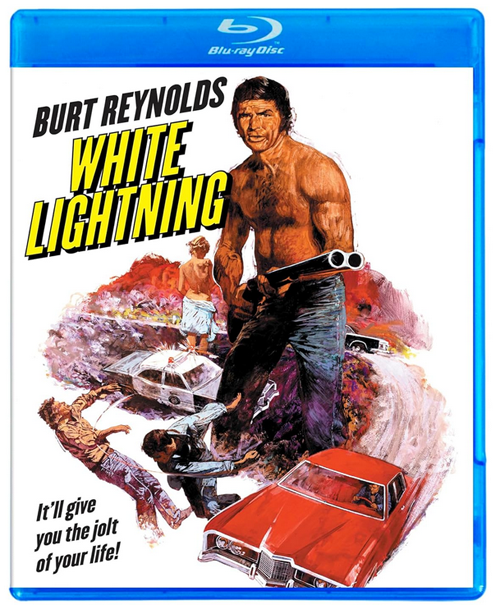
Burt Reynolds had been gnawing around the boundaries of genuine stardom for more than a decade, starring in short-lived television shows and top-lining "B" movies. He ingratiated himself to the American public by showcasing his wit and comedic abilities by appearing on chat shows. In 1972, he struck gold when director John Boorman cast him opposite Jon Voight as the two male leads in the sensational film adaptation of James Dickey's "Deliverance". Finally, he could be classified as a major movie star. Soon, Reynolds was cranking out major films even while his uncanny ability to publicize himself resulted in such stunts as his famed provocative centerfold pose in Cosmopolitan magazine. On screen, Reynolds sensed that he could cultivate an especially enthusiastic audience if he catered to rural movie-goers. He was proven right with the release of "White Lightning", a highly enjoyable 1973 action/comedy that perfectly showcased Reynolds' favored image as a handsome, unflappable hero with a Bondian knack for tossing off quips while facing death and also engaging in good ol' boy towel-snapping humor. Playing bootlegger Gator McClusky, Reynolds drew major crowds, very much pleasing United Artists, which enjoyed hefty profits from the modestly-budgeted production. Reynolds learned, however, that his audience wouldn't necessarily follow him if he deviated from that image. When he went against the grain in films like "The Man Who Loved Cat Dancing", "At Long Last Love" and "Lucky Lady", the movies bombed. When he stuck to the basics, he had hits with "Shamus", "The Longest Yard" and "W.W. and the Dixie Dance Kings". The legendary Variety headline that read "Hix Nix Stix Pix" was no longer true. The American heartland loved Burt Reynolds, especially when he played characters that rural audiences could embrace.
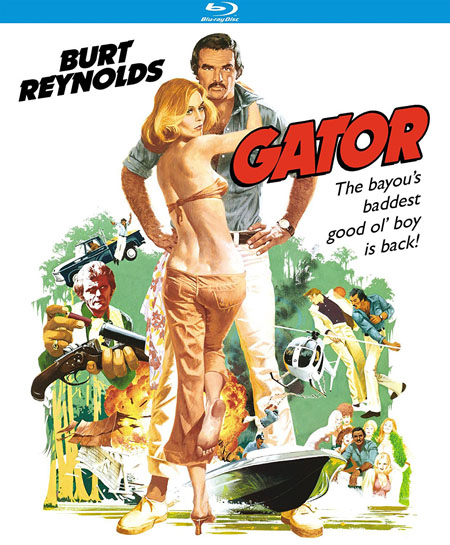
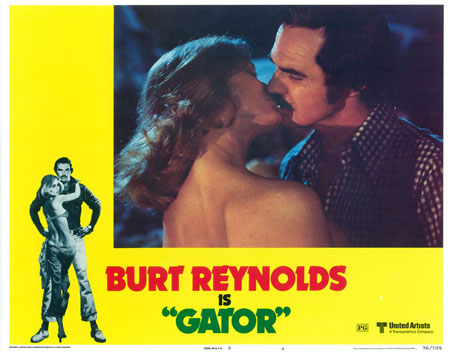
In 1976, Reynolds fulfilled another career milestone by directing his first feature film, a sequel to "White Lightning" titled "Gator". Like the first movie, it was shot entirely on location in Georgia and picked up on the adventures of everyone's favorite moonshiner. When we first see Gator in the sequel, he his getting out of jail only to be targeted by the feds to be used as a pawn in a multi-state crackdown on an epidemic of political corruption that threatens the career of the self-serving, ambitious governor (played very well by famed chat show host Mike Douglas in his big screen debut.) Gator is living in a shack located deep in an inhospitable swamp with his elderly father and precocious 9 year-old daughter when the feds launch a major raid to arrest him on moonshining charges. In reality, they want to use the warrant as leverage to convince him to go undercover for them inside the crime ring. Gator wants no part of it and leads the feds on a merry chase around the bayou in which he is pursued by speed boats and helicopters before finally relenting. The lead federal agent in charge is Irving Greenfield (Jack Weston), an overweight, hyper-nervous Jewish guy from Manhattan who has the unenviable task of ensuring that Gator follows orders. A good portion of the film's laugh quotient comes from Irving's less-than-convincing attempts to "blend in" with small town southern locals. The crime ring is run by Bama McCall (Jerry Reed), an outwardly charming and charismatic fellow who, in reality, uses brutally violent methods to ensure loyalty and intimidate local businessmen to pay protection money. He and Gator are old acquaintances and he doesn't hesitate to give Gator a good-paying job as an enforcer for his mob. Things become more intriguing when Gator sets eyes on Aggie Maybank (Lauren Hutton), an attractive local TV anchor with liberal political beliefs that find her squaring off against Bama in order to protect the poor merchants he is exploiting. "Gator" proceeds on a predictable path but its predictability doesn't detract from its merits, which are considerable. Reynolds is a joy to watch and it's small wonder he leaped to the top ranks of cinematic leading men. His cocky, self-assured persona served him well on the big screen and "Gator" is custom-made to please his core audience. He also proved to be a very able director, handling the action scenes and those of unexpected tragic twists with equal skill. He also gets very good performances from his eclectic cast, with Weston engaging in his usual penchant for scene-stealing. Reed also shines in a rare villainous role and ex-model Hutton proves she has admirable acting chops, as well. The action scenes are impressive thanks to the oversight of the legendary Hal Needham, who would forge a long-time collaborative relationship with Reynolds.
The Kino Lorber Blu-ray is a reissue with extras from the 2018 release ported over. The new additional material consists of a commentary track by film historians Steve Mitchell and Nathaniel Thompson, who also provide a new track on the KL reissue of "White Lightning". The track is quite valuable and entertaining, as old pros Mitchell and Thompson provide a wealth of interesting facts and observations about the film. For example, they discuss that "Gator" is far lighter in tone than the revenge thriller "White Lightning" and say that Reynolds thought the script for "Gator" was sub-par but did the film on the proviso he could direct it. The disc is also impressive not only because of the excellent transfer but also because it contains a filmed interview with Reynolds, who extols the film's virtues and its personal meaning to him. In an unusually candid conversation, he divulges amusing anecdotes about Hutton's on-set quirks that included a penchant for exhibitionism (she would flash her breasts to appreciative crew members.) He also relates how a car crash stunt almost killed Hal Needham. Most poignantly, he talks about his personal affection for Georgia, a state he has filmed over twenty movies in. He also candidly expresses his regret that only directed a few films and never fulfilled his dream of directing productions he didn't star in. The Blu-ray set also includes a new gallery of trailers for Reynolds films available from KL. In all, a highly impressive release of an action film showcasing Reynolds at his best. Recommended.
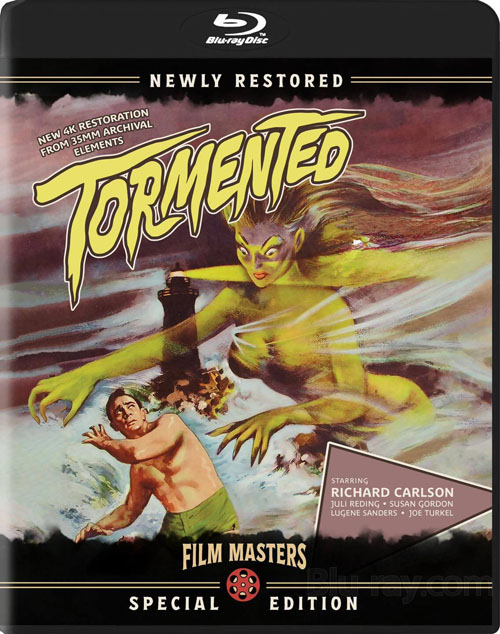
Cult director Bert I. Gordon was at the helm
for this terrifying story of supernatural passion. Set on an island in a
tight-knit community, Tom Stewart (Richard Carlson) is preparing to marry the
woman he loves. All is well until Tom's old girlfriend, Vi (Juli Reding), confronts him at
the top of the island's lighthouse, claiming he can only be hers! A freak
accident throws the scorned woman to her death. At first relieved, Tom's tune
changes when her vengeful spirit begins to follow him wherever he goes. He's
soon tormented, body and soul, by an unforgiving she-ghost! What lengths will
Tom go to in order to protect his secret? Will the vengeful Vi finally reveal
herself to the others at hand?
And the scene is pretty much set for a quite
wonderful slice of low- budgeted shenanigans. Bert I. Gordon was of course a
master of his art in this particular genre of filmmaking. Starting off in
advertising using his trusted 16mm camera, Gordon wasn’t one to sit back and
wait for success, instead he chased his dream, and as a result accomplished a
pretty good career in movies. He’s best known for writing and directing science
fiction and horror B-movie classics such as King Dinosaur (1955), The Amazing
Colossal Man (1957), Earth vs. the Spider (1958), Village of the Giants (1965),
and later the Joan Collins fun fest Empire of the Ants (1977).
In the late 50’s, ghostly supernatural films
were building in popularity, movies such as Roger Corman’s The Undead (1957),
Edward L. Cahn’s Voodoo Women (1957) and William Castle’s House on Haunted Hill
(1959) signified a change in trends. Gordon was always astute and possessed a good
sense of understanding when it came to successful box office. And so, following
the current trend, Gordon embarked upon his own ghost story in the form of
Tormented (1960). Starring Richard Calson, the actor that had already
established himself in genre classics such as The Maze (1953), It Came from
Outer Space (1953) and Creature from the Black Lagoon (1954). Carlson engages
in the fun like a seasoned pro. He’s supported by former child star, Lugene
Sanders, the marvellously formed Juli Reding, child actress Susan Gordon
(daughter of the director) and a young, hip Joe Turkel – who appeared in Stanley
Kubrick's The Killing (1956), Paths of Glory (1957), and later in The Shining
(1980). Aside from being hugely enjoyable throughout, this Film Masters 4K restoration
looks absolutely perfect. Stark, sharp and beautiful on the eye, the amount of
work afforded to this rather cheaply made movie really elevates it to a much
higher level. Blacks are nice and deep, and the images contains just the right
amount of grain without over-cooking it. There seems to be a couple of very
minor jump cuts along the way – best rest assured, blink at the right time and
they’re pretty much undetectable. The print shows no wear, scratches and
virtually free of dust and dirt spots. The audio clarity is also clean and
bright in both DTS and the Dolby digital track. It’s very obvious that the
efforts in restoring this film have really paid off and the results are hard to
fault.
But this Film Masters release offers so much
more – you really have to praise the package as a whole, there’s really no skimping
or cutting corners in terms of its content. Firstly, and as we have come to
expect with the Film Masters releases, there’s an interesting and insightful
commentary track by historian, writer and filmmaker Gary Rhodes along with
contributions by Larry Blamire. The track is a detailed and informative
education. There is an all too brief featurette, Bert I. Gordon: The Amazing
Colossal Filmmaker – which features an archival interview with the charismatic
director who provides us with a general overview of how he began in the
business of movies. Then there is Bigger Than Life: Bert I. Gordon in the
1950’s and 1960’s, a Ballyhoo Motion Pictures documentary featuring film
historian C. Courtney Joyner. This documentary provides a great insight into
the director’s career, with plenty of clips, stories, trailers, poster art and
rare photos illustrated throughout – a real joy. For the more serious scholars,
there is an enjoyable visual essay by The Flying Maciste Brothers (Howard S.
Berger and Kevin Marr). The Spirit is Willing: CineMagic and Social Discord in Bert
I. Gordon’s Tormented, offers a much deeper analysis of the movie and its
implications – which is fine should you want to delve into that particular
territory. At the other end of the spectrum, Film Masters also offers the whole
film again, this time in the form of the Mystery Science Theater 2000 version
(1992). There’s no disputing the fact that these presentations are purely
produced as a put down or a ‘roasting’ for light-hearted entertainment – which is
fine if this is your thing. At least Film Masters has again had the foresight
to cover all areas, and provide something for everyone – dependent upon your
particular taste. One thing I did find particularly interesting during this
version is that it contains the original opening Allied Artists title –
something that was missing from the restored main feature version. There are two
Tormented trailers included, an original ‘raw’35mm version and a 2024 re-cut
version using restored element. Again, a nice way of satisfy all audiences with
both the old and the new, and I’m fully behind that way of thinking. Also
included on the disc is an ‘unreleased TV pilot’ of Famous Ghost Stories
featuring Vincent Price. I was initially quite excited about viewing this, as
it tied in nicely with Tormented because the episode again starred Richard
Calson and Susan Gordon. So, I was a little disappointed to discover that this
was not the full episode and instead was simply just the opening and closing
intro and outro clips featuring Vincent Price. The entire show would hade been
a real treat if included. But overall, this minor quibble takes nothing away
from what is a very generous collection of extras.
On top of that, Film Masters have also
included a nicely produced 22-page illustrated booklet with essays by respected
film historian Tom Weaver and novelist/filmmaker John Wooley. The film sleeve
and booklet cover make good use of the original film artwork.
Film Masters have produced
an excellent package with their presentation of Tormented. The company seems to
grow from strength to strength with each of their new releases. It’s a rare
feeling to feel genuinely excited when considering what might be waiting around
the next corner. I can only hope it’s more of the same.
The White Bus (aka Red, White and Zero) is an experimental film by future acclaimed director Lindsay Anderson. Running a scant 46 minutes, the movie was intended to be one third of a feature film that consisted of other offbeat stories by different directors. For various reasons, the other segments were never completed, thus leaving Anderson's work an orphan. The movie is currently being streamed on the Screenpix service. The merits of the film are debatable. It's visually striking. Filmed primarily in B&W with occasional short sequences in color, the movie is a fairly incomprehensible critique of British society. Like Bryan Forbes' The Whisperers, the movie was largely photographed in and around Manchester and the city fairs equally bad in Anderson's work. The plot, such as a it is, centers on an unnamed young woman (Patricia Healey) who is bored working in a London office. We see her at the end of another mundane day getting ready to leave for home. However, the viewer is then exposed to a pair of legs dangling from above her desk. Someone has hanged themselves, but no one in the office pays the slightest bit of attention. The girl takes a train to Manchester and ends up inexplicably deciding to board a white tourist bus that is packed with an eclectic assortment of international eccentrics. The bus stops at various locations including factories and the group is escorted about by the Lord Mayor (Arthur Lowe) who is decked out in full regalia.
There are bizarre sequences that are at times rather mesmerizing - like outtakes from an episode of The Prisoner in that they mingle realism with fantasy. Anderson seems to be making a cynical comment about the degradation of society and the loss of individualism, though the message is muddled amidst the arresting visual aspects of the film. Consequently, the whole enterprise becomes rather frustrating and wearying. Anderson has something to say but is so obtuse about making his point that the film becomes rather like one of those pretentious movies designed to please no one other than pseudo intellectuals who populate panels at film festivals.
There are some other talented people involved in this enterprise including future Oscar winning producer Michael Deeley (The Italian Job, Blade Runner, The Deer Hunter), acclaimed film maker and movie historian Kevin Brownlow(It Happened Here) and screenwriter Shelagh Delaney, whose novel the segment is based on. Young Anthony Hopkins also has a brief bit in the film. Anderson fans will certainly want to check out this early endeavor, but for the average viewer its rather difficult to warm to.
(Screenpix is available as an add-on subscription to subscribers to Amazon Prime, Hulu and YouTube. Click here for more information.)
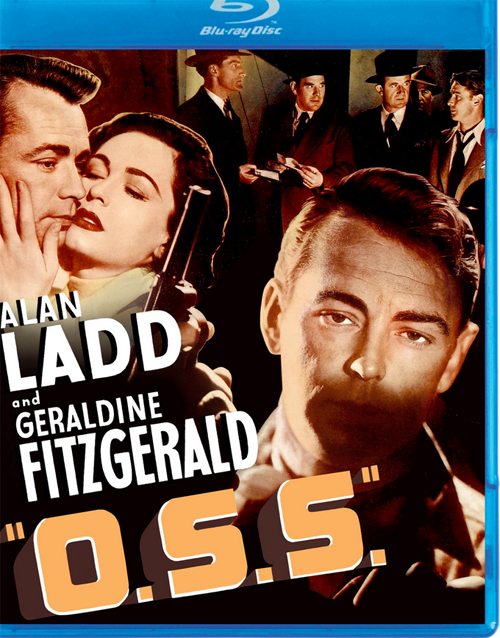
Alan
Ladd and Geraldine Fitzgerald are American agents in the newly-formed WWII era spy
agency “O.S.S.,” on Blu-ray from Kino Lorber. Ladd is Philip Masson, an agent
in the recently formed Office of Strategic Services. The head of the spy group
is Commander Brady, played by Patric Knowles, who sends Masson and several
other agents on their first mission to German occupied France in 1942. Their
mission is to blow up a railway tunnel using plastic explosives and connect
with the French Resistance. Along the way they encounter Nazis, French
collaborators and informants. Joining Mason is Ellen Rogers played by Fitzgerald
and they meet up with fellow OSS agents Robert Bouchet, AKA Bernay the radio
operator, played by Richard Benedict, and Rodney Parrish, AKA Gates, the leader
of Team Applejack, played by Don Beddoe.
Philip
and Ellen have assumed new identities as John Martin, a pipe smoking laborer (his
pipe is a nifty gadget that turns into a gun), and Elaine Duprez, a visiting
artist. Gates is captured and killed by the Gestapo soon after the team parachutes
into France. Gates outs himself at a restaurant by using his fork and knife in
the wrong hand moving Philip into the leadership position. Philip becomes
romantically interested in Ellen which is complicated by the arrival of a local
German commander, Colonel Paul Meister (played by John Hoyt making his screen
debut) who is also interested in “Elaine,” after he asks her to create a bust
of himself. Soon he asks “Elaine” to join him on a trip via rail which will take
them through the tunnel they are sent to destroy.
Working
alongside Commander Brady in England is Gloria Saunders as Radio Operator
Sparky. She receives and sends coded messages with Bernay and they quickly form
a friendship. A local Gestapo agent, Amadeus Brink (played by Harold
Vermilyea), discovers the plot, and provides cover for the team of saboteurs as
long as his extortion demands are met. The bust created by “Ellen” is made of
the plastic explosives and this is used to destroy the railway tunnel. Philip
rescues Elaine during the chaos of the explosion and after they escape she
tells him, “Never come back for me again.”
Ladd,
Fitzgerald, Hoyt and Knowles are all terrific, as is the supporting cast. The
movie is dark, intense and a very good spy thriller making good use of light
and shadows. The film was directed by Irving Pichel, who is known for such
genre favorites as “The Most Dangerous Game,” “She,” “Mr. Peabody and the
Mermaid” and “Destination Moon” spanning the 30s, 40s and 50s. The screenplay
by Richard Maibaum was a forerunner to his work in the James Bond series
produced by Albert R. Broccoli and Harry Saltzman starting with the 1962
release, “Dr.r No” and continuing through “Licence to Kill” in 1989.
The
cinematography by Lionel Lindon is a highlight, as much of the action takes
place either at night or in dimly- lit rooms and the aforementioned tunnel.
Lindon was cinematographer or director of photography on the movies “Around the
World in 80 Days,” “Casanova’s Big Night,” “Dead Heat on a Merry-Go-Round,” “Going
My Way,” “Grand Prix, “The Manchurian Candidate,” “My Favorite Brunette,” “Submarine
Command,” and TV series episodes for “Alfred Hitchcock Presents,” “M Squad,” “McHales’s
Navy” and “The Munsters,” to name just a few of his many credits which spanned decades.
Released
by Paramount in May 1946, the movie was made with the approval and support of
the O.S.S. and definitely can be viewed as government propaganda, but it’s much
more than that. The disc features a fascinating audio commentary track by Samm
Deighan which is chock full of interesting information of the origins of the
O.S.S., spy movies and the post WWII communist and Hollywood blacklist. The
movie looks and sounds terrific in glorious black and white clocking in at 108
minutes. The disc also features the trailer for this and other Kino Lorber
titles. “O.S.S.” is highly recommended for fans of Alan Ladd, spy thrillers and
WWII drama.
Cinema Retro has received the following press release from Warner Home Entertainment :
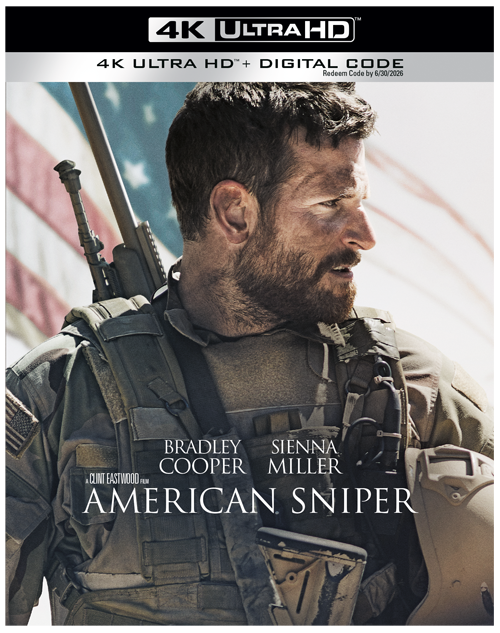
AMERICAN
SNIPER COMES
TO 4K ULTRA HD BLU-RAY AND DIGITAL
THE 2014
BIOGRAPHICAL WAR DRAMA DIRECTED BY CLINT EASTWOOD AND STARRING BRADLEY COOPER
WILL BE AVAILABLE FOR THE FIRST TIME IN 4K RESOLUTION WITH HIGH DYNAMIC RANGE
(HDR)
Purchase
the film on 4K Ultra HD Disc with Collectible Steelbook Packaging, 4K Ultra HD
Disc and Digital on May 14
Burbank, Calif., March 26, 2024 – American Sniper,
the 2014 biographical war drama directed by Academy Award Winning Director
Clint Eastwood and starring Academy Award nominee Bradley Coopers as will be
available for purchase on 4K Ultra HD Disc and Digital for the first time on
May 14.
American Sniper will be available to
purchase on May 14 on Ultra HD Blu-ray Disc from online and in-store at major
retailers and available for purchase Digitally from Amazon Prime Video,
AppleTV, Google Play, Vudu and more.
American Sniper stars Bradley Cooper as
Chris Kyle. A two-time Oscar® nominee for his work in “Silver Linings Playbook”
and “American Hustle,” Cooper stars alongside Sienna Miller, Luke Grimes, Jake
McDorman, Cory Hardrict, Kevin Lacz, Navid Negahban and Keir O’Donnell.
Oscar®-winning filmmaker Clint Eastwood (“Million Dollar Baby,”
“Unforgiven”) directed American Sniper from a
screenplay written by Jason Hall, based on the book by Chris Kyle, with Scott
McEwen and Jim DeFelice. The autobiography was a runaway bestseller, spending
18 weeks on the New York Times bestseller list, 13 of those at number
one. The film is produced by Eastwood, Robert Lorenz, Andrew Lazar,
Bradley Cooper and Peter Morgan. Tim Moore, Jason Hall, Sheroum Kim, Steven
Mnuchin and Bruce Berman served as executive producers.
American Sniper was nominated for 6
Academy Awards including Best Picture and Best Actor and won the Academy Award
for Best Sound Editing.
American Sniperwill
be available on Ultra HD Blu-ray Disc with collectible steelbook packaging
for $40.43 ERP and includes an Ultra HD Blu-ray disc with the
theatrical version of the feature film in 4K with HDR and a Digital download of
the film, and on Ultra HD Blu-ray Disc for $33.99 ERP and includes an
Ultra HD Blu-ray disc with the theatrical version of the feature film in 4K
with HDR and a Digital download of the film. Fans can also own American
Sniper in 4K Ultra HD via purchase from select digital retailers beginning
on May 14.
About the Film
From director Clint Eastwood comes “American Sniper,”
starring Bradley Cooper as Chris Kyle, whose skills as a sniper made him a hero
on the battlefield. But there was much more to him than his skill as a
sharpshooter. Navy SEAL Chris Kyle is sent to Iraq with only one mission:
to protect his brothers-in-arms. His pinpoint accuracy saves countless lives on
the battlefield, and as stories of his courageous exploits spread, he earns the
nickname “Legend.” However, his reputation is also growing behind enemy lines,
putting a price on his head and making him a prime target of insurgents. He is
also facing a different kind of battle on the home front: striving to be a good
husband and father from halfway around the world. Despite the danger, as well
as the toll on his family at home, Chris serves through four harrowing tours of
duty in Iraq, personifying the spirit of the SEAL creed to “leave no one
behind.” But upon returning to his wife, Taya (Sienna Miller), and kids, Chris
finds that it is the war he can’t leave behind.
Warner Bros. Pictures presents, in association with Village
Roadshow Pictures, A Mad Chance Production, A 22nd & Indiana Production.
American Sniper Ultra HD Blu-ray disc contains
the following previously released special features:
·One Soldier's Story: The Journey of American Sniper
·Chris Kyle: The Man Behind the Legend?
·Clint Eastwood: A Cinematic Legacy – The Heart of a Hero
·Navy SEALs: In War and Peace
·Bringing
the War Home: The Cost of Heroism?
·The
Making of American Sniper?
·Guardian
American Sniper
Ultra HD Blu-ray Languages: English, French, Spanish
Ultra HD Blu-ray Subtitles: English French, SDH, Spanish
Cinema Retro has received the following press release from Kino Lorber. If you're politically correct, then stop reading now!:
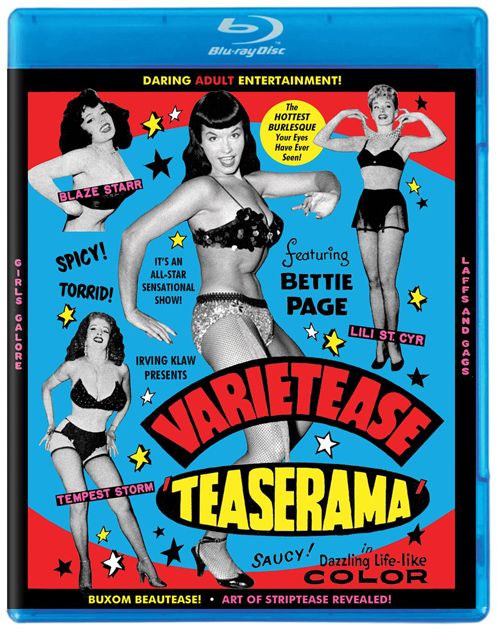
Experience the golden age of burlesque in this titillating triple feature of 1950s grindhouse classics, newly restored from the original negatives. Pinup goddess Bettie Page shares the screen with striptease legend Tempest Storm in the holy grails of full-color burlesque films: Varietease (1954) and Teaserama (1955). Directed by girlie-pix impresario Irving Klaw, the dance card includes performances by strip queens Lili St. Cyr, tantalizing Trudy Wayne, and “female impersonator” Vickie Lynn, interspersed with obligatory appearances by baggy-pants comics and sunny songsters. Concluding the trilogy is Klaw’s Buxom Beautease (1956), which incorporates the short color film Striptease Revealed, and features incendiary performances by Blaze Starr and Dorian Dennis. Working in collaboration with Something Weird, the Sonney Amusement Enterprises Film Collection, and the UCLA Film & Television Archive, Kino Lorber has performed meticulous 4K restorations of these essential films, introducing them to a new generation of burlesque aficionados.
Product Extras :
4K Restorations of TEASERAMA and VARIETEASE from the 16mm Original Camera Negatives
4K Restoration of BUXOM BEAUTEASE from the 35mm Camera Negative and 16mm Materials
DISC 1: TEASERAMA
TEASERAMA – 4K Restoration
Audio Commentary by Jo Weldon, Author of The Burlesque Handbook
TEASERAMA – Something Weird Video Edition
Audio Commentary by David F. Friedman and Mike Vraney
BUXOM BEAUTEASE – 4K Restoration
TEASERAMA – Theatrical Trailer
BUXOM BEAUTEASE – Theatrical Trailer
DISC 2: VARIETEASE
VARIETEASE – 4K Restoration
Audio Commentary by Film Historian Alexandra Heller-Nicholas
VARIETEASE – Something Weird Video Edition
Audio Commentary by David F. Friedman and Mike Vraney
When
I was in college, my friend Bill Davis and I spent nearly half a day one
Saturday from 11 a.m. to 9 p.m. at a local movie theatre for a ten-hour
marathon. The lineup included Sergio
Leone’s “A Fistful of Dollars,”
“For a Few Dollars More,” and “The Good, the Bad,
and the Ugly,” capped with Clint Eastwood’s American Western, “Hang ‘Em High,”
an attempt to replicate the Italian filmmaker’s violent, gritty style. It was the equivalent of binge-watching in
those long-ago days, before home video and streaming services made it easy to
access older films. To revisit favourite
movies in that Neolithic age, you had to hope they would return for second- or
third runs on the big screen, or wait until they resurfaced on TV in visually
degraded, ad-infested prints. The fact
that the Leone movies were still pulling in healthy ticket sales on rerun, four
years after their initial U.S. release, attests to their popularity. Aside from special events like the periodic
return of “Ben-Hur” or “The Ten Commandments,” the only other pictures with the
same level of second-run durability at the time were the first five James Bond
features with Sean Connery.
The
initial success and ongoing appeal of the Leone trilogy prompted Hollywood to
import other Spaghetti Westerns in hopes of matching (or at least approaching)
the same level of commercial success. The era ran from 1968 to the mid-1970s, surviving even the U.S.
box-office disaster of Leone’s fourth Western, “Once Upon a Time in the
West.” The operatic epic starring
Charles Bronson, Henry Fonda, and Jason Robards was lamely marketed here as a
conventional Western, baffling fans of John Wayne and “Gunsmoke.” Adding insult to injury, it suffered
wholesale cuts that rendered entire sections of the story incoherent. On smaller investments, more modest
imitations in the mode of “The Good, the Bad, and the Ugly” fared better. One such picture was Giuseppe Colizzi’s
Western, I quattro dell'Ave Maria, a tremendous hit in
Europe. The Italian title cryptically
translates to “The Four of the Hail Mary,” which sounds more like a farce about
comedic nuns than a Western. Paramount
Pictures (the same studio that, ironically, mishandled “Once Upon a Time in the
West”) wisely retitled the production “Ace High” for U.S. release.
In
Colizzi’s film, bounty hunters Cat Stevens (Terence Hill) and Hutch Bessy (Bud
Spencer) ride into El Paso with $300,000 in stolen money recovered from train
robber Bill San Antonio. They intend to
turn in the money and claim a hefty reward. The Bill San Antonio back story referred to Colizzi’s previous Western
with Hill and Spencer, “God Forgives . . . I Don’t!” (1967; U.S. release,
1969), but you needn’t have seen the predecessor to get up to speed. Cat and Hutch discover that the bank
president in El Paso was Bill San Antonio’s partner, not his victim, and
instead of settling for the reward, they demand the entire $300,000, else
they’ll expose the banker’s secret. In
turn, the banker approaches an outlaw, Cacopoulos (Eli Wallach), who sits in
jail waiting to be hanged the next morning. He offers to free Caco (as the scruffy felon is called) if he’ll kill
Cat and Hutch.
This
being a Spaghetti Western, a genre that reveres double-crosses like no other,
thanks to the template set by Leone, Caco correctly guesses that the banker
plans to do away with him too, as soon as the bounty hunters are out of the
way. Grabbing the $300,000, he flees
town on his own quest for vengeance. The
money will finance his long-delayed pursuit of two former friends, Paco and
Drake, who left him to take the fall for a heist years before. Cat and Hutch follow after him to reclaim the
$300,000. Caco finds Paco south of the
Border, presiding over the summary execution of rebellious peons, and Drake
(Kevin McCarthy, in hardly more than a brief guest appearance) as the owner of
a lavish gambling house on the Mississippi. Drake is still a crook who swindles his rich patrons with a rigged
roulette wheel. Along the way, Caco and
the bounty hunters befriend a Black high-wire artist, Thomas (Brock Peters),
whose talent is pivotal for the bounty hunters’ scheme to break into the
impregnable casino to take control of the wheel and clean Drake out. Italian viewers probably realized that Caco,
Cat, Hutch, and Thomas were “the four of the Hail Mary” in Colizzi’s original
title, planning their break-in as Caco fingers his rosary. Following Sergio Leone’s lead, the Italian
Westerns loved to tweak Catholic piety.
Colizzi
also dutifully copies other elements of the Leone playbook, especially those
featured in “The Good, the Bad, and the Ugly.” Alliances are made to be broken, greed and expediency always overrule
loyalty, and the sins of thieves and hired killers are dwarfed by the inherent
corruption and callousness of society as a whole. But Colizzi’s cynicism seems superficial
compared with Leone’s, and his violence toned down. In the Leone movies, showdowns are “hideous
fantasies of sudden death,” to quote the late film critic Bosley Crowther, in
which the losers literally line up in groups to be gunned down. When my friend Bill and I watched the Leone
marathon all those years ago, we counted a hundred casualties even before we
were well into the third feature, “The Good, the Bad, and the Ugly.” In one gunfight in “Ace High,” Hutch, Cat,
and Thomas simply shoot the hats off their opponents’ heads, the kind of
slapstick more likely to appear in a comedy Western with Bob Hope or Don
Knotts. The final shootout with Drake
and his henchman is a parody of Leone’s showdowns, which invariably were
choreographed to Ennio Morricone’s dramatic music. Caco has dreamed for years that his reckoning
with his traitorous partner would be accompanied by “slow, sweet” music, and so
Cat and Hutch order Drake’s house orchestra to play a waltz as the “Four of the
Hail Mary” square off against Drake and his henchmen. On one hand it’s a clever idea for viewers
who recognise the joke, but on the other, it trivialises the revenge motif in a
way Leone never would have.
In
another connective thread with “The Good, the Bad, and the Ugly,” Eli Wallach’s
scruffy character is virtually a clone of his bandit “Tuco” from the Leone
epic, even to a nearly identical name. But Leone shrewdly counter-balanced Wallach’s manic performance with
Eastwood’s laconic presence and Lee Van Cleef’s steely menace. In “Ace High,” Colizzi already has two
mismatched characters who play off each other—Terence Hill’s terse, handsome
Cat and Bud Spencer’s burly, grouchy Hutch. Wallach is mostly left to his own Actors Studio devices of grins, tics,
and swagger, which is good for fans who couldn’t get enough Tuco but not so
good for others who just want the story to move on. Tied up by villagers who intend to torture
him to learn the location of his stolen $300,000, Caco relates a long,
soporific account of his childhood. The
scene serves a dramatic purpose, since Caco is trying to lull a drowsy guard to
sleep, but it goes on and on. You’re
likely to nod off before the sentry does.
“Ace High” is
available in a fine Blu-ray edition from Kino Lorber Studio Classics, offering
Colizzi’s film at the correct 2.35:1 ratio in a rich Technicolor transfer. Films like this always looked good on the big
screen, but most casual fans probably remember them instead from lousy,
pan-and-scan TV prints in the old days. The Blu-ray includes the original trailer, plus trailers for several
other Spaghetti Westerns released by KL. The company’s go-to expert on the genre, Alex Cox, contributes a new
audio commentary. Cox has always been
forthright in his dour opinion of directors like Giuseppe Colizzi, Gianfranco
(Frank Kramer) Parolini, and Giuliano (Anthony Ascott) Carnimeo, who turned the
Italian Western in the direction of burlesque in the late 1960s, and away from
the gritty style of Sergio Leone, Sergio Corbucci, and Sergio Sollima. But his comments on “Ace High” are
even-handed, informative, and entertaining.
Cinema Retro has received the following press release:
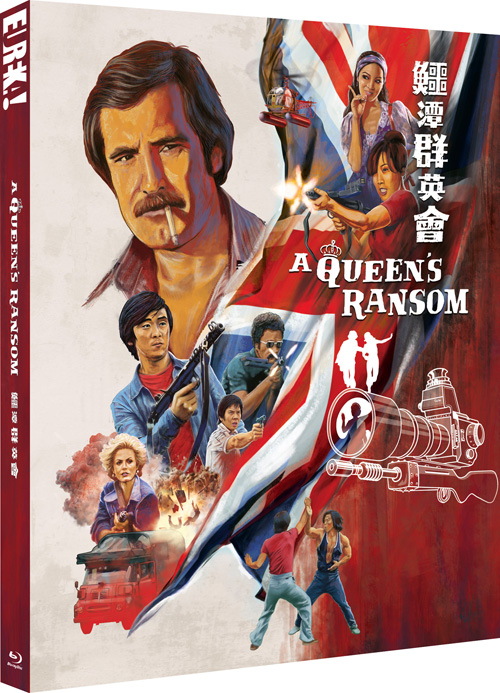
Perhaps even God can't save the Queen in Golden Harvest's
A Queen's Ransom (also known as International Assassin), an explosive
action-thriller starring George Lazenby (The Man from Hong Kong), Angela Mao
(Lady Whirlwind) and the legendary Jimmy Wang Yu (The One-Armed Swordsman).
As Queen Elizabeth II arrives in Hong Kong for a state
visit, a band of skilled mercenaries plan her assassination. Contracted by an
Irish Republican (Lazenby), the international group of hired killers includes a
Japanese explosives expert (Chang Pei-shan), a Thai boxer (Bolo Yeung), a
Filipino sniper (Peter Chan Lung) and a veteran of the National Liberation
Front of South Vietnam (Wang Yu). As the conspirators move to carry out their
plot, two police officials (Ko Chun-Hsiung and Charles Heung) work with a young
socialite (Tanny Tien Ni) in a race against time to save the Monarch's head -
while also trying to manage a crisis that has brought a huge number of refugees
to Hong Kong, including a young Cambodian princess (Mao).
Written and directed by Ting Shan-hsi (Rebel Boxer), A
Queen's Ransom was Golden Harvest's attempt to capitalize on the popular
success of the political thriller in the wake of The Day of the Jackal. Eureka
Classics is proud to present the film for the first time ever on Blu-ray from a
brand new 2K restoration.
BONUS FEATURES:
·1080p HD presentation on Blu-ray of the
original Hong Kong theatrical cut from a brand new 2K restoration ·1080p HD presentation on Blu-ray of the
original English language export cut from a brand new 2K restoration ·Original Mandarin and optional classic
English dub (Hong Kong theatrical cut) ·Classic English dub (Export version) ·Optional English subtitles, newly translated
for this release ·Brand new audio commentary on the Hong Kong
theatrical version by Asian film expert Frank Djeng (NY Asian Film Festival) ·Brand new audio commentary on the export
version by action cinema experts Mike Leeder and Arne Venema ·Brand new documentary featurette by martial
artist and actor Michael Worth ·Reversible sleeve featuring original poster
artwork ·Trailers
One
of the most iconic and influential movies ever made, ONCE UPON A
TIME IN THE WEST has been restored from the original 35mm Techniscope camera negative by Paramount’s archive team, L'Immagine Ritrovata and The
Film Foundation. This
restoration honors the 2007 Film Foundation photochemical restoration overseen
by legendary director Martin
Scorsese by matching its build and color palette. The
result is the definitive home release of the film, which features the
165-minute extended cut restored to its glory.
A
must-own for every cinephile’s collection, ONCE UPON A TIME IN THE
WEST will be presented in a Limited-Edition two-disc 4K Ultra
HD/Blu-ray™ set that includes both new and legacy bonus
content, as well as access to a Digital copy of the film. The film is
presented in Dolby Vision™* and HDR-10, along with English 5.1
DTS-HD Master Audio and English Restored Mono Dolby Digital for an exceptional
home viewing experience.
·Commentary
by the Hosts of the Spaghetti Western Podcast –NEW!
·A
Look Back with Leonard Maltin—NEW!
·Commentary
with contributions from directors John Carpenter, John Milius & Alex Cox,
film historians Sir Christopher Frayling & Dr. Sheldon Hall, and cast and
crew
Widely
considered to be one of the greatest Westerns—and one of the greatest
films—ever made, ONCE UPON A TIME IN THE WEST was
selected for preservation by the Library of Congress in the U.S. National Film
Registry in 2009. The film stars Claudia Cardinale, Henry Fonda, Jason
Robards, and Charles Bronson.
Synopsis
Set
in the dying days of the Old West, a struggle to control water in a dusty
desert town embroils three hard-bitten gunmen in an epic clash of greed, honor,
and revenge.
ONCE UPON A TIME IN THE WEST will also be available on
4K Ultra HD Digital on May 14.
This is a limited edition. Click here to pre-order now from Amazon.
The first African-American to direct a major film for a Hollywood
studio was Gordon Parks, whose feature film debut "The Learning Tree"
was released in 1969. Parks may have shattered the glass ceiling but
there wasn't a tidal wave of opportunities that immediately opened for
other minority filmmakers, in part because there were so few with any
formal training in the art. One beneficiary of Parks' achievement was
Ossie Davis, who was internationally respected as a well-rounded artist.
He was a triple threat: actor, director and writer but his directing
skills had been relegated to the stage. In 1970 Davis co-wrote the
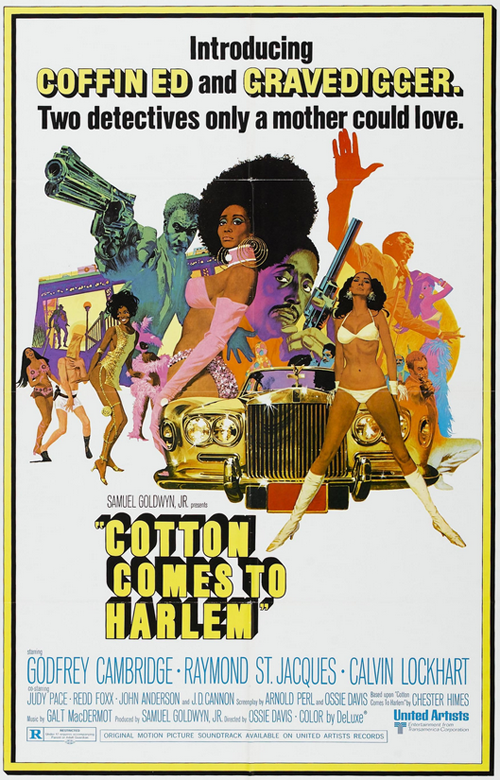
screenplay for and directed "Cotton Comes to Harlem", a major production
for United Artists. The film was based on a novel by African-American
writer Chester Himes and proved to be pivotal in ushering in what became
known as the Blaxploitation genre. In reality, it's debatable whether
"Cotton" really is a Blaxploitation film. While most of the major roles
are played by Black actors, the term "Blaxploitation" has largely come
to symbolize the kinds of goofy, low-budget films that are fondly
remembered as guilty pleasures. However, "Cotton"- like Gordon Parks's
"Shaft" films which would follow- boasts first class production values
and top talent both in front of and behind the cameras. Regardless, the
movie had sufficient impact at the boxoffice to inspire a seemingly
endless barrage of Black-oriented American films that were all the rage
from the early to mid-1970s. The Blaxploitation fever burned briefly but
shone brightly and opened many doors for minority actors.
The film was shot when New York City was in the midst of a
precipitous decline in terms of quality of life. Crime was soaring, the
infrastructure was aging and the city itself would be on the verge of
bankruptcy a few years later. Harlem was among the hardest hit areas in
terms of the economy. The once dazzling jewel of a neighborhood had
boasted popular nightclubs, theaters and restaurants that attracted
affluent white patrons. By the mid-to-late 1960s, however, that had
changed radically. Street crimes, organized gangs and the drug culture
spread rapidly, making Harlem a very dangerous place to be. It was
foreboding enough if you were Black but it was considered a "Forbidden
Zone" for most white people, who spent their money elsewhere, thus
exacerbating the decline of the neighborhoods. "Cotton Comes to Harlem"
serves as an interesting time capsule of what life was like in the area,
having been shot during this period of decline. Director Davis was
considered royalty in Harlem. Despite his success in show business, he
and his equally acclaimed wife, actress Ruby Dee, never "went
Hollywood". They stayed in the community and worked hard to improve the
environment. Thus, Davis was perfectly suited to capture the action on
the streets in a manner that played authentically on screen. Similarly,
he had a real feel for the local population. As with any major urban
area, Harlem undoubtedly had its share of amusing eccentrics and Davis
populates the movie with plenty of such characters.
The film opens with a major rally held by Rev. Deke O'Malley (Calvin
Lockhart), a local guy who made good and who is idolized by the
population of Harlem. O'Malley is a smooth-talking, charismatic con man
in the mode of the notorious Reverend Ike who uses religion as a facade
to rip off gullible followers. This time, O'Malley has launched a "Back
to Africa" campaign for which he is soliciting funds. It's based on the
absurd premise that he will be able to finance disgruntled Harlem
residents back to the land of their ancestry. The hard-working,
semi-impoverished locals end up donating $87,000 in cash but the rally
is interrupted by a daring daytime robbery. An armored car filled with
masked men armed with heavy weaponry descend upon the goings-on, loot
the cashbox and take off. They are pursued by two street-wise local
cops, "Grave Digger" Jones (Godfrey Cambridge) and his partner "Coffin"
Ed Johnson (Raymond St. Jacques). Davis provides an exciting and
colorful car chase through the streets of Harlem, as the cops fail to
snag the robbers. They also discover that O'Malley has gone missing,
leading them to believe that he orchestrated the heist himself so he
could keep the proceeds raised at the rally. The plot becomes rather
convoluted, as Jones and Johnson learn that a bale of cotton has arrived
in Harlem and its somehow connected to the crime. They assume that the
stolen money has been stashed in said cotton bale, which quickly changes
hands among the most unsavory characters in the community. Getting in
on the action is a white mob boss and his goons who are also trying to
recover the cotton bale. The cotton itself is resented in Harlem because
of its historical links to slavery and by the end of the film, the bale
ends up in a stage show at the famed Apollo Theater where it is used as
a prop in a bizarre production that involves historical observations
about the black experience intermingled with a striptease act! Through
it all, Jones and Johnson doggedly chase any number of people through
the streets, engage in shoot-outs and car chases and come in and out of
contact with Rev. O'Malley, who professes his innocence about being
involved in the robbery. The Rev isn't so innocent when it comes to
other unscrupulous activities such as chronically cheating on his
long-suffering girlfriend Iris (Judy Pace) and manipulating other women
in a variety of ways.
The most delightful aspect of the film is the showcasing of some very
diverse talents of the era. Godfrey Cambridge (who made it big as a
stand-up comic) and Raymond St. Jacques enjoy considerable on-screen
chemistry even if the script deprives them of the kind of witty dialogue
that would have enhanced their scenes together. They make wisecracks
all the time and harass some less-than-savory characters but the
screenplay never truly capitalizes on Cambridge's comedic potential. The
film's most impressive performance comes from Calvin Lockhart, who
perfectly captures the traits of phony, larger-than-life "preachers".
He's all flashy good looks, gaudy outfits and narcissistic behavior.
Lockhart seems to be having a ball playing this character and the screen
ignites every time he appears. There are some nice turns by other good
character actors including pre-"Sanford and Son" Redd Foxx, who figures
in the film's amusing "sting-in-the-tail" ending, John Anderson as the
exasperated white captain of a Harlem police station that is constantly
on the verge of being besieged by local activists, Lou Jacobi as a junk
dealer, Cleavon Little as a local eccentric, J.D. Canon as a mob hit man
and Dick Sabol as a goofy white cop who suffers humiliation from
virtually everyone (which is sort of a payback for the decades in which
Black characters were routinely used as comic foils). The film has a
surprisingly contemporary feel about it, save for a few garish fashions
from the 1970s. It's also rather nostalgic to hear genuine soul music
peppered through the soundtrack in this pre-rap era. Happily, life has
not imitated art in the years since the film was released. Harlem has
been undergoing the kind of Renaissance that would have seemed
unimaginable in 1970. The old glory has come back strong and the center
of the neighorhood, 125th Street, is vibrant and thriving once again.
These societal perspectives make watching "Cotton Comes to Harlem"
enjoyable on an entirely different level than simply an amusing crime
comedy.
The film is currently streaming on Screenpix, available for subscription through Amazon Prime.
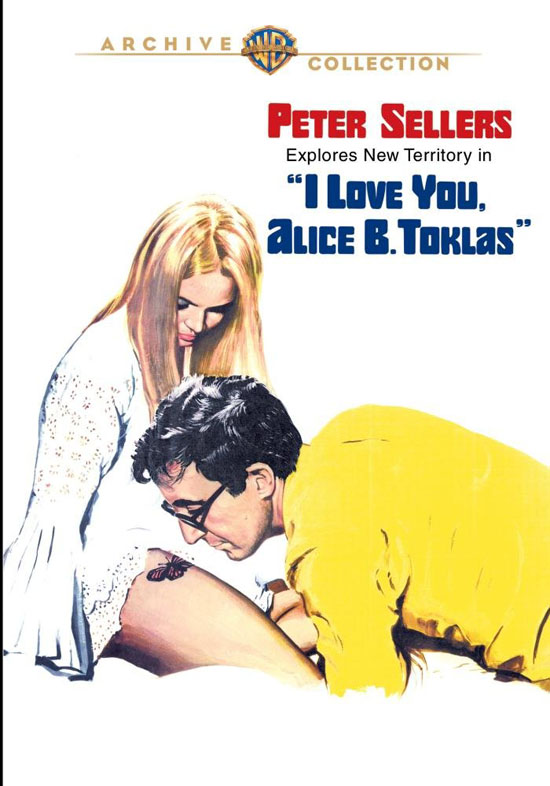
"I Love You, Alice B. Toklas" might leaving contemporary viewers asking "Who is Alice B. Toklas?" The answer: she was a companion of writer Gertrude Stein. Toklas was a fellow writer who became idolized by pop culture addicts for daring to have written a cookbook that included a recipe for pot brownies. The 1968 big screen farce was anything but fun to make. Paul Mazursky and Larry Tucker were to have made their directorial debuts with this film. However, once Peter Sellers was signed to star, the mercurial and unpredictable actor had them bounced from the directors chair(s), though their screenplay was retained. Shortly after production began, Sellers brought Mazursky back on board to offer advice about salvaging a production that Sellers was growing increasingly leery about. The truce was short-lived because Mazursky criticized the way Sellers played a love scene with Leigh Taylor-Young, who made her big screen debut in the film. Mazursky was fired again as the film hobbled through production under the direction of Hy Averback. Sellers was apparently also feuding with his wife, Britt Ekland, who was simultaneously filming "The Night They Raided Minsky's" against Sellers' wishes.
The story presents Sellers as Harold Fine, an L.A. lawyer and self-described "square". He is courting his law firm's secretary, Joyce (Joyce Van Patten), an amiable bubble-head who constantly pressures Harold into proposing to her. He finally relents and a wedding date is set, much to the delight of Harold's parents (amusingly played by Jo Van Fleet and Salem Ludwig). In the meantime, Harold finds himself unexpectedly immersed in the local hippie culture when his car is damaged and he finds the only accessible vehicle is a flower-powered decorated loaner he gets from the repair shop. At the same time, his hippie brother Herbie (David Arkin) introduces him to the gorgeous Nancy (Leigh Taylor-Young), a free-spirited young woman who indulges in drugs and free love. Harold finds himself smitten by her and when she leaves him some pot-laced brownies, it results in the film's funniest scene in which Harold ends up serving them to his parents and Joyce, resulting in the kind of over-reaction one might attribute to a tab of LSD. Nevertheless, it is quite an amusing segment. Ultimately, Harold leaves Joyce at the synagogue seconds before taking the vow of marriage. He dashes home and vows to start a new life with Nancy. Before long, he is sporting long hair, mod eyeglasses and is living in his car. It seems perfect until the screenplay predictably delves into one of those scenarios in which the motto is "Be careful what you wish for- you just may get it!".
Sellers is the glue that holds the fragile premise together, even if his American accent slips every now and then. Taylor-Young makes for a lovely leading lady and Joyce Van Patten is stuck in the role of constantly jilted lover who craves Harold no matter how many times he humiliates her. Unfortunately, the premise wears thin pretty quickly and the movie is never as funny as it should be or you expect it to be. In fact, it bears a certain resemblance to Blake Edwards' "The Party", which was released the same year. Both films were based on an initially funny scenario that ultimately ran out of steam as the movie wore on. At the time, Roger Ebert reviewed the film favorably but pointed out that it was another example of a Hollywood studio punting when it came to presenting the hippie culture and depicting the rebellious young people as sanitized caricatures. Perhaps the biggest laugh to be had was by Paul Mazursky, who would direct the smash hit "Bob & Carol & Ted & Alice" the following year, thus establishing himself as a major name in the film industry.
The region-free Warner Archive boasts a fine transfer. The only bonus feature is the trailer.
Kino Lorber has released a Blu-ray edition of The Internecine Project, a 1974 London-based thriller directed by Ken Hughes and starring James Coburn in a bravura performance as a charismatic villain. Coburn plays an internationally respected economics expert who finds himself being tapped to be an adviser to the President of the United States. However, he must first ensure that his sordid sideline of running a small London crime ring is swept under the rug. To do so, he devises a complex scheme to convince each member of his team to murder another. The film, written by Barry Levinson and Jonathan Lynn, bristles with tension and leads to a wonderful and satisfying conclusion. Aside from Coburn's outstanding performance, you can relish yeoman work from Lee Grant, Kennan Wynn, Harry Andrews and Ian Hendry- all set to Roy Budd's atmospheric score.
The Blu-ray is a welcome upgrade from the previous Scorpion DVD edition. It ports over the interview with Jonathan Lynn, who would go on to be best known for writing famous British comedy TV series. On most special editions produced by major studios, the interviews are chopped into brief soundbites. Refreshingly, this one allows Lynn to talk for almost 30 minutes- and he goes beyond discussing The Internecine Project to detailing working on Clue, which he wrote and directed.Unfortunately, this edition does not include the interview with Coburn's daughter that was featured on the DVD release. The Blu-ray does contain the original trailer along with trailers of other crime thrillers available from KL. Highly recommended.
The conventional wisdom is that physical media (DVDs, Blu-rays) is in a death spiral in the age of streaming. In article for the BBC's web site, writer Claire Thorp makes the case for treasuring physical media. Let's face it: streaming is great, but as the article points out, your "ownership" of your favorite videos is tentative, subject to them vanishing without warning due to licensing expiration situations and other factors. Additionally, streaming can't provide those great bonus extras collectors treasure. The article advises that the only way to permanently possess these treasured films is to own them outright. Click here to read.
Cinema Retro has received the following press release:
Legendary director Don Siegel (Dirty
Harry) directs the iconic John Wayne as an ageing gunfighter dying of cancer in
his final screen appearance, a superb adaptation of Glendon Swarthout's classic
western novel, The Shootist.
John Bernard Books is the stuff of
legend, a renowned 'shootist' whose reputation looms large. But it's 1901, and
like the old west, John is dying and a reputation like his draws trouble like
an outhouse draws flies. As word spreads that the famous gunfighter is on his
last legs, the vultures begin to gather; old enemies, the marshal, newspaper
men, an undertaker, all eager to see him dead. Other men might die quietly in
bed or take their own lives, but J. B. Books will choose his executioner and
face down death with a pistol in each hand.
With an outstanding cast that
features not only Wayne, but James Stewart, Lauren Bacall, Ron Howard, Scatman
Crothers and John Carradine, The Shootist is an elegiac ode to a monumental
screen presence and to the Western genre itself.
Bonus Materials
·New 2K remaster by Arrow
Films from the original 35mm camera negative
·High Definition Blu-ray
(1080p) presentation
·Original lossless mono
audio
·Optional English
Subtitles for the deaf and hard of hearing
·Brand new audio
commentary by filmmaker and critic Howard S. Berger
·The Last Day, a new
visual essay by film critic David Cairns
·A Man-Making Moment, a
new interview with Western author C. Courtney Joyner
·Laments of the West, a
new appreciation of Elmer Bernstein’s score by film historian and composer Neil
Brand
·Contemplating John
Wayne: The Death of a Cowboy, a new visual essay by filmmaker and critic Scout
Tafoya
·The Shootist: The Legend
Lives On, archival featurette
·Theatrical trailer
·Image gallery
·Reversible sleeve
featuring original and newly commissioned artwork by Juan Esteban Rodríguez
·Double-sided fold-out
poster featuring original and newly commissioned artwork by Juan Esteban
Rodríguez
·Six postcard-sized lobby
card reproductions
·Illustrated collector’s
booklet featuring new writing by film critic Philip Kemp
This Blu-ray will be released on March 12. Click here to order from Amazon.
Here's a fine documentary examining the life and career of Robert Mitchum from The Hollywood Collection.
"For nearly a century, Hollywood has captivated and influenced generation after generation of moviegoers. Its magic has left an indelible imprint on every culture with a movie projector. Originally broadcast on PBS, HBO/Cinemax, TNT, A&E, Lifetime, and Bravo, this is one of the most comprehensive collections of biographies and cinema retrospectives ever compiled, a spectacular treasury of 32 revealing biographies of Hollywood’s most beloved stars. These biographies, some narrated by the stars themselves, include interviews with friends, family members and colleagues, as well as clips from their most memorable films, and in some cases, rare home movies.
“Over 350 actors, writers, directors, producers, make-up people, publicists, agents, and family members all gave of themselves to help make these shows possible. This was the way it was in Hollywood in its classic era and these were the stars that captured us.” – Gene Feldman, producer/director of The Hollywood Collection."
(To watch in full screen mode, click on "Watch on YouTube".)
Arrow Films has released director Peter Yates' 1971 WWII adventure "Murphy's War" starring Peter O'Toole as a Blu-ray special edition, loaded with impressive extras. Click here for more info and to order from Amazon.
“Tales
of Adventure Collection 2,” a special edition, Blu-ray box set from
Australia’s Imprint Films, gathers five movies from the 1940s and ‘50s with
“wild and dangerous” jungle settings. To
the best of my memory, I don’t recall seeing any of them among the scores of
jungle pictures I enjoyed as a kid in the ‘50s and early ‘60s, either on the
big screen or on local TV morning movie matinees. Of the five diverse selections in the Imprint
box set, three are Republic Pictures productions, the fourth is a Paramount
release, and the fifth bears the Columbia Pictures logo. All five feature superior transfers (the
three Republic entries are transfers from 4K scans of the original negatives)
and captions for the deaf and hard of hearing, and four of them come with
excellent audio commentaries. Younger
viewers be aware, the films tend to reflect attitudes about race and
conservation that were commonplace seventy years ago, but frowned upon today;
you won’t see anything remotely like Black Panther’s democratic technocracy of
Wakanda here.
The
older two Republic releases, both in black-and-white and paired here on one
disc, underscore the studio’s reputation as a purveyor of lowbrow entertainment
with stingy production values. “Angel on
the Amazon” (1948) begins with Christine Ridgeway (Vera Hruba Ralston) trekking
through the Amazon jungle with safari hat and rifle, stalking panthers. It promises (or threatens, if you’re a
conservationist) to become a film about big-game hunting, where wild animals
exist to be turned into trophy heads. But
then Christine’s station wagon breaks down, and she radios for help. Pilot Jim Warburton (George Brent) flies in
with the needed carburetor part, just in time for the party to escape from
“headhunters.” This may be the only
jungle movie in history where rescue depends on a delivery from Auto Zone. Jim is enchanted by Christine, but she has
something to hide and refuses to warm up to his advances. Later, meeting Jim again in Rio de Janeiro,
she becomes frightened when an elderly, apparently harmless man watches her
from a distance. As film historian
Philippa Berry notes on the informative audio commentary for the Blu-ray, the
answer to the mystery revolves around the then-popular theme of physical
effects from psychological trauma, here given a mystical and somewhat absurd
twist. The studio-bound sets and back
projection that waft the characters from the Amazon to Rio and then to
Pasadena, California, are charmingly phoney. George Brent and two other fading co-stars from the 1930s, the
aristocratic Brian Aherne and Constance Bennett, stoutly maintain straight
faces in the backlot rain forest.
“Daughter
of the Jungle” (1949) is even more formulaic, as a young blonde woman raised in
the jungle comes to the aid of pilot Paul Cooper (James Cardwell), a policeman,
and two gangsters in the lawman’s custody when their plane crashes somewhere in
Africa. Called Ticoora by the local
tribe, she is actually Irene Walker, who was stranded with her millionaire
father in their own plane crash twelve years before. As film historian Gary Gerani notes in his
audio commentary track, Ticoora is one of a long line of virginal jungle sirens
in movies that range from the ridiculously sublime, like 1959’s “Green
Mansions,” to the sublimely ridiculous, like 1983’s “Sheena, Queen of the
Jungle.” She can summon elephants with a
Tarzan-like yodel that recalls Carol Burnett’s parodies on her old TV
show. As Ticoora leads the party to
safety, the oily head gangster, Kraik, schemes a way to claim her inheritance,
which awaits in New York. Some viewers
will see Kraik, played by the great Sheldon Leonard with a constant volley of
“dese, dose, and dem” insults, as the only reason to stay with the movie’s plod
through lions, gorillas, crocodiles, and indigenous Africans played by white
actors in greasepaint. Others (I plead
guilty) tend to view unassuming, ramshackle pictures like this one more
leniently, providing we can accept if not endorse their racial attitudes as a
product of their times. Consistent with
Republic’s nickel-and-diming on its B-feature releases, especially those made
in the late ‘40s, the more spectacular long shots of Ticoora swinging from
vines in her above-the-knee jungle skirt were recycled from one of the studio’s
earlier releases. In those scenes, it’s
actually Francis Gifford’s stunt doubles in the same outfit from the 1941
serial “Jungle Girl,” not Lois Hall who plays Ticoora in the new footage. Gary Gerani’s audio commentary provides lots
of information about the cast, including the two obscure leads, Lois Hall and
James Cardwell. Gerani points out that
the Blu-ray print, from the original negative, presents the movie’s full
80-minute version for the first time ever. The 69-minute theatrical release in 1949 omitted some B-roll filler and
some scenes where Paul woos Irene. More
action, less kissy, was crucial for encouraging positive playground
word-of-mouth from sixth graders in the audience—the pint-sized forerunners of
today’s Tik-Tok influencers.
The
third movie retrieved from Republic’s vaults, “Fair Wind to Java” (1953), was
one of the studio’s intermittent efforts to offer more expensive productions in
living Trucolor, with a rousing Victor Young musical score, to compete with
major postwar costume epics from the MGM and Paramount powerhouses. Ironically, Paramount now owns the rights to
Republic’s home video library. In 1883
Indonesia, New England sea captain Boll (Fred MacMurray) picks up the trail of
lost diamonds also sought by a pirate chief, Pulo Besar (Robert Douglas). Obstacles include the pirates, some scurvy
knaves in Boll’s own crew, Dutch colonial authorities, and the fact that the
only person who can direct Boll to the treasure is dancing girl Kim Kim (Vera
Hruba Ralston), who has only an imperfect memory of the route from her
childhood. Substitute Indiana Jones for
Captain Boll, and you’d hardly notice the switch. It turns out that the gems are hidden in a
temple on Fire Island—unfortunately for the captain, not the friendly enclave
of Fire Island, N.Y., but the volcanic peak of Krakatoa. Will Krakatoa blow up just as the rival
treasure hunters make landfall there? Are you kidding? The script doesn’t disappoint, and neither do the FX by
Republic’s in-house technical team, Howard and Theodore Lydecker. A former ice skating star who escaped
Czechoslovakia ahead of the Nazis, Ralston was the wife of Republic studio head
Herbert J. Yates and widely derided as a beneficiary of nepotism who couldn’t
act her way out of an audition. She was
still a punch line for comics in the 1960s, long after most people had
forgotten the point of the joke. In
reality, both here and in “Angel on the Amazon,” she is an appealing performer,
no more deserving of ridicule than other actresses of her time with careers
mainly in escapist pictures. The sultry
but vulnerable Kim Kim was the kind of role that Hedy Lamarr might have played
under other circumstances. Ralston’s
performance is at least as engaging, and she looks mighty nice in brunette
makeup and sarong.
If
you first met Fred MacMurray as the star of “My Three Sons,” as I did as a kid,
it may take some adjustment to see him in action-hero mode. It’’s no big deal when Dwayne Johnson or
Jason Statham slings a bandolier over his shoulder or has his shirt torn off in
a brawl with a pugnacious sailor . . . but Fred MacMurray? When Boll ponders whether or not to trust his
shifty first mate Flint (John Russell), it’s a little like MacMurray’s suburban
dad asking Uncle Charlie if he should trust Robbie and Chip with the family
car. John Wayne was originally
envisioned for the role, following his starring credit in a similar Republic
production, “Wake of the Red Witch,” but MacMurray wasn’t completely out of his
element, having played lawmen and gunslingers in several Westerns before his
sitcom days. Frankly, it’s fun to see
the normally buttoned-down actor shooting it out with the pirates and racing a
tsunami. Imprint includes another
excellent commentary, this one by historian Samm Deighan. As she notes, colourfully mounted and briskly
scripted movies like this were designed to attract the whole family in those
days before Hollywood marketing fractured along lines of audience gender, age,
and race. As she observes, Junior might
not recognise the sado-sexual elements of the scene where Pulo Besar’s burly
torturer (played by Buddy Baer!) strips Kim Kim and plies his whip across her
bare back. All in a day’s work in the
dungeon. But dad likely would have sat
up and paid close attention.
Only
a year later (1954), Paramount’s “Elephant Walk” furthered Hollywood’s trend of
filming exteriors for its more prestigious movies in actual overseas locations
rather than relying on studio mockups, as “Fair Wind to Java” did. Ruth Wiley (Elizabeth Taylor at her most
luminous) travels to Ceylon (now Sri Lanka) with her new husband John (Peter
Finch), the charming and prosperous owner of a tea plantation. Initially, Ruth is enraptured by the lush
countryside and John’s bungalow, Elephant Walk, actually a mansion almost as
large as Grand Central Station and a lot more lavish. But trouble portends as Ruth realizes that
the memory of John’s imperious father Tom, reverently called “the Governor” by
John and the other British residents, still pervades and controls the
household. The elderly head steward,
Appuhamy (Abraham Sofaer), is quietly hostile when Ruth questions the need to
continue running the house exactly as it was run in the Governor’s day. In trying to communicate with the other
indigenous servants and workers, she runs into the barriers of language and
culture. The estate itself, complete
with Old Tom’s mausoleum in the backyard, is built across an ancestral path the
native elephants still try to use as a short cut to their watering holes. Hence its name. Wiley keeps the peripatetic pachyderms out
with a wall. His plantation manager
(Dana Andrews) is more sympathetic to Ruth, and the two fall in love as the
increasingly surly John lapses back into old habits of drinking all night with
rowdy fellow expatriates who camp out in the sprawling mansion. Andrews’ character is named “Dick Carver,”
the kind of name you’re not likely to see on credits anymore outside
Pornhub. I wonder if some moviegoers in
1954 found it funny too?
If
the combination of shaky marriage, illicit affair, and luxurious colonial life on a jungle plantation sounds
familiar, you may be thinking of “Out of Africa” (1985) or the less
romanticised “White Mischief” (1987), the latest examples of this particular
jungle sub-genre of domestic drama in the tropics. As Gary Gerani points out in his audio
commentary, enthusiasts of melodrama will also cry “Rebecca!” in the subplot
about the shadow that “the Governor’s” pernicious, posthumous influence casts
over the married couple. The movie’s
lush Technicolor palate, William Dieterle’s sleek direction, the special FX of
an elephant stampede, Edith Head’s ensembles for Liz, and Franz Waxman’s
symphonic score have an old-fashioned Hollywood polish, shown to good effect on
the Blu-ray. But as Gerani notes, the
script by John Lee Mahin, based on a 1948 novel, offers an implicit political
commentary too. As viewers of “The
Crown” know, British rule was already crumbling in the Third World in the early
1950s and would soon fall, just like Wylie’s wall faces a renewed assault by
drought-stricken elephants in the final half hour of the movie. Thanks to the capable cast, glossy production
values, and a script that takes interesting, unexpected turns, I liked
“Elephant Walk” more than I thought I would.
Terence
Young’s “Safari” (1956) from Columbia Pictures begins with a jaunty title song
to a percussive beat that wouldn’t be out of place in “The Lion King”—“We’re on
safari, beat that drum, / We’re on safari to kingdom come”—leading you to think
that the picture will be a romp like “Call Me Bwana” (1963), “Clarence the
Cross-Eyed Lion” (1965), or the last gasp of jungle comedies so far, “George of
the Jungle” (1997). But the story takes
a grim turn almost immediately. An
American guide and hunter in Kenya, Ken Duffield (Victor Mature), is called
back from a safari to find his 10-year-old son murdered and his home burned by
Mau Mau terrorists. He determines to
find and kill the murderer, Jeroge (Earl Cameron), a formerly trusted servant
who, unknown to Duffield, had “taken the Mau Mau oath.” The British authorities revoke Duffield’s
license to keep him from interfering with their attempts to apprehend Jeroge
and the other culprits, but then they hand it back under pressure from Sir
Vincent Brampton (Roland Culver), who comes to Africa to kill a notorious lion
called “Hatari.” “You know what ‘Hatari’
means, don’t you?” Duffield asks. “It
means danger”—the very tagline used for Howard Hawks’ movie of the same name a
few years later. Coincidence? Brampton is a wealthy, borderline sociopathic
bully who makes life miserable for his finance Linda (Janet Leigh) and
assistant Brian (John Justin), and Duffield doesn’t much care for him
either. But the millionaire insists on
hiring Duffield as the best in the business, and the hunter uses the safari as
a pretext for pursuing Jeroge into the bush. The script juxtaposes Duffield’s chase after Jeroge with Brampton’s
determination to bag Hatari, but the millionaire is such an unpleasant
character (well played by Culver) that most of us will hope the lion wins.
This
was one of the last “big bwana” movies where no one thinks twice about killing
wild animals for sport, and viewers sensitive about the subject may not share
Sir Vincent’s enthusiasm for Ken Duffield’s talents, or the production’s
matter-of-fact scenes of animals collapsing from gunshots. The political material about the Mau Maus is
a little dicey too; the Mau Mau insurrection of 1952-60 was more complicated
than the script suggests. Poster art for
the movie, reproduced on the Blu-ray sleeve, depicts a fearsomely painted
African. Actually, it isn’t a Mau Mau
but a friendly Massai tribesman; Linda makes the same mistake in the movie
before learning that the Massai have agreed to help Duffield track Jeroge. Squirm-worthy dialogue occurs as well, when
Duffield and Brampton alike refer to the hunter’s African bearers and camp
personnel as “boys.” But Terence Young’s
brisk, muscular direction on outdoor locations in Kenya is exemplary, and the
CinemaScope vistas of Kenya in Technicolor are sumptuous. This was one of Young’s four projects behind
the camera for Irving Allen and Albert R. Broccoli’s Warwick Films, preceding
Broccoli’s later partnership with Harry Saltzman when the producers engaged
Young to direct the inaugural James Bond entries. For 007 fans, it may be heresy to suggest
that his work on “Safari” equals that on his best Bond picture, “From Russia
With Love,” but so be it. The Imprint
Blu-ray doesn’t contain an audio commentary or other special features, but the
hi-def transfer at the 2.55:1 widescreen aspect ratio is perfect.
“Tales
of Adventure Collection 2” contains the four region-free Blu-ray Discs in a sturdy
hardbox, illustrated with a collage from the poster art for the five movies in
the set. Limited to a special edition of
1,500 copies, it can be ordered HERE. (Note: prices are in Australian dollars. Use currency converter for non-Australian orders.)
"Number One" (released in certain
countries under the title "Pro") is an off-beat vehicle for Charlon Heston, who was then at his peak of popularity. The fact that the
movie under-performed at the box-office and failed to score with
critics didn't diminish Heston's status as a leading man. He would go on
to star in such hits as "The Omega Man", "Skyjacked", "Soylent Green"
"Earthquake", "Midway"and "Airport '75"- with cameos in the popular "The
Three Musketeers" and "The Four Musketeers". The poor response to
"Number One" doesn't diminish its many merits - and the fact that Heston
was willing to play against type in a largely unsympathetic role. For
the film, he reunited with director Tom Gries, with whom he made the
acclaimed 1968 Western "Will Penny". Curiously, both movies center on
the same theme: a macho man who can't come to grips with the fact that
he is aging and, therefore, his chosen way of life is threatened. In
"Will Penny", Heston played the title character: a middle-aged cowboy
who feels the inevitable aches and pains of trying to maintain a career
that is clearly suited for younger men. Similarly, in "Number One" he
plays "Cat" Catlan, a star quarterback for the New Orleans Saints
football team. Catlan has seen plenty of fame and glory as the team's
Golden Boy and the idol of the crowds. But now he is 40 years old and,
although still in Herculean physical condition compared to most men his
age, he's fallen victim to the constant brutalities he suffers on the
field.
The film opens on a particularly disastrous game in which Catlan
makes some serious misjudgments about plays and bungles some key passes.
The result is an embarrassing loss for the team. The Saints' gruff
coach Southerd (John Randolph) isn't ready to give up on Catlin but
seemingly every other team member is. Catlan is subjected to some cruel
jokes and he has to contend with the fact that a much younger player
(Richard Elkins) is breathing down his neck, hoping to replace him as
quarterback. Things aren't much better at home for Catlan. His
long-suffering wife Julie (Jessica Walter) patiently endures his
mysterious absences, unpredictable mood swings and volatile temper. She
is a very successful fashion designer but Catlan is "old school" when it
comes to the role of wives. He wants Julie to stay home and cater to
his needs. In the midst of one of their frequent fights, he even stoops
so low as to cruelly tease her about her inability to conceive a baby.
Still, she sticks with him even when he confesses to having an affair
with an attractive, self-made woman, Ann (Diana Muldaur). Faced with the
fact that his career is winding down, Catlan reluctantly explores his
options for his post-NFL life. They aren't very enticing. His best
friend Richie (Bruce Dern), is an obnoxious former Saints player who
brags about having gotten out of the game at age 34. He now runs a very
successful car leasing business and lives a playboy lifestyle. He wants
Catlan to work for him, a prospect that doesn't sit well with the aging
quarterback. He also gets an offer from a computer company to work for
them but the idea of dealing of being surrounded by machines in the
confines of an office is repugnant to him. Ultimately, Catlan is
inspired by his wife to go out on a high note. During one of their rare
moments of domestic detente, she convinces him that he still has some
good games in his future if he can shake off the funk and get his
confidence back. The film's climactic game is the very definition of
mixed emotions. Catlan performs well and has his mojo back but the
movie's ambiguous final shot is anything but uplifting.
Tom Gries was a good director for Heston. He somehow managed to tamp
down Heston's larger-than-life personality and afford him the
opportunity to play everyday men. In "Number One", Heston is subject to
the sorts of problems that plague most middle-aged men. He's nervous
about his future. He often takes his frustrations out on the people
closest to him. He tries to reassert his youth by exerting his sexual
prowess through having an affair. Throughout it all, Heston admirably
does not try to make Catlan into a hero. There is a level of sympathy
accorded to him because of the emotional and physical stress he is under
but his sheer disregard for others makes him more a villain than a
hero. (He even refuses to give fans his autograph). Even worse is his
sheer selfishness in how he deals with his wife's needs. He feels
threatened by the success she is enjoying in her own career and
therefore diminishes her achievements. Heston gives one of his finest
performances, ironically, in what was one of his least-seen films.He
gets able support from the woefully-underrated Jessica Walter, whose
performance a couple of years later in "Play Misty For Me" should have
assured her of major stardom (and an Oscar nomination). Director Gries
also utilizes the talents of real-life football players, some of whom
exhibit impressive acting skills. Diana Muldaur also excels as the siren
who lures Catlan into her bed. There is an air of authenticity to the
film, primarily because Gries shot much of it in front of packed
stadiums. (Cinematographer Michael Hugo's work is especially
impressive). Gries also captures the feel of New Orleans back in the
day, capitalizing on the local scenery, jazz clubs and even getting the
great Al Hirt to perform a number and do a bit of acting. About the only
dated aspects of the film concern the off-the-field activities of the
NFL players. Catlan complains that they are paid like peasants, which
was probably true in 1969, but is a rather laughable notion today. Also,
the NFL team is required to wear jackets and ties when traveling to or
leaving the stadium, another rule that would be virtually unenforceable
by contemporary standards.
"Number One" never found its audience in 1969 but hopefully retro movie lovers appreciate its
merits. Th film did have at least one critic who appreciated the movie and Heston's
performance. Writing in the New York Times, critic Howard Thompson
wrote: "Charlton Heston, minus a beard, a loincloth, a toga or the Red
Sea, tackles a starkly unadorned role in one of the most interesting and
admirable performances of his career. If Heston could have been better, we
don't know how." Our sentiments exactly.
The film is currently streaming on Screenpix with an add on subscription for Roku and Amazon Prime subscribers.
Acclaimed films from Todd Haynes, Yorgos Lanthimos, Hou
Hsiao-Hsien, Christian Petzold, Lina Wertmuller, Ken Loach, Andrei Tarkovsky, Jafar
Panahi, Taika Waititi, Oscar Micheaux, Susan Sontag, Jean-Luc Godard, Bruno
Dumont, Jia Zhangke, Bernardo Bertolucci, Fritz Lang and more arrive on
streaming, some for the first time.
Kino Lorber’s recent acclaimed films Chile ‘76, Close
to Vermeer, and new 4K restorations of The Conformist and Millennium
Mambo arrive on streaming for the first time.
Kino Lorber, a leading name in independent film
distribution for over 45 years, has launched KINO FILM
COLLECTION, a new streaming service available in the U.S. on the
Amazon Service via Prime Video Channels for $5.99 per month. The Collection
will feature new Kino releases fresh from theaters, along with hundreds of
films from its expansive library of more than 4,000 titles, many now streaming
for the first time.
Films available at launch include award-winning theatrical
releases and critically acclaimed hits and classics from around the globe
including new 4K restorations of THE CONFORMIST (Bernardo Bertolucci) and key
works by notable directors such as DOGTOOTH (Yorgos Lanthimos), TAXI (Jafar
Panahi), POISON (Todd Haynes), GANJA & HESS (Bill Gunn), THE SCENT OF GREEN
PAPAYA (Tran Anh Hung), A GIRL WALKS HOME ALONE AT NIGHT (Ana Lily Amirpour),
COMPUTER CHESS (Andrew Bujalski), PORTRAIT OF JASON (Shirley Clarke), and A
TOUCH OF SIN (Jia Zhangke). Joining them are entries from the long-revered Kino
canon such as METROPOLIS (Fritz Lang), NOSFERATU (F.W. Murnau), THE CABINET OF
DR. CALIGARI (Robert Wiene), BATTLESHIP POTEMKIN (Sergei Eisenstein),
BIRTHRIGHT (Oscar Micheaux) and THE SACRIFICE (Andrei Tarkovsky), all presented
in the best versions available anywhere. Rounding out the collection are
popular and acclaimed documentaries like BOMBSHELL: THE HEDY LAMARR STORY
(Alexandra Dean), Academy Award®-nominated FIRE AT SEA (Gianfranco Rosi), GRACE
JONES: BLOODLIGHT AND BAMI (Sophie Fiennes), and BILL CUNNINGHAM NEW YORK
(Richard Press).
The Kino Film Collection will be updated monthly with
regular streaming premieres of acclaimed films directly from theaters including
CHILE ‘76 (Manuela Martelli), FRAMING AGNES (Chase Joynt), BRAINWASHED:
SEX-CAMERA-POWER (Nina Menkes), THE SUPER 8 YEARS (Annie Ernaux, David
Ernaux-Briot), COSTA BRAVA, LEBANON (Mounia Akl) and THE WORST ONES (Lise Akoka
and Romane Gueret), alongside curated treasures from the Kino library and cult
film selections from the Kino vault to satisfy genre fans.
December streaming premieres will include a new 4K
restoration of MILLENNIUM MAMBO (Hou Hsiao-Hsien), SONGS MY BROTHERS TAUGHT ME
(Chloe Zhao), CLOSE TO VERMEER (Suzanne Raes), FINAL CUT (Michel Hazanavicius),
BACURAU (Kleber Mendonça Filho, Juliano Dornelles), TOKYO POP (Fran Rubel
Kuzui), TWO SMALL BODIES (Beth B), and more.
Richard Lorber, President and CEO of Kino Lorber, said
"I'm excited about Kino Film Collection as a destination for our newest
films fresh from festivals and theaters, as well as newly launched restorations
of classics and curated selections from our vast library, many streaming for
the first time. Over the last 45 years, we've introduced electrifying new films
from directors at the vanguard around the world to American audiences, and
built a library and brand synonymous with cinematic innovation, distinguished
curation, and enduring quality. The Kino Film Collection will be the place to
go to find the classics of tomorrow and the best of cinema past."
Lisa Schwartz, Chief Revenue Officer for Kino Lorber, who
will oversee the service, said, “The creation of Kino Film Collection is the
latest example of our continued commitment to independent film and to ensuring
our incredible collection remains available for audiences nationwide. Many
streaming services are currently undergoing a shift in their content focus and
consequently many titles are becoming increasingly difficult to find.
Therefore, we felt it was a business imperative to create a dedicated home
where our films would be consistently available to film lovers. This
curated collection allows us to highlight our successful new theatrical
releases as well as repertory films and beautifully restored library classics.”
Largely forgotten by the general public, Hickey & Boggs, a 1972 crime thriller,is
currently streaming on ScreenPix, a subscription service available as
an add-on for Amazon Prime and YouTube subscribers. The film's primary merit is that
it reunited I Spy co-stars Bill Cosby and Robert Culp (though by
this time, Cosby's fame had eclipsed Culp's, thus resulting in his
receiving top billing). In their classic TV show, Culp and Cosby played a
tennis pro and his trainer who were actually secret agents. The glitz
of the tennis world allowed them to live Bondian lifestyles while they
thwarted bad guys. Intriguingly, Hickey & Boggs goes in a very different direction. Resisting the temptation to revive their wise-cracking I Spy personalities,
Culp and Cos are seen as down-and-out private investigators in Los
Angeles. Both are divorced but pine away for their ex's; they can't pay
the office phone bill and they ride around in cars that look like they
barely survived a demolition derby. As the TV spots for the film said at
the time, "They have to reach up to touch bottom." On the brink of
financial disaster, the men finally get a case: they are hired by a
mysterious man to find an equally mysterious woman he wants to locate.
The money is good, but the seemingly mundane case soon turns deadly with
Hickey and Boggs dodging mob hit men, Black Power radicals and
unfriendly police brass.
Although the film boasts a screenplay by the noted Walter Hill, this is
the weakest aspect of the production. The story becomes completely
incomprehensible within minutes and, in terms of confusing aspects of
the plot, makes The Big Sleep play like a Pink Panther movie. So
many characters and relationships are introduced that the viewer is
never sure who is doing what to whom and why. What the film does have is
atmosphere, and Culp, who also directed, takes pains to distance the
two lead characters from their I Spy counterparts. They still
have terrific screen chemistry, however, even as they play against type
as two rusty private eyes who can't hit the broad side of a barn even
with their .357 Magnums blazing. The film features a number of exciting
action sequences and an excellent supporting cast including Rosalind
Cash, Vincent Gardenia, Ed Lauter, Bill Hickman (the legendary stunt
driver) and, in early career roles, James Woods and Michael Moriarty. It
would have helped immensely if the downbeat script was at least
decipherable, but as it stands there is still plenty to recommend about Hickey & Boggs.
"RETRO-ACTIVE: AN ARTICLE FROM THE CINEMA RETRO ARCHIVES"
By Doug Oswald
Released
as a burn-to-order DVD from the Universal Vault Series, some may be quick to add
that they should have kept "The Conqueror" in the vault. The movie is notorious
for being one of the worst movies in Hollywood history. Much has been written
about how terrible this movie is so I'm going to avoid jumping on that
bandwagon. After all, calling this movie bad is like calling out water for
being wet.
The
movie is also a part of a conspiracy theory of sorts because many of the cast
and crew died from cancer and some have connected those cancer deaths to the
location filming in St. George Utah which was the stand-in for the Gobi Desert.
St. George is downwind from where the above ground nuclear testing occurred in
Nevada. Indeed, many involved with this movie did succumb to cancer including lifetime
smoker John Wayne who also denied any connection between his cancer and the St.
George location filming.
The
CinemaScope widescreen image for "The Conqueror" looks terrific and has an
appropriately grand score by Victor Young. The movie stars John Wayne and Susan
Hayward and features some of the best character actors of the era including
Pedro Armendariz, Agnes Morehead, Thomas Gomez, William Conrad and Lee Van
Cleef. If only the movie was the western it tries so hard to be rather than a 13th
century historical epic taking place in Central Asia.
Apparently,
nobody was more surprised than former actor and director of "The Conqueror", actor
Dick Powell, when the Duke insisted on playing the lead. When asked by reporters
during production how Wayne looked as Genghis Kahn, Powell replied, "Murderous.
Just murderous." I'd say murderous for the viewer too. While there's a lot of
ethnicity in the cast (Native American Indians from a local reservation were
hired as extras to portray the Mongolian hordes in the movie) it's hard to
believe that they couldn't cast a single Asian actor in this movie.
The
movie pulled in a healthy profit world-wide for RKO at the time of its initial
release in 1956, but it was critically panned and is difficult to watch. "The
Conqueror" was a personal favorite of the movie's eccentric producer Howard
Hughes who owned RKO at the time and pulled the movie from theatrical and TV distribution.
Apparently Hughes watched the movie over and over again, but it was not seen by
mortal men again until 1974 after the rights reverted to Paramount. This was the
final movie that Hughes personally produced and some may say it would have been
better if he had destroyed the negatives and all copies of the movie.
"The
Conqueror" was previously released by Universal in 2006 as part of the, "An
American Icon: John Wayne 5 Movie Collection" DVD set. That release included
the trailer, subtitles and chapters. This burn to order release appears to be produced
from the same source material because it looks and sounds identical, but includes
no extras and the movie starts up immediately after loading. "The Conqueror" is
a rare turkey for the Duke, as most of his post-"Stagecoach" output is very
watchable. It's a must-see for die-hard fans of the Duke and when hosting movie
nights where you want guests to leave early.
By the time Burt Reynolds finally starred in the 1972 classic
"Deliverance", he had been paying his dues in Hollywood for many years
with varying degrees of success on television. His feature films,
however, were strictly "B" grade. Saul David, who produced a 1970 film
starring Reynolds titled "Skullduggery", bemoaned at the time that he
should have been a major movie star but bad luck seemed to always
interfere. Reynolds wisely cultivated an image as a hip, towel-snapping
wiseguy through appearing on seemingly every American game and chat
show. His appearances on "The Tonight Show with Johnny Carson" merited
"must-see TV" status. Ironically, "Deliverance" entirely abandoned this
popular image of Reynolds and afforded him a dramatic role that he
fulfilled with excellent results. But the success of the film made
Reynolds anxious to prove he could sustain his boxoffice clout without
the help of a strong co-star, in the case of of "Deliverance", Jon
Voight. Reynolds chose wisely for his follow-up feature. "White
Lightning" was developed under the working title "McClusky". The role of
a hunky, charismatic southern good ol' boy fit Reynolds like a glove
because it allowed him to incorporate his penchant for performing stunts
with his flippant, wise-cracking TV persona.
Filmed in Arkansas, the movie finds Reynolds as "Gator" McClusky, a
man doing prison time for running illegal moonshine. Gator still has
another year to spend on the prison farm when he gets word that his
younger brother has been murdered. (We see the scene play out over the
opening credits in which two young men are brutally drowned in a swamp
by the local sheriff, J.C. Connors (Ned Beatty) and his deputy.) Enraged
and spoiling for revenge, Gator accepts a deal to work undercover for
federal agents to expose Connors as the local Huey Long-type power
broker in Bogan County. Indeed, the seemingly affable, understated
Connors runs the entire county like a personal fiefdom, using extortion,
shakedowns and outright murder to ensure his stature. He also gets a
piece of the action from the very moonshiners he's supposed to
prosecute. Gator feels uncomfortable working as a snitch but it's the
only way to find out why his brother was killed and to bring Connors to
justice. Using his considerable charm and his background as a guy from a
small rural community, he finds himself quickly working for a moonshine
ring headed by Big Bear (R.G. Armstrong), who is brutal in retribution
against anyone who crosses him. Gator is assigned to deliver moonshine
with a partner, Roy Boone (Bo Hopkins). They spend a lot of time
together and become fast friends, even though Roy's hot-to-trot
girlfriend Lou (Jennifer Billingsley) succeeds in seducing Gator, thus
endangering his mission when Roy gets wind of the deception. When Gator
learns the reason why his brother and his friend were murdered, he
becomes even more vengeful, leading to a spectacular car chase involving
Connors and his corrupt deputies.
"White Lightning" was directed by Joseph Sargent, who was primarily
known for his work in television. He fulfills the requirements of the
film quite well, though the spectacular car chases and jaw-dropping
action scenes were largely the work of legendary stutman/coordinator Hal
Needham, who would go on to work on many films with Reynolds. The film
is consistently lively but it also has moments of poignancy and drama.
The supporting cast is terrific with Ned Beatty of "Deliverance"
reuniting with Reynolds with good results. Beatty underplays the sense
of menace attributable to his character. He also plays up his status as a
pillar of the community, tossing off barbs about how hippies and big
city liberals threaten "our values" and-worst of all- encourage "our
coloreds to vote!". Meanwhile, he is heading up a vast criminal
enterprise. Jennifer Billingsley is wonderful as the lovable air-headed
seductress who will jump into bed with a man if there's a prospect of
getting a new dress out of the bargain. There are also fine turns by Bo
Hopkins, R.G. Armstrong and Diane Ladd (whose name in the opening and
closing credits is misspelled as "Lad". Ouch!) The movie turned out to
be a big hit for United Artists, aided in part by striking ad campaigns
with the same weapon-as-phallic symbol design employed for Richard
Roundtree's "Shaft's Big Score" the previous year coupled with another
poster showing Reynolds behind the wheel of a speeding car. Sex and
speed became hallmarks for promoting a Reynolds action movie.
Kino Lorber has reissued their 2019 Blu-ray edition, which is
first-rate in all aspects, with a fine transfer and a 2014 interview
with Burt Reynolds, who looks back fondly on the importance the movie
had on proving he could be top-billed in a hit movie. The film initiated
his association with rural-based comedies and action films and three
years later, a successful sequel ("Gator") would be released. Reynolds
also drops the interesting fact that this was to be Steven Spielberg's
first feature film. However, Reynolds says the young TV director got
cold feet about his ability to film on so many difficult locations,
given that his background was largely working in studios. Reynolds
praises his co-star Ned Beatty and reminds everyone that "White
Lightning" was only his second film, having made his screen debut in
"Deliverance". He is also very complimentary towards Jennifer
Billingsley and regrets that she never became a big star. Reynolds also
discusses Hal Needham's zealousness for performing dangerous stunts and
relates how one key scene in which a car shoots out over water to land
on a moving barge almost went disastrously wrong. He says the film has a
realistic atmosphere because of the screenplay by William W. Norton,
who adapted many aspects of his own hard scrabble life. The only
negative note Reynolds sounds is about Diane Ladd, who he cryptically
says he did not like working with, although he doesn't go into detail as
to why.The set includes a new feature not available on the previous
Blu-ray release: a commentary track by film historian collaborators
Steve Mitchell and Nathaniel Thompson. As far as commentary tracks are
concerned, the duo are always terrific and this outing is no exception.
Their easy-going, laid-back and humorous style is appropriate for the
tone of the film. They go into great detail about aspects of the and
cast. I hadn't realized until listening to the track how on-the-mark
they are in assessing Ned Beatty as an actor whose physical appearance
varied dramatically depending upon the type of story he was cast in.
Indeed, they are correct. The evil good ol' boy corrupt sheriff of
"White Lightning" is light years away from the fish-out-water rape
victim of "Deliverance" or the demagogic TV executive of "Network". The
track is good enough to merit upgrading to this version of the Blu-ray
even if you have the previous release.
The Blu-ray also includes the original trailer, which was very
effective in playing up Reynolds' emerging star power and reversible sleeve art showing an alternative ad campaign. Highly
recommended.
If you're an Amazon Prime subscriber and in the mood to watch 2/3 of a terrific crime thriller, by all means check out "The Outfit", written by Graham Moore and Jonathan McLain. The production marks the directing debut of Moore, who won the Best Adapted Screenplay Oscar for his 2015 WWII spy thriller "The Imitation Game". Why do I refer to this as "2/3 of a terrific crime thriller"? I shall explain later. For now, let's examine the creative set-up of the film's plot. It is set in Chicago in 1956 and all of the action takes place inside a "Bespoke" tailor shop owned by Leonard Burling (Mark Rylance), a Brit who emigrated to Chicago right after WWII. The "Bespoke" aspect of his shop refers to a quaint term that indicates this isn't the place to buy off-the-rack suits. Rather, Leonard, who was Savile Row-trained, prides himself on creating custom-made duds for discriminating men of means. The shop is a dark, somewhat foreboding place and Leonard spends most of his days (and nights) obsessing over his latest masterworks in the back room. His only employee is his Girl Friday (to use an appropriately quaint term) Mabel (Zoey Deutch), a young woman who he takes a paternal interest in looking after. Leonard is affronted by being confused with a tailor and quickly points out that he is a professional cutter, a status that can only be achieved through years of apprenticeships and hard work.When asked if the destruction from the Blitz on London inspired his immigration to America, he quips that it wasn't and that his real enemy was the public's embracing of bluejeans. (It makes for a clever line, though, it's not accurate as bluejeans were certainly not a fashion rage during the 1940s.)
This seemingly unexciting setting is soon revealed to be a bastion of secrets. It seems that Leonard's best customer is a local mob kingpin, Roy (Simon Russell Beale), who has appropriated the shop as a communications hub for the wiseguys in his employ. Throughout the day and night, the gangsters drop off coded messages that are then picked up by other gangsters. In return for this cooperation, Leonard has become the preferred clothier for the nattily-dressed crooks. Two of the more frequent visitors to his shop are among the least welcome: Roy's son Richie (Dylan O'Brien) and his fellow mobster Francis (Johnny Flynn). The two are like brothers and share a penchant for cruelty, as evidenced by the fact that they constantly insult Leonard by not even addressing him by his name, opting instead to call him "English". Leonard keeps his head down and bears the humiliation. What else can he do? These are real-life killers with itchy trigger fingers. In the first of a number of revelations, Leonard learns that Richie is in a romantic relationship with Mabel. He knows she is making a mistake but she can't be dissuaded. Richie is handsome, exciting and has all the appeal of the trademark "bad boy" lover. The less divulged about the plot of a thriller, the better for prospective viewers. However, a few plot points need to be discussed. At one point during this seemingly endless evening, Francis returns to the shop with a seriously wounded Richie, who has been shot by a rival gang. He can't bring Richie to a hospital for fear of police involvement. Instead, he forces Leonard to remove the bullet and stitch up Richie using his tailoring instruments. It makes for a tense, suspenseful scene. Later, Roy arrives at the shop looking for a major character who has gone missing. What he doesn't know is that the person is dead and is being concealed in a large trunk in the very room. Adding to the drama is the revelation that the F.B.I. has secretly recorded incriminating conversations, which sets everyone off on a frenzied search for the tape before the rival gang obtains it. It makes for some genuine slow-boiling tension.
Until this point, about 2/3 of the way through the film, things have been going swimmingly as director Moore keeps the pace measured and the suspense building- and then...then...in the immortal words of Yeats, "Things fall apart." Revelations are made by so many people in such a frenzied manner that the scenario become unintentionally funny and more appropriate for a "Naked Gun" script. It seems that Moore the screenwriter is intent on undermining Moore the director. There are inexcusable cliches. For example, the script invokes my warning of what I call the "Bear Trap Scenario". This occurs in any film in which a bear trap is shown early in the story in a seemingly innocuous manner only to be used by someone as a weapon later in the story (See "Straw Dogs", "Dead of Winter" and "Skyfall"). In, "The Outfit", much is made about Leonard's affection for his prized pair of cutting shears. "Oh, no", I thought, "It would be too obvious to have them used as an instrument of violence." But, voila! At the film's conclusion they certainly are. Then there's the revelation that there's a "rat" in the gang, which makes everyone understandably paranoid. The finale also finds the introduction of an exotic female crime kingpin known as La Fontaine (Nikki Amuka-Bird), who presides over a Black gang. Although Amuka-Bird's performance is spot-on, the character is more suited for a Bond film than an old world Chicago crime scenario in which most of the characters are reminiscent of a Bogart Warner Brothers production. La Fontaine's presence comes off as a bit of gimmicky casting that undermines the quickly evaporating sense of realism that was apparent in the first 2/3 of the production. Finally, director Moore goes off the hinges by turning the climax into a quasi slasher film, complete with the seemingly immortal antagonist. Squaring off against him, Leonard then makes some startling revelations of his own. Mind you, he does so in the midst of a raging inferno that conveniently seems to stop spreading while he delivers a soliloquy of sorts for dramatic effect.
I can't remember the last time I've seen such a promising film devolve and self-destruct in the manner that "The Outfit" does. It's a pity, too, because Mark Rylance gives a mesmerizing performance and he benefits from a fine supporting cast. To be fair, some reviewers have lavished the film with praise, so judge for yourself. Meanwhile, if you want to see a first-rate underrated crime thriller with the same title, check out the 1974 caper movie "The Outfit" starring Robert Duvall. It's tense, suspenseful and makes sense...and you don't have to fear the "Bear Trap Scenario" angle.
Founded by producers James H. Nicholson and Samuel Z. Arkoff,
American International Pictures (A.I.P.) hit upon a formula of financing
and releasing low-budget exploitation films for non-discriminating
audiences (translation: the youth market). Specializing in horror films
and goofy comedies, A.I.P. occasionally strayed into other genres. In
1963, the company capitalized on the always-popular WWII genre with the
release of "Operation Bikini". Ostensibly, the movie's title referred to
the obscure atoll in the Pacific where atomic bomb tests were conducted
during the Cold War era. However, in true A.I.P. style, the advertising
campaign was designed to imply that the title might also refer to the
fact that the bikini bathing suit was popularized here by a French
designer who conducted a photo shoot on the atoll just days after an
atomic blast. (Ignorant of the risks from radiation poison, he merrily
pronounced that "Like the bomb, the bikini is small and devastating!")
Still, the sexploitation angle in "Operation Bikini" was saved for late
in the film. What precedes its appearance is a fairly routine combat
flick made somewhat more interesting by the obvious attempts of the
filmmakers to disguise the movie's very limited budget.
Tab Hunter, one of the top heart throbs of the era, had by this point
seen his popularity in decline. He nonetheless received top billing
over charismatic crooner Frankie Avalon, whose career was ascending and
who would find great popularity as the star of several A.I.P. beach
movies over the next few years. Hunter plays Lt. Morgan Hayes, the
leader of a secret commando team that has been ordered to rendezvous
with a U.S. submarine that has been ordered to transport them on a
secret mission. The team is supposed to locate and destroy the wreckage
of an American sub that was recently sunk off the coast of Bikini by the
Japanese. Seems the wreckage contains a prototype of a top secret sonar
device that the Allies can't afford to fall into enemy hands. From
minute one, Hayes' small group of rough house land-lubbers rubs the
Captain of the submarine, Emmett Carey (Scott Brady) and his crew the
wrong way. Hayes's men resent being cooped up in a floating "tin can"
and the naval crew resents the presence of these brash soldiers who seem
to be perpetually eager to provoke a fight. Carey gives Hayes a
dressing down about keeping the tension levels low and the two men
ultimately gain mutual respect for one another. Upon arriving at Bikini,
Hayes and his men must sneak ashore and traverse the dense jungle in
search of the area where the sunken submarine is located. They are
guided by local partisans who conveniently include a stunning beauty
named Reiko, played by Eva Six, a recent winner of the "Miss Golden
Globes" honor. (I will refrain from making any tasteless jokes.) Reiko
takes a shine to Hayes and gets his mind temporarily off his troubles by
seducing him. When Hayes and his men finally arrive at their
destination, they are dismayed to see a virtual fleet of Japanese
vessels guarding the coast line where the sub is already being salvaged
by the enemy. Hayes realizes that they are now probably on a suicide
mission. Nevertheless, they persevere courageously, dodging and
sometimes engaging Japanese patrols before sending in Hayes and some
fellow scuba divers to attach time bombs to the hull of the sunken sub.
(The sequence is rather absurd because the team accomplishes this in the
dead of night despite not being able to employ any lighting equipment
whatsoever.) Detected by the Japanese, Hayes and his heroes take some
casualties in their desperate attempt to make it back to Capt. Carey's
submarine.
"Operation Bikini" is a "by the numbers" WWII yarn that isn't noticeably
better or worse than many of the other "B" movies of this genre that
were released in the 1960s. Director Anthony Carras, who edited some of
the better Poe adaptations for producer Roger Corman, employs grainy
stock footage of real combat sequences to get around his limited budget.
However, there are a couple of sequences that are unintentionally
amusing in which we find the crew of the submarine standing on deck,
supposedly in the middle of the ocean. The scenes are clearly filmed on a
sound stage because there is absolutely no movement of the vessel at
all. Apparently the budget didn't even allow for a few crew members to
gently "rock" the vessel. Additionally, the backdrop consists of either a
white or black wall with nary a hint of nature evident. Hunter looks
sullen and dreary throughout the entire proceedings, even when stripping
off his shirt for the love scene. The supporting cast includes some
offspring of Hollywood legends: Jody McCrea (son of Joel) and Gary
Crosby (son of "Der Bingle"). Michael Dante is the executive officer of
the sub and in a rather offbeat bit of casting, Jim Backus is seen in a
dramatic role as a member of the demolition team. Hunter's fellow teen
idol Frankie Avalon is cast in his usual role as wise-cracking street
guy. In the film's most bizarre sequences, he drools over a photo of the
prim and proper girl he left behind. while singing an awful love song
about trying not to be tempted by the "bad girls" he meets while on duty
away from home. Although the film is in black and white, these fantasy
sequences are shot in color. The "good girl" is shown lovingly waiting
for him while dressed like somebody's great grandmother and is presented
in B&W. Meanwhile, the leggy temptress is seen in full color,
attired in a slinky cocktail dress and gyrating her hips suggestively.
The virginal good girl gets the short end of the stick. These weird
sequences are an amusing example of how A.I.P. used an "everything but
the kitchen" sink formula to appeal to young audiences, regardless of
the lack of logic. The formula is employed in the film's equally bizarre
epilogue which extols the fact that the bikini bathing suit is closely
associated with Bikini. We observe a several minute sequence (also shot
in color) in which two young women lounge around the beach in skimpy
swim attire for no apparent reason than to stimulate the already raging
hormones of the movie's intended male teenage audience.
(The film is currently available for streaming through ScreenPix, which is available to Amazon Prime subscribers for an additional fee every month.)
CLICK HERE TO ORDER THE DVD FROM THE CINEMA RETRO MOVIE STORE
I much prefer writing about obscure or little-known items of celluloid than attempt to tackle a bona fide film classic as The Quatermass Xperiment. The best chroniclers and historians of science-fiction and horror film history have proven to be a distinguished, thoroughly immersive, and informed band of researchers, commentators and authors. Which, sadly, leaves also-rans such as myself little insight to add to what discourse exists already. But in the rare event that someone who reads Cinema Retro is unfamiliar with Val Guest’s classic of British sci-fi, I’ll press on and attempt at a simple synopsis of The Quatermass Xperiment:
The nose end of an intact rocket ship crash lands in an open misty field deep in the English countryside. Within minutes, police, fire vehicles, ambulances and curious locals gather to view the wreckage. Among those taking command at the scene is the irascible and cocksure Professor Quatermass, barking orders that override even those of the assemblage of police and military officials. Quatermass, we soon learn, was the primary architect of this wrecked three-crew space mission. We also learn via the protest of an upset official from the Ministry of Defence, that Quatermass’s interstellar space voyage was unsanctioned by the British government.
Only one of the three astronauts originally launched, Victor Carroon, has seemingly survived this orbital freefall. Truth be told, it’s hard for scientists to determine conclusively. Two of the astronaut’s spacesuits are still aboard the craft, but now curiously empty of their occupants. Carroon is unable to explain what went on prior to the spacecraft’s unceremonious crash to earth. Carroon has returned in a near-catatonic state. He’s unable to speak… save for a desperate, mumbled plea asking his rescuers to “Help Me.” Unfortunately for all involved, they are mostly unable to.
To make matters more peculiar, upon close examination it becomes unclear to his caregivers if Carroon actually is Carroon. The fingerprints taken upon his return do not match that of the pre-flight astronaut. One doctor suggests the prints examined are not “even human” in form. It’s determined that whomever this “shell of a man” is, he’s being slowly transformed into something decidedly non-human.
As one might expect, this faux-Carroon manages to escape from his hospital quarantine. He roams the streets and riverbanks of London and surrounding areas, searching for food and scaring locals in the process. Quatermass, the police, and the military are in pursuit, helpfully assisted by Carroon’s continual shedding of human-form to something more gelatinous. As the ill-fated astronaut continues to devolve, he conveniently leaves behind a luminous path of radioactive waste in his wake for his pursuers to follow in trail. The film climaxes with a climactic showdown between earthlings and alien in the hallowed chamber of Winchester Cathedral.
The Hollywood Reporter was among the first of the trade papers in the U.S. to confirm that production of The Quatermass Xperiment was to commence in October of 1954. (Technically speaking, the earliest reports first offered details under the film’s working title of Shock!) It was announced that Val Guest would direct the extravaganza, a film soon to be trumpeted as “The Most Fantastic Story Ever Told!” Hammer Films’ Michael Carreras and Anthony Hinds would produce, with the picture’s U.K. distribution to be handled by London’s Exclusive Films. The screenplay of Shock! – based on the characters created by writer Nigel Keane for the Quatermass BBC television series of 1953 - was reported as a collaboration of veteran screenwriter Richard Landau and Guest.
Bringing Quatermass to the big screen seemed a sure bet. The earlier BBC series had proven wildly popular, millions of UK viewers tuning into their parlor sets to watch the extra-terrestrial exploits of the Professor. In a 1973 interview with Chris Knight (later published in the June 2018 issue of Richard Klemensen’s seminal Little Shoppe of Horrors magazine) Rudolph Cartier, the producer-director of the original BBC television series gave the lion share of credit to Kneale’s brilliantly conceived scenarios.
Cartier thought Kneale’s cliffhanger scripting was the deciding factor in the success of the television series. The producer was equally impressed by Kneale’s ability to write the natural dialogue of “real people,” which exhibited an unerring “ability to play on the underlying fears of the human soul.” In that very same issue of LSOH, director John Carpenter – no slouch in creating totemic horror and sci-fi films himself – equally acknowledged Guest’s big screen version of The Quatermass Xperiment as “horrifyingly groundbreaking.” Carpenter thought the film version offered well-executed and thoughtful explorations of “the fear of the unknown.”
On one of the supplements included on this release from Kino Lorber, Carpenter on Quatermass: On Camera Interview with Legendary Director John Carpenter,” the auteur recalls catching The Quatermass Xperiment (under its U.S. release title of The Creeping Unknown) as a youngster in Kentucky. He thought the film both “profound” and mind-blowing, arriving timely on the heels of a world post-atom bomb and on the cusp of American and Soviet interest in space exploration. Carpenter was of the opinion The Quatermass Xperiment was the “first powerful gift” of Hammer Films’ fright factory.
Perhaps. But in 1955 the original creators of the television series didn’t share that rosy view. Cartier acknowledged that Kneale was particularly unhappy with Hammer’s adaptation of his work. So much so that the scenarist even cautioned Cartier “not to go” to the cinema to visit the film upon release. Kneale might have been – perhaps understandably - over-protective of his personal vision, but he was not alone in his assessment. Upon the film’s release, one London-based critic mused while the first Hammer Quatermass film certainly offered cinemagoers the “full horror comic treatment,” he thought “Some of the TV Tension” of the original BBC series was “lost in this film’s extravagant chiller gimmicks.”
Today only aged folks with long memories can say whether Kneale’s The Quatermass Experiment series was greater than Hammer’s The Quatermass Xperiment (with an “X”). Sadly, only two of the original six-episode summer of 1953 BBC broadcast are extant, so comparisons aren’t possible. Oh, but about that “Experiment” versus “Xperiment…”
Guest was aware his picture would likely be given an “X” certificate designation – no child under the age of sixteen admitted into the cinema due to alleged “explicit” content. Such branding was not unexpected given the temperature of the times. Guest had previously submitted a sample copy of the script to a censor at the British Board of Film Classification who, upon reading, advised as such. But Guest chose to press on regardless of losing an important audience demographic. “Some people thought we were mad to go ahead, but I had faith in it,” he offered to Picturegoer. One BBC feature writer suggested the prominent “X” in the film’s “Xperiment” title was purposeful, Hammer Film’s sly rebuke of the picture’s undeserved “X” classification.
Upon the film’s release, it appeared Guest’s gambit had paid off. London’s Picturegoer was particularly enthused with The Quatermass Xperiment, enthusing that a British studio had - at last - managed a production, “to make Hollywood’s Frankenstein’s and Dracula’s curl up in their crypts.” That might have been so, but Guest nonetheless cautioned the film not be preemptively tagged as a run-of-the-mill “horror” movie. Such designation brought with it expectations. “We didn’t really set out to make that kind of film, you know,” Guest corrected. “I’d prefer it if you call the film a ‘chiller.’”
Picturegoer noted there were plans to release the film in U.S. markets under its provisional title of Shock! But that re-title wouldn’t happen. In March of 1956, Variety reported that Robert Lippert of United Artists had paid a flat fee of $125,000: he believed this “thriller-type film” held “potential value” in the U.S. market. The brief item also noted the film’s U.S. domestic release title change would be The Creeping Unknown. Upon its U.S. release - and following its scoring of “fancy” box-office returns for United Artists - a Variety critic acknowledged, The Creeping Unknown (“a gelatinous octopus-like mass that absorbs all plant and animal life that it touches”) was a “competently made drama, containing sufficient suspense and frightening elements.”
The film’s success in the U.S. was not assured. As neither Nigel Kneale’s Quatermass BBC serial – nor the Professor Bernard Quatermass character – were generally on the radar of American couch-sitters, United Artists retitling The Quatermass Xperiment under the far more provocatively sinister and exploitative name of The Creeping Unknown made sense. (On a special feature included here that compares the differences between the U.K. and U.S. cuts of the film - the latter running approximately two and-a-half minutes shorter - it’s noted that a surviving continuity script titled the film in pre-release as Monster from Outer Space).
The Creeping Unknown was paired in the U.S. as the undercard of a ballyhoo “Double Horror Show! of “Two Terrific Horror Pictures!” (of which Reginald LeBorg’s The Black Sleep (1956) would top-line). The LeBorg film, while no venerable classic, was certainly the more marketable of the two – at least in the U.S. The cast of The Quatermass Xperiment were peopled with faces mostly unfamiliar to U.S. moviegoers. In contrast, The Black Sleep offered an illustrious cast of familiar and beloved genre actors: Basil Rathbone, Lon Chaney Jr., Bela Lugosi, John Carradine and Tor Johnson amongst them.
United Artists certainly wasn’t about to gamble on its investment in this British undercard. Under the title banner of The Creeping Unknown, the U.S. marketing department was tasked to play up the film’s more exploitative angles. The art department conjured up a garish one-sheet poster featuring a crashed rocket ship and gigantic demonic creature hovering above the heads of a terrified, fleeing populace. The poster’s caption read: “You Can’t Escape It! Nothing Can Destroy It! It’s Coming for You from Space to Wipe all Living Things from the Face of the Earth! Can it Be Stopped?”
It was a prudent time for United Artists to release the film in the U.S. as the 1950s “Silver Age” of cinematic science-fiction in full bloom. In 1956 alone, theater cash boxes were stuffed with receipts from such pictures as Earth vs. the Flying Saucers, Forbidden Planet, Godzilla, King of the Monsters, Invasion of the Body Snatchers, It Conquered the World, The Creature Walks Among Us, The Mole People, and World Without End – and that’s to name only a few. Interest in sci-fi would continue to blossom and explode throughout the 1950s, with 1957 and 1958 being particularly banner years for the genre.
According to the film’s U.S. pressbook, director Val Guest had helmed no fewer than seven motion pictures in a twelve-month span, The Creeping Unknown being the seventh. Guest had been, all things considered, an odd choice to be asked to direct. Guest admitted he was a mostly disinterested observer of science fiction of any sort. So he expressed surprise when producer Anthony Hinds had approached him to helm the film. Most of the films Guest had previously directed - and was best known for - were straight-on comedies. Since Guest admitted honestly to having not watched the wildly popular BBC series, Hinds pressed copies of Kneale’s original tele-scripts to help familiarize him with the material. On holiday with his wife in Tangiers, Guest – at first, reluctantly - began to read through the scripts. He would acknowledge Kneale’s storytelling left him “pinned to his deckchair.”
There was certainly interest that Hammer test the viability of The Quatermass Xperiment/The Creeping Unknown playing overseas. There was one major hurdle. Should the film employ only or primarily a British cast, the main players would be practically unknown to U.S. moviegoers. Guest noted it was mostly at the insistence of the American distributor that an actor of some marquee standing in the U.S. be given the lead role. So the producers brought in the American actor Brian Donlevy to play Professor Quatermass.
Donlevy was well known to American film audiences. The actor had worked regularly and steadily in Hollywood, more often than not in rough-and-tumble tough-guy roles: prize-fighters to cowboys to soldiers to film noir detectives. But certainly not as an egg-head scientist. (As a completely irrelevant aside – but a fun fact all the same - Donlevy would later wed the widow of Bela Lugosi). The casting of Donlevy was the only major talent concession. Most folks cast were familiar faces of past Guest productions, the director preferring to work alongside the dependable professionals of his own repertory company.
Both Carpenter and Guest suggest that Kneale was particularly unhappy with the casting of a brash, somewhat tactless Yank as Quatermass. Kneale’s Quatermass was, in Guest’s reading, “a very English, Professor-like character,” a model of British gentility. Donlevy exhibited none of these qualities, but Guest welcomed bringing the actor’s tough-guy persona to the fore – even if that meant partly re-creating the character as envisioned by the dissatisfied Kneale. Carpenter too recalled Kneale’s obvious displeasure in the Donlevy casting, but personally found the actor’s performance as suitable. Having worked with the scenarist on two projects (an ultimately unmade remake of The Creature from the Black Lagoon and on Halloween III: Season of the Witch (1982, for which the writer’s contribution was uncredited), Carpenter reminisced that Kneale - while certainly talented - was a “handful” to work with.
In any event, the film was a success. By spring of 1956, Donlevy was already back in London to work on a second Quatermass film, X the Unknown (also co-written and directed by Guest). As this follow-up would cost $140,000 to produce (a 60% increase over the more economically-budgeted The Quatermass Xperiment), Exclusive Films, the United Kingdom distributor, entered into a partnership with United Artists – the latter agreeing to put up 75% of that cost for a 50/50 box office share.
In some manner of speaking, the American had been upstaged in the first film. Donlevy’s co-star Richard Wordsworth was mostly unknown to U.S. moviegoers, the actor having only recently graduated from stage to television to film acting. Indeed, The Quatermass Xperiment would log as his first big-screen credit. His performance as the alien-infected mute Victor Carroon received good notices: quite a feat considering his character spoke nary a line of dialogue. In many respects, Wordsworth steals the show, delivering a frightening, tortured portrait of the empty-shell astronaut. Guest thought Wordsworth “brilliantly” acted the part, relying solely on the conveyance of haunted facial expressions and gentle physical movements to emote.
Kino Lorber has premiered its Kino Lorber Film Collection streaming service, available through Amazon Prime for an additional $5.99 per month. Click here for details.
No one has ever clamored for a remake of director Howard Hawks' "Red River". The 1948 film is routinely considered to be one of the great American westerns, although Hawks was never completely satisfied with the end result. Between changes he made to the film and some changes imposed by the studio, the result was that film scholars are still debating which version should be considered as the final cut. However, the film's impact is indisputable. It afforded John Wayne the best role of his career up to that time and elevated up-and-coming Montgomery Clift to major stardom. I must admit that I was surprised to learn of a 1988 television remake of the film when I saw it is now streaming on ScreenPix, an optional subscription channel, which is available for a nominal monthly fee to Amazon Prime subscribers. It would take a big man to step into Duke Wayne's shoes but James Arness filled the bill. In fact, Wayne was a mentor to Arness and made several films with him before he convinced the young actor to accept CBS's offer to star as Marshall Matt Dillon in the TV series "Gunsmoke", an adaptation of the popular radio program. Arness plays Thomas Dunson, who was on a wagon train to Texas along his fiancee. Dunson and his sidekick Groot (Ray Walston in a role originally played by Walter Brennan), leave the wagon train to scout for appropriate land to settle on. While they are away, the wagon train is attacked by Indians. The begins with Dunson and Groot discovering that all of the pioneers have been killed except for a young boy, Matt Garth (Mickey Kuhn), who Dunson unofficially adopts as a son. The gesture proves to be mutually beneficial, as it helps both grief-stricken people cope with their losses. Ultimately, the headstrong Dunson finds the perfect land to claim for his own and it stretches as far as the eye can see. The film then jumps ahead a number of years. Dunson's spread, known as the Red River D, has been a major success and he is getting ready to move his enormous herd to Sedalia, Missouri to sell the steers for a considerable profit. He is heartened by the return of Matt (now played by Bruce Boxleitner), who has been away fighting with Southern forces in the Civil War. With Matt and Groot as his trusted right-hand men, Dunson assembles a major company of experienced drovers for the perilous journey that lies ahead.
As with Hawks' version of "Red River", the TV production chronicles the increased hardships the cattlemen endure and the slow breakdown in morale as food supplies become skimpy and the dangers increase from inclement weather and the threat of hostile Indians. Dunson rules the company with an iron fist and tells the men that he is financially broke, as he's put all of his money into the cattle drive. He reminds them that the only way they will get paid is if they get the herd to Sedalia, where it can be sold. Some cowhands encounter the drovers and say there is a rumor that the rail line has now reach Abilene, Kansas. If true, it will make for a lucrative market to sell the cattle in order to feed the booming population. It's also a shorter and safer journey for the drovers to make. However, Dunson will have not risk changing direction on the basis of an unfounded rumor. Ultimately, some men choose to leave the drive. However, when a couple of drovers also steal some precious food before absconding, Dunson has them hunted down and captured. Enraged, he tells them he will lynch them. When Matt can't convince him that he is going to far, a major rift occurs and Matt informs Dunson that he is taking control of the herd and gambling on taking the cattle to Abilene. Dunson refuses to go along and promises to hunt Matt down and personally kill him, despite the fact that Matt intends to turn any proceeds over to his adoptive father.
The story continues to follow events in the film, albeit in truncated fashion since the film runs 96 minutes compared to the 133 minutes of the original version. Matt and flashy gunslinger Cherry Valance (Gregory Harrison) encounter a wagon train besieged by Indians. They ultimately rescue the survivors which include Kate Millay (Laura Johnson), a Civil War widow with a young son. Both Matt and Cherry are smitten by her, which introduces an element of sexual tension as both men become antagonistic towards each other in increasingly dangerous ways. Ultimately, Matt gets the herd to Abilene and finds that the rumors were true. The town is booming and anxious to buy the herd for top dollar. Matt's joy is short-lived, however, as Dunson arrives with his personal posse of hired gunmen- and he's intent on keeping his vow to kill Matt.
There is nothing in the TV version of "Red River" that improves on Hawks's original in any meaningful way. However, it does offer some fine performances. It's interesting to see Arness, who gives a commanding performance, finally play a character whose judgment is flawed and whose actions border on the reckless. He has good chemistry with Bruce Boxleitner, possibly because the two were old friends who had co-starred in Arness's post-"Gunsmoke" TV series "How the West Was Won". Gregory Harrison has a meatier role as Cherry Valance than John Ireland did in the original version, possibly because Harrison was an executive producer on this production. He provides ample doses of both charm and reckless behavior. There are plenty of familiar Western stars who make brief appearances including Ty Hardin, Robert Horton, L.Q. Jones and Guy Madison, in his final screen appearance. The script has been updated with some new characters added, most notably Stan Shaw, very good as Jack Byrd, an ex-slave who must endure bigotry before winning the respect of the drovers with his skills. The film is crisply directed by Richard Michaels, who keeps the balance between action and personal dramas well-balanced.
I viewed the film with the expectation that it would be simply a pale imitation of the 1948 classic. However, while the original reigns supreme, I'm happy to say that if the TV version is viewed as a stand-alone production, it's actually surprisingly good.
I can find no record of this film having been released on home video aside from an early VHS version, so the Screenpix option is the best way to view it.
as an Iconic Warrior King and a Suspenseful WWII Epic with Peter O’Toole
On January 30th, Conan The Barbarian,the award-winning epic starring Arnold Schwarzenegger, arrives on 4K UHD and Blu-ray for the first time. John Milius directs Academy Award-winning writer Oliver Stone’s
adaptation of the pulp novels by Robert E. Howard to the big screen. A
global phenomenon ruling the box office upon its initial release in
1982, the fantasy forged Schwarzenegger’s status as a true cinematic
icon. Schwarzenegger stars as Conan – enslaved as a young boy after cult leader Thulsa Doom (James Earl Jones)
murders his parents. Conan pushes himself from slave to gladiator to
freed warrior in search of Thulsa Doom to exact his vengeance. Along the
way Conan learns of love, friendship, wisdom, and loyalty. The film
features electrifying star performances by Schwarzenegger and Jones, and
an impressive supporting cast, including Max von Sydow, Sandahl Bergman, Gerry Lopez, and Mako.
The
Limited Edition 4K UHD comes in a 2-Disc set, loaded with extras,
including new interviews with cast and crew, rarely seen footage and
archival materials. The Blu-ray and 4K UHD Limited Edition sets each
include a double-sided fold-out poster, six double-sided collectors’
postcards, an illustrated collectors’ booklet featuring new writing by
Walter Chaw and John Walsh, and an archive set report by Paul M. Sammon.
Also on the same day, Conan The Destroyer makes its debut on 4K UHD and Blu-ray. The sequel to the wildly successful Conan The Barbarian, Arnold Schwarzenegger returns as Robert E. Howard’s sword-wielding anti-hero. Conan is offered the opportunity to take a young princess (Olivia D’Abo)
on a quest to retrieve the jeweled horn of the dreaming god Dagoth. In
return, the love of his life Valeria will be brought back to life,
though Conan and his fellowship get more than they bargained for as
Dagoth may not be the benevolent demi-god they expected. Directed by Richard Fleischer, Conan The Destroyer features an international cast that includes supermodel/icon Grace Jones, Olivia D'Abo, NBA Hall of Famer Wilt Chamberlain, Tracey Walter, and Sarah Douglas.
The
Blu-ray and 4K UHD Limited Edition sets include a double-sided fold-out
poster, six double-sided collectors’ postcards, an illustrated
collectors’ booklet featuring new writing by Walter Chaw and John Walsh,
and an archive set report by Paul M. Sammon.Bonus
features include a brand new 4K restoration from the original negative,
4K Ultra HD Blu-ray (2160p) presentation in Dolby Vision (HDR10
compatible), newly restored original mono audio and remixed Dolby Atmos
surround audio, archive feature commentary by director Richard
Fleischer, actors Olivia d’Abo, Tracey Walter and Sarah Douglas, newly
filmed interviews and commentary with cast and crew, theatrical
trailers, and an image gallery.
The month ends with a bang in Murphy’s War, coming to Blu-ray on January 30. Peter O’Toole
stars as Murphy, the sole survivor of a German U-boat attack off the
coast of Venezuela at the end of WWII. Nursed back to health by a Quaker
nurse (Siân Phillips),
Murphy has one goal: to destroy the U-boat that killed his mates.
Nothing will stop Murphy from exacting vengeance. Featured co-stars of
O’Toole include Philippe Noiret (La Grande Bouffe, Cinema Paradiso), and Horst Janson (Captain Kronos – Vampire Hunter, Shout at the Devil),. The film is directed by Peter Yates (Bullitt) and beautifully shot by Indiana Jones cinematographer Douglas Slocombe, with a propulsive score from John Barry.Special features across the release include Running Out of War, a new visual essay by film critic David Cairns, A Great Adventure, an archive interview with assistant director John Glen, Dougie, Chic and Me, an archive interview with focus puller Robin Vidgeon, One Man Army,
an archive interview with film critic Sheldon Hall, the theatrical
trailer, an image gallery, a reversible sleeve featuring original and
newly commissioned artwork by Peter Strain, and an illustrated
collector’s booklet featuring new writing by film critic Philip Kemp.
Australian video label Imprint has released a Blu-ray boxed set dedicated to the films of Sidney Lumet. The movies included are:
Serpico
The Group
The Pawnbroker
The Deadly Affair
The Offence
Child's Play
The set includes hours of bonus features and a new documentary about Lumet's early career achievements. Cinema Retro's Editor-in-Chief Lee Pfeiffer is joined by fellow film historians Paul Scrabo and Tony Latino for the commentary track on "The Offence", which stars Sean Connery in what many believe is his best performance.
The discs are all region-free. The set is a limited edition. Click here to order.
Prices are in Australian dollars. If you reside outside of Australia, use a currency converter to calculate the price in your currency.
As a monster-movie loving kid growing up in the shadow of
Manhattan, most of my Saturday night plans in the late 1960s and early 1970s
were solidly set.That night was
reserved for watching old horror and sci-fi flicks on New York City’s Chiller (WPIX-TV) or Creature Features (WNEW-TV).I don’t recall the latter program surviving
past 1980 – and even then there had been an interruption of some six years in
the scheduling of Creature Features.Though the program would return to the
airwaves in 1979, the 8 PM broadcasts were now a thing of the past.The revived telecasts had moved to midnight
and well into the early hours of Sunday morning.It hardly mattered, really.I no longer watched Creature Features with the same fervor of 1969 through 1973.I was age nineteen in 1979 and found other
(if not necessarily better) things to
do on Saturday nights.
This absence from Creature
Features caused me to miss out on a number of obscure, aging films
broadcast 1979-1980.Among this mix of occasional
cinematic gems with near-misses was a mostly forgotten mystery programmer of
1944 titled The Man in Half Moon Street.I was particularly sorry to have missed this
one: if my research is correct, I believe the film was broadcast only once – just
shy of 2 A.M. - on March 29, 1980.Though one New York area newspaper listing dismissed the film as little
more than a “Moody and marginally interesting tale of eternal youth through
murder,” such lukewarm praise actually piqued my interest.This seemed my kind of movie.And for
some forty-three years I’ve lamented having missing that broadcast.
It has been a tough film to get ahold of: though I’m
guessing gray-market copies could have been found at conventions or through those
“specialty” dealers of vintage VHS tapes from the ‘80s onward.But as far as I can tell (and, please, feel
free correct me if you know better), The
Man in Half Moon Street has never been officially
available on any home video format: not Laser Disc, VHS, DVD or Blu Ray.Well, that is until now, as we near the
eightieth year of the film’s original cinematic release.We have Australia’s Imprint Films to thank
for finally issuing this superlative, region-free coded Blu-ray release.
As in the case of many Hollywood pictures of the day, The Man in Half Moon Street was not an
original invention of the filmmakers: the scenario was actually based on the British
stage drama of playwright Barré Lyndon.Lyndon’s play, published in 1939 by London’s Hamish Hamilton Publishing
House, had first toured Bournemouth, Oxford, Manchester and Brighton on a
two-week testing-sortie in February of ’39.The play would formally open at the New Theatre in London’s West End on
22 March 1939.
Lyndon’s main antagonist in the stage drama, chemist John Thackeray (Leslie Banks), is a ninety-year
old man.One wouldn’t notice the dotage
as Thackeray appears decades younger.This
is due to the chemist having discovered that by combining radium and periodically replacing his aging
super-renal glands with fresh specimens he can retain both youth and
immortality.Of course the collection of
fresh glands requires innocent others to lose their lives to Thackeray’s ghoulish
harvesting.
Over a fifty-year period eight bank cashiers – those with
access to large sums of money - have fallen prey to Thackeray’s criminal doings.Dissolving their bodies in acid baths, the
chemist then steals the cash reserves his victims had been minding in their
bank-telling guardianship.Thackeray
requires the large sums so he can pay a confidant: in this case an
ethically-challenged surgeon friend, to perform the necessary life-sustaining
gland grafts.But Scotland Yard takes up
the case just as the chemist readies to take the life of a targeted ninth
victim for his evil ends.
Interestingly, playwright Lyndon would go on to write
screenplays for Hollywood studios by the mid-1940s, including such moody
mystery-noirs as John Brahm’s The Lodger
(1944) and Hangover Square
(1945).But in late January of 1940, it
was announced that Don Hartman, a dependable scenarist for Paramount, was
scheduled to begin work on adapting Lyndon’s stage play to the big screen.Hartman was, at present, in New York, trying
to finish up his co-write (with Clifford Goldsmith) of The Further Adventures of Henry Aldrich.
That May of 1940, Paramount optimistically announced
there would be no production delays on their twenty-five million dollar film
schedule budget for the upcoming year.This declaration was made “despite war conditions in Europe which
continue to threaten returns” in both national and international film markets.One of the films on the Paramount schedule
was The Man inHalf Moon Street. Early reports suggested that Basil Rathbone was
to take on the leading role. The actor was available to assume the role of
Thackeray as he had only recently completed work on Paramount’s A Date with Destiny (soon retitled The Mad Doctor).
Rathbone had played the villainous role in The Mad Doctor which, despite the intriguing
title, was not a horror film, but a mystery crime-drama.The Los
Angeles Citizen-News would report in June of 1940 that while Half Moon too was not of “bogeyman
classification,” it on the “fantastic side” with its lurid sci-fi angle.In any case, the film project fell
temporarily to the wayside, first due to scripting issues and afterward to the
cranking out of patriotic films necessitated by America’s entry into WWII
following the attack at Pearl Harbor.
But by early winter of 1943, the long dormant Half Moon project was showing signs of
revival.On March 2, 1943 it was
announced in the Hollywood trades that Lester Fuller, recently arrived in Los
Angeles from New York, had been offered the director’s chair for The Man in Half Moon Street.In spring of 1943, Albert Dekker, a Hollywood
“heavie” who recently scared audiences as Universal’s Dr. Cyclops (1940), was announced to assume the leading role.
But on June 15, 1943, Variety
reported that Fuller was out of the Half
Moon project. Ralph Murphy was now chosen to direct.Technically, the pair’s previously assigned directorial
spots were merely traded-off.Murphy had
initially been chosen to helm Paramount’s production of Marseilles, but former stage director Fuller was now tasked to
assume responsibility on that particular film. Murphy was to move over to
direct Fuller’s Half Moon project.
Murphy’s first assignment was a formidable one:he was “to order a complete rewrite job on
the script.”There was also a report
that such rewriting would likely require a recasting of principal characters.Though Swedish film star Nils Asther had been
the latest actor announced to assume the film’s leading role, his participation
in the project was now suggested as being “off” - for the time being, at
least.The film’s producer Walter
MacEwan wanted to weigh casting options “until further developments” in the
scripting of Half Moon were resolved.
The re-writing of Half
Moon would eventually fall to scenarists Charles Kenyon and Garrett Fort. The final screenplay credit would ultimately go
to Kenyon alone who, like Fort, was a veteran of old Hollywood: their work in
the industry could be traced to silent cinema’s earliest days.Fort’s resume for this sort of film was
particularly impressive: he had written or co-written such totemic pre-code
Golden Age Horrors for Universal as Dracula
(1931), Frankenstein (1931) and Dracula’s Daughter (1936). But Fort’s credit on Half Moon only noted his role in adapting Lyndon’s play for the
screen.
The final screenplay drafted would, peculiarly, expunge
most of the ghoulish and murderous elements of Lyndon’s stage play – perhaps
America’s real-life wartime experiences were horrific enough.There are no murders of bankers.The Thackeray character (renamed Dr. Julian
Karell in the film) appears to be already a man of means, an accomplished
portrait artist and scientist.He
attends black-tie, high society, posh parties and conducts his experiments at
an upscale London row house.The film curiously
offers no scenes of on (or off) screen physical violence.
There are no gruesome acid baths in which the bodies of
victims are disposed. The film’s lone “action” scene captures a moment when
Karell “rescues” a despondent medical student (Morton Lowry) from a watery suicide
attempt near the Thames Embankment.Most
scenes of this dialogue-heavy script are set in parlors and sitting rooms –
which, to be honest, really proves a drag on the film’s ninety-two minute running
time.One begins to welcome even the
briefest scenes when Karell ventures out into the shrouded night and pea-soup fog
of the London Streets.Not that much
happens during these interludes, but such moments provide a measure of
moodiness to this otherwise slowly paced non-mystery.
Truth be told, The
Man in Half Moon Street is no detective nor mystery film; we know almost
from the beginning what’s going on.We
learn the handsome and youthful Karell is actually more than one hundred years
old in age.But through a century of
experimentation – and with the assistance of the aging Dr. Kurt Van Bruecken, the
“world’s greatest living surgeon and necrologist” (Reinhold Schünzel), Karell has
managed to stay young through his drinking of a luminous serum and periodically
undergoing fresh glandular transplants at ten year intervals.
There are problems ahead.Following a stroke, the shaky hands of the elderly Van Bruecken are no longer
trustworthy to perform the necessary surgeries.Besides, Van Bruecken has undergone a change of heart: he fears that
Karell is no longer working in the interest of science and humanity in staving off
the aging process.He fears (rightfully)
Karell is now consumed only by his burning desire for the lovely Eve Brandon (Helen
Walker) and selfish self-interest in maintaining a “fraudulent youth.”
“No man can break the law of God,” Van Bruecken cautions,
but Karell is confident if anyone can do it, he can.Even if that means farming the glands of the
suicidal medical student he’s imprisoned upstairs.The other more pressing problem facing Karell
is that his mysterious activities have finally brought him to the attention of
an ethical surgeon (Paul Cavanagh), a cabal of fine art appraisers and Scotland
Yard.
With Paramount now holding what they believed an
acceptable – and mostly non-horrific - script in place, the casting of the film
proceeded in earnest. In May of 1943 it was suggested that young actress Susan
Hayward would play a “featured role” in Half
Moon, though the report cautioned Paramount was still “having a time of it
procuring someone to play the sinister male lead.”The earlier front-running names of Rathbone
and Dekker were both out, and rumors of Alan Ladd’s casting were squelched when
the actor chose instead to sign up for military service.
That same month producer MacEwan confirmed Nils Asther would in fact play the role of Dr.
Julian Karell as earlier rumored.The
trades suggested that it was Asther who, in fact, first suggested that Paramount
pick up the rights to Lyndon’s play and cast him in the lead role.There was some mild press controversy regarding
Asther’s casting.Some Hollywood gossips
dismissed the actor as “Yesterday’s Star” (born in 1897, Asther had appeared in
silent films with Greta Garbo).Though
his character was scripted as someone thirty-five years of age, Asther was in
reality 46 years old at the time of production.Still, there was an acknowledgement that the dashingly tall, slender, handsome
(and rumored bi-sexual) actor “still has a big following.”
Though the actor was to star opposite the sultry Hayward,
the role of Karell’s paramour Eve Brandon was ultimately given to Helen Walker.There would be some delay before she could
join the production: the actress, currently on a wartime U.S.O. tour, was expected
to report to the set near September’s end.Truthfully, Walker doesn’t have a lot to do in the film.She certainly photographs well as Karell’s
doting and perhaps too protective and
morally-blind girlfriend.Even though Karell’s
work is secretive – so much so that it causes him to disappear for weeks or
months at a time – Eve chooses to accept her lover’s “general mysteriousness”
as a byproduct of his genius.I
personally found Brandon less likable and sympathetic as the film progresses.
When it’s finally revealed to her that Karell’s experimentations have brought
harm to innocents, she’s so in love with him she dismisses his guilt, choosing
instead to reflexively defend the “grandeur” of his ambitions.
If the main characters in this picture aren’t always
likable, there’s still a lot to admire about the film.Miklos Rozsa’s moody musical score is
certainly worthy of praise.Henry
Sharp’s fog-bound “exterior” photography is similarly moody, but unfortunately not
up on the screen much.In the final
minutes of the film when Karell dramatically reverts to his actual age,
long-time make-up man Wally Westmore – of Hollywood’s make-up family dynasty –
does his best on the effects.But the
camera cheats the audience of a full on-screen transformation ala Westmore’s
make-up on Rouben Mamoulian’s Dr. Jekyll
and Mr. Hyde (1931) – which remains the “gold standard” of Golden Age
horror transformations.Ralph Murphy’s
direction is competent but workmanlike in execution.He creates very little visual tension until
the film’s final scenes and, by then, it’s simply too late.Following the completion of Half Moon, Murphy was planning to move
back to New York City to direct the Broadway stage production of Sleep It Off.
Of course World War II was still on-going, interrupting,
ruining and/or ending the lives of countless innocents globally.In such an atmosphere Hollywood was not immune
to war-time production delays and release date restrictions.Paramount alone had accumulated an
unprecedented backlog of thirty-one completed films awaiting release in early
summer of 1944.There was some confidence
that the tide was turning in favor of the Allies, studios cooperating in the
war effort by rolling out whatever patriotic war films they were sitting on.There was a consensus it was time to empty
the vault of such films.It was believed
that movie audiences would weary of war films following the cessation of
fighting overseas.
There was, at long last, a belated screening of The Man in Half Moon Street held at a
Hollywood tradeshow on October 16, 1944.Variety thought the script was
a “compact and interesting,” the Kenyon/Fort scenario displaying a “few new
twists from the formularized style of long-life mystery tales to keep interest
at consistent level.” But the reviewer acknowledged, not unreasonably, that the
film would best serve as “strong support” to a superior attraction.Other critics likewise suggested Half Moon was too weak to see
top-billing on a double-attraction.
Indeed, The Man in
Half Moon Street (already in U.S. regional release as early as December
1944 although the film’s copyright is listed as 1945 on the sleeve of the snap
case) was featured as the undercard of a double-bill. (On his commentary, Tim
Lucas reveals the film actually had its world-wide premiere in Australia in
early November of 1944).On its U.S.
run, the film was usually topped by director Fritz Lang’s cinematic take of
novelist Graham Greene’s Nazi espionage tale Ministry of Fear.This double
feature actually did reasonably well, the trades citing solid - if not necessarily
boffo - returns as the package was rolled out across U.S. markets and into 1945.Newspaper columnists tended to give the Lang
film the lion’s share of its critical attention, though both films were generally
branded as little more than decent programmers of primary interest only to devotees
of suspense and mystery films.
I wouldn’t have fared well in Puritan America of
1642.A title overlay inscription on the
front end of Robert G. Vignola’s The
Scarlet Letter (1934) offers, “Though to us, the customs seem grim and the
punishments hard, they were necessary in the formation of the U.S.
destiny.”With the benefit of hindsight,
I might argue this opinion otherwise, but it is what it is… or, rather, was
what it was.Puritan America seemed a
bit too inhospitable to my taste: everybody at one time or another was being
publically humiliated or punished for terribly mild transgressions.
In 1642 you could find yourself in the stock for laughing
on the Sabbath, or publically gagged and propped for gossiping, or aggressively
poked with a long stick if caught dozing off during a long and ponderous sermon.And that’s not to mention having the Towne
Crier ordering you to extinguish your lights for a pre-ordained bedtime set by the
whims of a council of elders.Of course
all of this, I suppose, is all still far preferable to being trussed to a pole and
stoned by your “righteous” and “pious” neighbors for accusations of adultery
and other crimes.
Nathaniel Hawthorne’s novel of 1850, The Scarlet Letter, is widely regarded as a masterwork of early
American literature.The novel’s
storyline is set in Puritan American of 1642, beleaguered seamstress Hester
Prynne forced to wear a scarlet “A”
on her clothing, a mark identifying her as an adulteress.With her physician husband missing from the
village for two years and presumed lost at sea, Prynne gives out-of-wedlock birth
to a daughter, Pearl.Though castigated and
ostracized by the community, Prynne refuses to name the father of the child,
thereby preserving his unsoiled reputation.Despite the travails, Prynne manages to live her life with a sense of dignity
and compassion – and a measure of moral clarity not exemplified by the
religious zealots who continue to harass and condemn both mother and child.
There had been several film adaptations of The Scarlet Letter, preceding this 1934
effort directed by Vignola, though all previous were released as silents.The first adaptation was a 1908 adaptation
directed by Sydney Olcott, a film short now presumed lost.Interestingly, Olcott was still alive and
kicking when the Vignola film went into production.In June of 1934, the Los Angeles Post-Record reported, “One visitor to the set was
Sydney Olcott who directed the one-reel 1908 version of The Scarlet Letter in one day.Olcott was still proud of his effort, telling actor Henry B. Walthall, “We didn’t do so bad in 1908, Henry. We
didn’t have cranes, microphones and we didn’t use big crowds.We had a solitary cameraman and he helped
with the props […] Them was the days.”
Olcott’s film may have been the first cinematic
adaptation, but certainly not last.Between 1911 and 1926, the film was re-made as at least on five
occasions.Some of these versions –
varying as one to nine reelers in their release – are also presumed lost or suffer
missing reels.The most famous of these silent
era cinematic adaptations have survived:Victor Seastrom’s 1926 version for Metro Goldwin Mayer featuring Lillian
Gish and Henry B. Walthall.
But producer Larry Darmour, the founder and president of
Majestic Pictures, was determined to bring The
Scarlet Letter to the big screen for the title’s first sound version.A wartime cameraman and newsreel editor,
Darmour was interested in creating Hollywood productions, ultimately scoring
his earliest success with a series of Mickey Rooney Mickey McGuire comedy shorts.Then - riding on the coattails of Universal’s successful Dracula and Frankenstein pictures – Darmour served as an uncredited executive
producer for Frank R. Strayer’s The
Vampire Bat (1933), a fine Golden Age chiller featuring Lionel Atwill and
Fay Wray.
It was gossip columnist Louella Parsons who broke the big
news in March of 1934: “The Scarlet
Letter, the picture that MGM would just as soon forget, is to be brought
back to life.But this time it will be
made without the airy, fairy Lillian Gish and in a different mood.I don’t know how it can be made different,
but Larry Darmour […] says they will bring a little humor into it.Hope Nathaniel Hawthorne won’t turn in his
grave if they put too much humor into his famous novel.” Parsons would also
report that Leonard Fields and David Silverstein had been hired to script from
Hawthorne’s novel.
It is true that Darmour made the odd decision to bring in
episodes of light-comedy relief to this otherwise somber and dramatic
enterprise.Actors Alan Hale
(“Bartholomew Hockings”) and William Kent (“Sampson Goodfellow”) are written
into the storyline – neither character appears in the original novel – and the
pair’s misadventures as offered are completely irrelevant to the film’s
storyline and disturb the scenario’s sense of dramatic tension.Variety
certainly noted this scripting failure in their review of September 25, 1934,
noting this “venerated classic [goes] wrecked on the rocks of comedy relief. Hawthorne’s
tense plot is lightened with a John Alden-Miles Standish development that
recurs with mathematical precision about every so often to spoil whatever
tension the players have been able to create.”
The role of beleaguered Hester Prynne was given to the
acclaimed silent-film actress Colleen Moore, just coming off her early sound role
as “Sarah” in J. Walter Ruben’s gun-less and pretty pedestrian crime-drama Success at any Price (1934).In the words of an overly critical journalist
from the Evening Vanguard (Venice,
CA), Moore’s assumption of the Prynne role might “atone somewhat” for the
failures of Success.Moore was already disillusioned with
Hollywood’s new way of doing things, this ingénue of the silent screen
uncomfortable with both microphones and sound recording.Moore’s appearance in The Scarlet Letter would in fact prove to be her final big screen
credit.
The actor Henry B. Walthall more easily made the
transition to sound pictures.He had been
knocking around movie sets since 1908 and would continue working until his
death in 1936.Walthall was cast to
reprise his role as Prynne’s surprisingly-retuned-from-sea husband Roger
Chillingworth: who now lives only to bitterly exact revenge on the unnamed father
of young Pearl and bring public “dishonor” upon Hester as a “faithless woman.” Hardie
Albright rounds out the cast’s major players, taking on the role of preacher
“Arthur Dimmesdale,” a fallen Man-of-God tortured by a secret that has eaten
away at his soul.
In May of 1934, the Los
Angeles Times reported this first sound version of The Scarlet Letter was to go before cameras on or about May 23rd.The film was shot primarily at Culver City’s
Pathe Studios and at RKO’s forty-acre desert Pathe Ranch location.The latter area suffered no shortage of
rattlesnakes crawling about. Film producer-distributor Sam Sherman suggests on
a commentary that a cruel joke played on snake-fearing actress Moore by members
of the film crew actually led to the actresses’ hospitalization for a nervous
breakdown.
There were some journalist-train spotters who seemed
dismissive of the project from its onset, carping on the smallest of details of
Majestic’s economically-budgeted feature.Again, from an on-set report in June of 1934 courtesy of the Evening Vanguard:“An anachronistic note occurs in the
churchyard.The dates on the tombstones
are of the nineteenth century.On a
major lot, such a state of affairs would not be tolerated for a moment.”The filmmakers protested such eagle-eyed nonsense,
noting – accurately – that such graves would only be seen “from a distance” in
the final print.
By 2 July 1934, production was already completed, Variety reporting that Darmour was in
process of producing no fewer than thirteen features for Majestic, with The Scarlet Letter and Ralph Cedar’s She Had to Choose (with Buster Crabbe
and Isabel Jewell) already in the can.There was a preview screening of The
Scarlet Letter held at Pasadena’s Colorado Theatre held in July of 1934. Billboard allowed the film was a “sincere
effort, singling out Moore’s performance as “the only redeeming thing about the
whole business, [but] the balance of the cast are mere shadows.”The review also thought the film demonstrated
a “slow development and uneven tempo.” The critic mused the script might have
benefited with modern dialogue, as the cast was (…) “to speak the silly lither
of year’s gone past.”
The critic from Variety
was in agreement that Moore’s performance was “informed by gentle humility
which gives the part dignity and appeal.”And though the scenarists were given credit for a mostly “well done”
script, the writers were chided for not digging “below the surface” to reflect
the “real soul-tragedy” of this man/woman relationship, choosing instead to only
amplify the “community’s cruelty to the transgressor.”Though the Boston Globe thought the film a worthwhile effort, this critic too made
plain The Scarlet Letter was not a
“first-rank picture.” Post-dated tombstones aside, it was the reviewer’s belief
the film offered, “Too much attention to realism of detail, and not enough of
virtue of emotion in drama.”
But ultimately the harshest critic of Vignola’s The Scarlet Letter was the powerful Archbishop
John T. McNicholas of The Catholic League of Decency who found the age-old
subject matter of adultery and babies born out of wedlock to be contemporaneously
dangerous and abhorrent.The League put
the film on its banned list as a “Class C” film, a rating deeming such films as
“indecent and immoral and unfit for public entertainment."This was problematic for the producer Darmour
as many Americans accepted the judgement of the clergy as holy writ to be wholeheartedly
obeyed.
Hoping to change the mind of the “Decency” League ruling
– while arguing for the right of free expression in America – Darmour would
telegram McNicholas in September of 1934.The ruling, he protested, was unfair.After all, the producer argued, 95% of U.S. schools offered Hawthorne’s book
as “compulsory reading” in their curriculum of American literature studies.Darmour also sent a copy of his telegram to
newspapers.It read:
We
were moved to produce The Scarlet Letter because of its widespread use in
schools, logically feeling that a faithful screen adaptation should be
acceptable to educators.We have adhered
faithfully to the basic theme related in Hawthorne’s great work.
If
the campaign you are waging for decency is carried to its logical end, why,
then, are not attempts made to bar the book in schools and public
libraries?Since the film version is a
faithful adaptation of the book, your ban on the film appears as agitation
against one medium and not another.One
is forced to admit this is discrimination and wholly undemocratic.”
Sadly, it appears as though this telegram, with minor
changes in the particulars, could be sent to administrators of certain U.S.
States in 2023.The more things change,
the more they stay the same, huh?
Cinema Retro has received the following press release from Shout! Factory.
For
the honor of the crown and the destiny of a country, four heroes must
reassemble for one last epic battle in the cult film classic, THE MAN IN THE IRON MASK. Directed by Randall Wallace (We Were Soldiers, Pearl Harbor), Leonardo DiCaprio (Killers of the Flower Moon) leads a phenomenal cast, including Jeremy Irons (Red Sparrow), John Malkovich (Bullet Head), Gérard Depardieu (To the Ends of the Earth), and Gabriel Byrne (Hereditary) in this thrilling tale of majesty and Musketeers. On December 26, 2023, Shout! Select will release THE MAN IN THE IRON MASKCollector’s Edition in 4K UHD™+ Blu-ray™.
This must-have home entertainment release features new 4K transfer from
the original negative in Dolby Vision, and special bonus content. Movie
collectors and fans can now preorder THE MAN IN THE IRON MASK
Collector’s Edition 4K UHD™+ Blu-ray™ at ShoutFactory.com.
Louis
XIII, King of France, had a son, Louis, who succeeded his father to the
throne. But, known to very few, the heir had a twin brother, Philippe,
hidden away after birth and forced to languish in prison, his identity
unknown behind an iron mask. His brother, now grown and King Louis XIV,
proved to be both corrupt and a tyrant. Louis sends Athos’ son, Raoul
off to certain death in war, so that he could have his woman for
himself. Athos, together with two of the other Musketeers, Porthos and
Aramis, swear revenge. Only D’Artagnan remains loyal to the crown, but
will he join his former compatriots to free Philippe from prison, kill
the king, and put Philippe on the throne in his place?
UNITED ARTISTS Presents A RANDALL WALLACE Film LEONARDO DiCAPRIO JEREMY IRONS
JOHN MALKOVICH GÉRARD DEPARDIEU GABRIEL BYRNE “THE MAN IN THE IRON MASK”
ANNE PARILLAUD JUDITH GODRÈCHE A UNITED ARTISTS CORPORATION LTD. Production
Music by NICK GLENNIE-SMITH Costume Designer JAMES ACHESON Edited by WILLIAM HOY
Production Designed by ANTHONY PRATT Director of Photography PETER SUSCHITZKY
Based upon the novel by ALEXANDRE DUMAS Co-Producer PAUL HITCHCOCK Executive Producer ALAN LADD, JR.
Produced by RANDALL WALLACE RUSSELL SMITH Written for the Screen and Directed by RANDALL WALLACE
THE MAN IN THE IRON MASK Collector’s Edition
Bonus Features for UHD/Blu-ray
DISC ONE (4K UHD):
· NEW 4K Transfer From the Original Camera Negative
· Audio: DTS-HD Master Audio 5.1, 2.0
· In Dolby Vision (HDR-10 Compatible)
· Audio Commentary With Writer/Director Randall Wallace
DISC TWO (BLU-RAY):
· NEW 4K Transfer From The Original Camera Negative
· Audio: DTS-HD Master Audio 5.1, 2.0
· Audio Commentary with Randall Wallace
· Interview With Producer Paul Hitchcock
· Interview With Production Designer Anthony Pratt
Life goes from bad to worse for Confederate soldier John
Warner (George Hilton) in the opening half hour of “A Bullet for Sandoval,” a
1970 Spaghetti Western now available on Blu-ray in a Special Edition from VCI
Entertainment. On the eve of battle in Texas, Warner learns that his sweetheart
Rosa has just given birth to their son in plague-ridden Los Cedros, and now is
dying from cholera. Denied authorisation to leave camp, Warner rides off
anyway, incurring a death sentence for desertion. Arriving in Los Cedros with
hopes of marrying Rosa before she dies, he finds no sympathy there either. Rosa
has passed away, and her father Don Pedro Sandoval (Ernest Borgnine), a
powerful grandee who loathes “gringos” in general and Warner in particular, is
infuriated that the soldier has returned. He disowns the baby and drives Warner
and the newborn out of his palatial hacienda.
Fleeing Los Cedros with his son, Warner is rebuffed at
one way-station and then a second when he begs for milk for the infant. The
people at both places are fearful of being infected when they learn that he has
just come from Los Cedros. The weakened, feverish baby dies, and Warner becomes
a vengeful outlaw, assembling a gang of henchmen to raid the settlements that
drove him away when he needed their aid to keep his child alive. Three of the
men—Sam, Lucky, and Priest—are trustworthy. The other three—Morton, One-Eye (“a
sex maniac convicted of raping two little girls”), and Guadalupano—not so much.
Warner comes to enjoy the riches and women that accrue from his new career as a
bandit, but his ultimate target remains Sandoval. In the meantime, Don Pedro and
his fellow cattle barons on the Border convince the Confederate army to help
them pursue and eradicate Warner and his band.
Like most Spaghetti Westerns, “A Bullet for Sandoval” was
an international production with Italian studio backing, a cast of actors from
several countries, outdoor locations in the Spanish desert, and in this case, a
Spanish director (Julio Buchs), and Spanish writers. In the starring role,
George Hilton (born Jorge Hill Acosta y Lara) was an accomplished, darkly
handsome Uruguayan actor who had a thriving career in Italian genre movies but
was largely unknown to U.S. moviegoers. For marquee value in the States, the
producers paired him with Ernest Borgnine as the imperious Don Pedro. Who
didn’t know Ernest Borgnine from “The Wild Bunch,” “Ice Station Zebra,” a
hundred other movies, and “McHale’s Navy”?
With Borgnine’s name prominently displayed on ads, “A
Bullet for Sandoval” was one of several Spaghetti Westerns that opened in the
U.S. in 1970, after the surprise success of “The Good, the Bad, and the Ugly.”
Derided by most critics as violent trash, they were usually relegated to
drive-ins and second-run movie houses. There, they filled a void on
double-bills left by the death of traditional, American-made B-Westerns like
those made a decade before with aging stars like Dana Andrews, Glenn Ford, and Robert
Taylor. Sometimes, ironically, they were paired with the homegrown Spaghetti
imitations that Hollywood studios had begun to produce, like “Two Mules for Sister Sara,”
“Barquero,” “Macho Callahan,” and “El
Condor.”
The critics may have dismissed the genre, but their
opinions were immaterial for the U.S. target audience of young guys in their
teens and early twenties, who welcomed pictures like “A Bullet for Sandoval” on
all-night movie marathons at local drive-ins. At one o’clock in the morning, in
a pleasant stupor of fatigue and beer, few would question the accuracy or
plausibility of a Civil War in which Confederate officers pause their military
campaign to help ranchers chase outlaws. As far as fans were concerned, such
fine points could be argued by history professors, as long as they could rely
on filmmakers like Buchs to deliver a gritty succession of gunfights, chases,
and gorgeous European starlets—in the case of “A Bullet for Sandoval,”
Annabella Incontrera, Mary Paz Pondal, and Paquita Torres—in low-cut peasant
blouses.
VCI Entertainment’s new Special Edition of “A Bullet for
Sandoval” presents the film in a remastered, 4K version from the original
negative, adding the English-dubbed voice track and diligently restoring ten
minutes of footage edited out of the U.S. print in 1970 and consequently, out
of previous American home video releases. As director and enthusiast Alex Cox
suggests in his informative audio commentary for the disc, the movie is better
than its synopsis implies. The script and direction give the story an epic
scope despite a limited budget, culminating in a briskly staged showdown in a
bullfighting arena, and Hilton and Borgnine offer heartfelt performances as the
two antagonists. Relatively rare for a Spaghetti Western, both Warner and Don
Pedro are emotionally damaged characters instead of the cool-cat bounty hunter
and deranged bandido who usually anchor such films.
Cox notes that the grim scenes of Warner and his friends
Lucky and Priest trying to keep Warner’s baby alive in the desert owe an
obvious debt to “Three Godfathers,” John Ford’s 1948 parable of the Nativity
story with horses and six-shooters. Ford was ever the optimist, and the infant
in “Three Godfathers” survives, delivered safely to a Western town called
Jerusalem by outlaw Bob Hightower, played by the indomitable John Wayne.
Warner’s newborn isn’t as fortunate in a world bereft of Christian charity, reflecting
the grim philosophy of the Spaghetti genre where the innocent are as likely to
suffer as the corrupt and the guilty, and often, more likely.
In addition to Alex Cox’s commentary track, the VCI
Special Edition includes the title sequence from the original Spanish version,
titled “Los Desperados,” and the U.S. theatrical trailer. It is an admirably
respectful package for a movie that few would have regarded as anything other
than disposable entertainment five decades ago.
Celebrating
its 40th anniversary in 2024, the beloved classic FOOTLOOSE
arrives for the first time ever on 4K Ultra HD™ February 13, 2024
from Paramount Home Entertainment.
Originally
released on February 17, 1984, FOOTLOOSE thrilled audiences with
its spirited dancing, electrifying soundtrack, and inspiring story. Kevin
Bacon gives a star-making performance as a city boy whose rebellious love for
music and dancing shakes up a small town.
Directed
by Herbert Ross and written by composer and writer Dean Pitchford, FOOTLOOSE
was a massive success, earning $80 million at the domestic box office.
The film features an exceptional supporting cast, including Lori Singer, Dianne
Wiest, John Lithgow, Sarah Jessica Parker, and Chris Penn, along with a
sensational soundtrack featuring Kenny Loggins, Shalamar, Deniece Williams,
Bonnie Tyler, Quiet Riot, John Mellencamp, Foreigner, and more. Both
“Footloose” and “Let’s Hear It for the Boy” were nominated for the Academy
Award® for Best Music, Original Song.
Newly
remastered, FOOTLOOSE will be available in a two-disc 4K Ultra
HD/Blu-ray™ set or a collectible SteelBook™ with artwork designed to
look like an 80s Walkman. Both sets include access to a digital copy of
the film and the Blu-ray includes the legacy bonus content detailed below:
·Commentary
by Craig Zadan and Dean Pitchford
·Commentary
by Kevin Bacon
·Let's
Dance! Kevin Bacon on Footloose
·From
Bomont to the Big Apple: An Interview with Sarah Jessica Parker
·Remembering
Willard
·Kevin
Bacon's Screen Test
·Kevin
Bacon Costume Montage
·Footloose:
A Modern Musical - Part 1
·Footloose:
A Modern Musical - Part 2
·Footloose:
Songs That Tell A Story
·Theatrical
Trailer
Synopsis
City-boy
Ren McCormick (Kevin Bacon) is new to an uptight small town where dancing has
been banned. Ren quickly makes a new best friend in Willard (Chris Penn) and
falls fast for the minister's daughter (Lori Singer), but his love for music
and dancing gets him into hot water equally as fast.??
Humphry
Bogart and Eleanor Parker feature in the aviation romance drama, “Chain
Lightning,” available on Blu-ray via the Warner Archive Collection. Bogart is hot-shot
test pilot Matt Brennan flying for an aircraft manufacturer contracted to
produce a supersonic jet for the newly formed United States Air Force. The
movie soon flashes back to 1943 in WWII England where we see the origins of the
relationship between Bogart and Parker. Parker is Joan “Jo” Holloway, an
American Red Cross nurse stationed in England where Lieutenant Colonel Matt Brennan
is an experienced B-17 pilot. Richard Whorf is Carl Troxell, an engineer working
for a B-17 aircraft manufacturer sent to research the reason for aircraft
failures. Matt tells Carl exactly the issue which is obvious to those flying
the bombing missions, the air war and the lack of long-range air cover support.
While on a mission, they encounter a German Messerschmitt Me 163 Komet, a
rocket powered interceptor that moves faster than anything in the allied
arsenal.
Matt
gets word he’s being rotated stateside to sell war bonds after surviving so many
bombing missions over Europe. He’s faced with a complicated choice because he
has to leave Jo in England. We hope he fulfills his promise to her, but this is
Bogart and I think we know what will happen. We meet up with Matt again after
the war working as a pilot trainer until he has a chance meeting with Leland
Willis, the head of Willis Aviation, that leads to a job as test pilot working
on developing jets for the Defense Department. Willis is played by Raymond
Massey as the semi-villain of the film. Carl is working for Willis and is also
now involved with Jo. The Matt, Jo, Carl love triangle is resolved, but tension
arrives in the rivalry between Matt and Carl as they each work on projects to
create a safe, fast jet.
Bogart
is good playing Bogart and this role is no exception. He does have genuine
chemistry with Eleanor Parker playing the girl who never fell out of love with him.
While this is by no means a Bogart classic, it is certainly a small gem in his
film career. Massey is good as the businessman who is willing to risk lives in
order to succeed and Whorf is a bit too predictable as the third part of the
love triangle and works hard to be the opposite of Bogart.
The
movie is chockfull of WWII aviation footage which is integrated well into the
story,including the crash landing in the early part of the movie. There is also
pretty good model work later as we see Bogart piloting the jets and he’s seen
at the controls in a studio cockpit and models used for the new jet attempting
to break a cross- continent flight record.
The
film was directed by Stuart Heisler, who had a career working on mostly B-movie
dramas and thrillers, though he had a few stand-outs like “The Biscuit Eater”
in 1940, “The Glass Key” in 1942, “Storm Warning” in 1950 and “Tokyo Joe” from
1949, the first of two movies with Bogart. Bogart’s filmography is filled with
classics, duds and those in between like “Chain Lightning.” Eleanor Parker
appeared in many movies, sometimes as the lead, throughout the 50s and early
60s. Raymond Massey was great at playing heavies and semi-villainous roles with
occasional heroic figures such as Abraham Lincoln. Richard Whorf is a bit of an
enigma for me, featuring in mostly B-movies and never quite reaching leading
man status.
Released in 1950 with
a flight time of 95 minutes, the movie looks and sounds terrific on this
region-free Blu-ray upgrade from the previous DVD release. Extras on the disc include the
animated “Bear Feat,” the Joe McDoakes comedy short film “So You Want to Be an
Actor” and the trailer for the film. The movie is recommended for Bogart fans
and aviation movie enthusiasts.
Imprint, the Australian video label, has released a region-free Blu-ray set, "Tales of Adventure Collection #2" consisting of four jungle-based action films: "Safari", Elephant Walk", "Fair Wind to Java" and "Angel of the Amazon". This is a limited edition set of 1,500 units.
BRING HOME ALL OF YOUR FAVORITE HILARIOUS
CHRISTMAS EPISODES
IN ONE BRAND NEW JOLLY COLLECTION
THE
OFFICE:
COMPLETE
CHRISTMAS COLLECTION
FROM
UNIVERSAL PICTURES HOME ENTERTAINMENT
AVAILABLE
ON BLU-RAYTM & DVD
SYNOPSIS:Come join
Dunder Mifflin for a holiday celebration like no other with The Office:
Complete Christmas Collection! Developed by Primetime Emmy Award winner
Greg Daniels, relive all 7 of the wackiest workplace holiday episodes in TV history.
Featuring “Christmas Party”, “A Benihana Christmas”, “Moroccan Christmas”,
“Secret Santa”, “Classy Christmas”, “Christmas Wishes” and “Dwight Christmas”,
‘tis the season for non-stop laughs.
SYNOPSIS:Come join
Dunder Mifflin for a holiday celebration like no other with The Office:
Complete Christmas Collection! Developed by Primetime Emmy Award winner
Greg Daniels, relive all 7 of the wackiest workplace holiday episodes in TV history.
Featuring “Christmas Party”, “A Benihana Christmas”, “Moroccan Christmas”,
“Secret Santa”, “Classy Christmas”, “Christmas Wishes” and “Dwight Christmas”,
‘tis the season for non-stop laughs.
EPISODES:
Christmas
Party – Holiday cheer is in short supply when Michael
insists on doing a last-minute swap of Secret Santa gifts, and Jim becomes
alarmed that his sweet and sentimental gift for Pam will end up in Dwight’s
hands.
A
Benihana Christmas – It’s a time for joy and goodwill toward others,
but the staff is feeling none of it as Michael deals with a broken heart and
Angela and Pam create rival Christmas parties.
Moroccan
Christmas – It’s time for the annual Christmas party and a
drunken Meredith gets into the holiday spirit by setting her hair on fire.
Secret
Santa – Michael is outraged when Jim allows Phyllis to be
Santa at the Christmas party, where holiday spirits are dampened by the
company’s troubles. Meanwhile, Andy’s Secret Santa gifts to Erin backfire and
Oscar has a secret crush.
Classy
Christmas – Toby takes a leave of absence and corporate sends
Holly to cover for him; Michael forces Pam to hold a second Christmas party on
the day Holly arrives; Dwight challenges Jim to a snowball fight.
Christmas
Wishes – Andy tries to make this year’s Christmas the best
ever by granting each person’s holiday wishes; Robert California tries to drown
his sorrows at the office party.
Dwight
Christmas – When the party planning committee drops the ball
on the annual Christmas party, Dwight gets everyone to celebrate with a
traditional Schrute German Christmas.
BONUS
FEATURES:
Audio
Commentaries
“Christmas Party” Commentary with Jenna Fischer, B.J. Novak, Kate
Flannery, David Denman, Editor Dave Rogers, Writer Mike Schur and Executive
Producer Greg Daniels
“Moroccan Christmas” Commentary with Kate Flannery, Angela Kinsey, and
Brian Baumgartner
“Secret Santa” Commentary with Mindy Kaling, Ellie Kemper, and Claire
Scanlon
Kino Lorber has released a Blu-ray collection: ""Columbo: The 1970s, Seasons 1-7"
Here are the details:
"Columbo" is the landmark series that set the standard for the
murder mystery genre. Remastered in 4K by Universal, "Columbo: The 1970s"
includes the first seven seasons of this enduring classic on Blu-ray!
Starring Peter Falk in his four-time Emmy-winning role as the
cigar-chomping, trenchcoat-wearing police lieutenant.
Special Features: • Restored in 4K by Universal Pictures • Includes the 1968 Movie-of-the-Week "Prescription: Murder" and the 1971 Pilot "Ransom for a Dead Man" • Shorter 71-Minute Cut of "ÉTUDE IN BLACK" • Optional Music and Effects Tracks for All Episodes • Episode Guide Booklet • Newly Commissioned Slipcase Cover Illustration by Tony Stella • Optional English Subtitles
This Season 6 episode of Rowan and Martin's Laugh-In features guest star John Wayne, who at one point is dressed as the Easter Bunny. There's also an abundance of politically incorrect humor that would never be broadcast today. Click here to view.
Here's your chance to enjoy season one of the classic TV series "The Saint" starring Roger Moore. Shout! TV is making all of the episodes available for free streaming. Click here to view.
The
film classic that put director Bernardo Bertolucci on the map outside of Italy
was 1970’s The Conformist, hailed by the arthouse cinema circuit as one
of the masterpieces of international filmmaking in that decade.
An
Italian-French-West German co-production, The Conformist was filmed in
Italy and France and stars celebrated French actor Jean-Louis Trintignant, who
made several pictures in Italy along with the many in his native country.
Although Trintignant could speak Italian, he was almost always dubbed by an
Italian actor in these pictures; in fact, all Italian movies of the era were
usually dubbed in post-production. Luckily, the dubbing here is quite good
because at least Trintignant is mouthing the correct Italian language dialogue.
This
is a gorgeous-looking movie, often cited as a groundbreaker in cinematography.
Vittorio Storaro made his name with the picture, just as Bertolucci did.
Francis Ford Coppola allegedly used The Conformist as the “look” he was
going for when he made The Godfather. Storaro is one of only three
people who have won the Best Cinematography Oscar three times (he won for Apocalypse
Now, Reds, and The Last Emperor, another Bertolucci title).
This
is reason alone to view the film today. The content is perhaps a little too
attached to the time period in which it was made, in that the editing and
narrative flow of the movie is somewhat experimental with its use of flashbacks
and time-jumping that filmmakers liked to play with in those days. As a result,
the first half of The Conformist takes some getting used to (and is, at
first, difficult to follow), but the second half is riveting. The subject
matter is also extremely political in that it is a psychological character
study of a man torn between the desire to fit in and to do what is right within
the context of the socio-political climate of his time.
It’s
1930s Italy, during Mussolini’s reign. Trintignant is Marcello, a wannabe
social climber… but to do so, he must during those years be a member of
Mussolini’s party and, well, a fascist. Most of his friends are members of the
party, as is his closest pal, a blind man named Italo (José
Quaglio). In 1938, Marcello accepts the assignment to assassinate his former
college professor, Luca Quadri (Enzo Tarascio), a staunch anti-fascist living
in Paris with his wife, Anna (Dominique Sanda). Marcello marries Giulia
(Stefania Sandrelli), a pretty girl who is naïve and rather common, in an
attempt to be “more like ‘normal’ people.” Marcello disguises his true purpose
on the trip to Paris by bringing along Giulia, and he is shadowed by his
handler, Agent Manganiello (Gastone Moschin, recognizable to Western audiences
as Don Fanucci from The Godfather Part II). Once in Paris, Marcello and
Giulia enjoy social gatherings with the Quadris, and there is some eyebrow-raising
hanky-panky that occurs between Anna and not only Marcello, but also Giulia!
(The seductive dance between Anna and Giulia at a party is a highlight of the
movie, and stills from the sequence dominated its marketing.) In the meantime,
Marcello is struggling with his assignment. Thrown into his head torment is the
trauma he suffered back in 1917, when as a boy he was molested by a young man.
There
is a lot going on within the characters’ psyches in The Conformist. It
is a rich, deeply layered motion picture that asks many questions and provides
few answers. Some sequences were shocking in 1970 and are still disturbing
today. This is potent cinema, providing the early evidence that Bertolucci was
a formidable artist who would push the envelope.
The
RARO Cinema Art Blu-ray edition (from RAROvideousa.com, distributed by Kino
Lorber) is a 2-disk set. The first disk contains a new stunning 4K restoration
from the original camera negative. This is accompanied by an audio commentary
by film critic Bilge Ebiri. The second disk is the 2011 HD restoration that
both Bertolucci and Storaro worked on. The inclusion of the second disk feature
is curious since the new restoration is far, far superior and should be the
go-to viewing. It appears that the second, older version is simply there for
comparison.
Supplements
spread over the two disks include an interview with Valentina Ricciardelli, the
president of the Bernardo Bertolucci Foundation; an hour-long documentary, “In
the Shade of The Conformist”; and trailers of the film from 1970, 2014,
and 2023.
The
Conformist is
for fans of Bernardo Bertolucci, Vittorio Storaro, Jean-Louis Trintignant,
international cinema, and political films.
Cinema Retro has received the following press release:
On November 28th, Arrow Video brings
director Roger Vadim’s Barbarella to 4K UHD and Blu-ray with a brand
new, eye-popping 4K restoration from the original negative. The film is based
on the scandalous international comic book and stars Jane Fonda as a
beautiful and intrepid cosmic adventurer. The story follows space vixen,
Barbarella, as she engages in sexy, interplanetary romps while trying to stop
the evil Durand Durand (Milo O'Shea) from using the ultimate weapon of
mass destruction he’s created. Featuring actors John Phillip Law, Marcel
Marceau, David Hemmings, Claude Dauphin, and Anita
Pallenberg, and an out-of-this-world ‘60s pop visual style, Barbarella
is a feast for the eyes in 4K UHD.
The two-disc 4K UHD Blu-ray and Blu-ray
limited edition bonus content includes a reversible sleeve and a fold-out
poster featuring original and newly commissioned artwork by Tula Lotay; six
double-sided collector’s postcards; an illustrated collector’s booklet
featuring new writing on the film by Anne Billson, Paul Gravett, Véronique
Bergen and Elizabeth Castaldo Lundén, and select archival material.
Both discs are loaded with bonus
content, including audio commentaries, featurettes, interviews, trailers, image
galleries and more.
Click here for full details and to order from Amazon
RETRO-ACTIVE: MEMORABLE ARTICLES FROM THE CINEMA RETRO ARCHIVES
By
Hank Reineke
In September of 2021 I attended Manhattan’s Quad Cinema screening
of Thomas Hamilton’s affectionate documentary Boris Karloff: the Man Behind the Monster.As a life-long fan of the actor - and the
owner of dozens of books examining the actor’s career in film, stage and radio
- this was the sort of career-spanning appraisal I was hoping to someday
see.Then, only a few weeks following
that theatrical screening, Cinema Retro
was provided a stream of the doc for critical review.This enabled me to watch the film a second
time, revisiting bits of commentary I had missed or recalled only hazily.At the time the stream was provided to Cinema Retro, it was still uncertain if Boris Karloff: The Man Behind the Monster
would be offered on physical media.That
question was answered in October 2022 when the film became available as a two-disc
combo Blu ray/DVD set from Voltage Films/Abramorama.
In the sixteen-page booklet that’s included in the set, director
Hamilton advises both he and scripter Ronald MacCloskey originally envisioned
their Karloff doc as a bold “4-hour, 2-part film or a 6 part miniseries.”They certainly had enough material to do so,
with a reported 60+ hours of interviews involving no fewer than fifty-five
subjects.And, that sixty hours of
recorded interviews, of course, didn’t include the footage gleaned from
Karloff’s fabled filmography.
While you’re not going to find some sixty-odd hours of
extras on this release,the set does suggest that it offers an expanded
director’s cut (titled on packaging - but not on the film itself - as Boris Karloff: The Rest of the Story).This is a bit curious.The version screened theatrically at the Quad
ran 103 minutes – at least as per its billing at the cinema.The
Rest of the Story disc runs one hour and forty-three minutes.Which, if my math skills haven’t failed,
equals the same 103 minutes of running time.
Of course the new set does feature two additional bonus
selections.The first, Meeting Boris Karloff, is, truthfully,
not a terribly essential addition, but not uninteresting.It’s an offering of fourteen minutes of interview/commentary
by three figures a bit tangential to Karloff’s legend.Of the trio, author and film historian Kevin
Brownlow shares his reminisce of his November 1964 interview with Karloff.He recalls Karloff as an interesting
interviewee – one who wasn’t remiss to take issue or correct erroneous information
found in the press clippings Brownlow had collected.But he noted Karloff always challenged misinformation
in a gentlemanly manner.
Andrew Pratt, described as a “great nephew” of the actor,
then shyly recounts his one and only meeting with his great uncle.He credits that meeting as inspiration to
pursue a career in film art direction – a career that would earn him a number
of nominations and awards from the Academy, BAFTA, and the Art Directors
Guild.The last subject interviewed was
Anthony Bilbow, a television host of BBC-2’s Late Night Line-Up. His only real connection to Karloff was when
the actor was a guest on the program, September of 1968.He recalls Karloff as a gentleman kind and
warm, modest and self-effacing – but not in a “counterfeit” sort of way.
The final bonus feature of the set is a three-minute
interview with the co-scriptwriter of Boris
Karloff: the Man Behind the Monster, Ron MacCloskey.This New Jersey-based writer and comedian
fell under Karloff’s spell at age seven, having caught Frankenstein on a late night TV telecast.A collector of Frankenstein memorabilia,
MacCloskey’s interest in Karloff’s work proved lifelong and ultimately led to
his teaming with director Thomas Hamilton to start shooting this documentary in
2018.
If the doc itself is truly an expanded version of the original,
it doesn’t really change or radically alter anything presented in the
theatrical cut.I’m more than willing to
stand corrected if indeed, the doc is offered here in an expanded form.My frame-by-frame memories of those 2021
screenings are all a bit hazy now, so I can’t say with any certainty if extra
footage/commentary was included.But, if
you missed it the first time, I’ll tack on my original “streaming” review of
October of 2021.I very much enjoyed the
doc on its original run and my opinion of its merit has not changed at all.Read on, should you wish:
There’s a telling moment at the dénouement of Thomas
Hamilton’s and Ron MacCloskey’s affectionate documentary Boris Karloff: The Man behind the Monster.Sara Karloff, the now eighty-two year old daughter
of the beloved actor, opines that her father’s lasting cinematic legacy is due,
in part, to the tenaciousness of his devoted fan base.It’s a demographic that we soon discover
consists of a number of amazingly creative people: folks whose loyalty to and
enthusiasm for Karloff’s work has not wavered over the decades.Sara’s contention is inarguably true.As this ninety-nine minute Voltage
Films/Abramorama documentary unspools – crisply narrated by Paul Ryan and
featuring commentary by preeminent Karloff scholar and “Biographical
Consultant” Stephen Jacobs - we discover the actor’s admirer’s bridge several
generations of fans and filmmakers.
The first generation to discover Karloff in the decades
following his big splash as the Frankenstein monster in 1931, include directors
Roger Corman and Peter Bogdanovich.Both
men would have the opportunity and honor to work with the actor in his twilight
years.The second generation of admirers
were those introduced to Karloff via neighborhood cinema screenings or through
television broadcasts of Shock Theater
in the late 1950s/early 1960s.
These filmmakers, profoundly influenced by Karloff’s art,
would go on to create a few cinematic gems of their own:John Landis, Joe Dante, and Guillermo Del
Toro, to name a few.The latter
gentleman is particularly effusive in his praise, describing Karloff’s
performance as the vampiric Wurdalak
in Mario Bava’s Black Sabbath as a
“tremendous” example of the great actor’s “physical presence, his majesty, his
demonic power.”
If the documentary is chock-full of talented filmmakers offering
tributes, the film is also supported by the erudite commentaries of film
scholars David J. Skal (The Monster Show:
a Cultural History of Horror), Gregory W. Mank (Bela Lugosi and Boris Karloff: the Expanded Story of a Haunting
Collaboration), Donald F. Glut (The
Frankenstein Legend: a tribute to Mary Shelley and Boris Karloff), Sir
Christopher Frayling (Frankenstein: the
first Two Hundred Years), and critic Leonard Maltin.
There are also short tributes and reminisces by several
actors – three now gone - who had worked with Karloff at some point in their
career: Dick Miller (The Terror),
Christopher Plummer (The Lark, Even the Weariest River), Ian Ogilvy (The Sorcerers), and Orson Bean (Arsenic and Old Lace).Karloff’s tells part of his own story through
audio recordings made available to the filmmakers courtesy of the British cinema
historian/author Kevin Brownlow (The
Parades Gone By…) and the Pacifica Radio Archive.
It has long annoyed me that when one searches out the
term “Boris Karloff” in the ever-expanding IMDB, the resulting prompt
identifies the actor’s signature film as The
Grinch that Stole Christmas (1966).My daughters would remind me that my personal agitation of this result is,
by definition, a “first world” problem, one hardly worthy of condemnation.But as cinema’s preeminent boogeyman for four
decades, seeing Karloff’s storied career reduced to a role featuring only his
disembodied voice as the Grinch… Well, let’s just say that I still find it somewhat
misleading and inappropriate.
Be that as it may, Hamilton’s film reminds Karloff
himself might disagree with my wariness of the Grinch being bandied as the
cinematic crown jewel of the actor’s legacy.Sara Karloff recalls receiving a phone call from her father immediately
following his recording of the narration for that beloved Dr. Seuss vehicle.The actor we learn was profoundly happy with
his work on the now-famous animated holiday classic, telling his daughter
proudly, “I’ve done something which I think is pretty good.”
Karloff would pass away a couple of years following the
first broadcast of The Grinch that Stole
Christmas, but he worked to the very end of his days, appearing in a number
of memorable – and a few less-than-memorable – films, several of which would see
release in years following his passing.His last films were little more than cameo-length appearances shot on a
Hollywood sound stage.It was director
Jack Hill’s idea to take the Karloff footage from these shoots and blend the
results into a series of Mexican horror films.
Karloff, rightly and proudly, would choose to refer to
his spell-binding turn as the semi-autobiographical aging horror film actor Byron
Orlok in Bogdanovich’s Targets (1968)
as his feature film swan song.Technically,
it wasn’t.But the brief appearances in that
post- Target series of Hollywood-Mexico
co-production mash-ups were mostly an excuse for an old pro to continue to ply
his trade and keep busy.But working
oxygen-tank dependent and wheelchair bound on the Jack Hill-directed sequences,
Karloff was prevented from doing much of anything with the already somewhat
cut-and-paste material given to him.
Karloff, of course, was not the only “horror film” star
of the genre’s celebrated Golden Age of the 1930s and 40s. Karloff, we learn, was actually not happy with
the designation “horror movie”, much preferring his films to be termed as
“thrillers” or “shock” pictures. His contemporary competitor as grand ghoul of
the horror film - one whose own legacy would burn bright into the next century -
was Bela Lugosi.Although Lugosi had too
often played second-fiddle to Karloff in matters of employment and billing, the
Hungarian’s post-mortem fame may have eclipsed his friend’s star over the last few
decades.
For starters, Lugosi’s sad and lurid dependency on morphine
and alcohol in his final years made him the subject of tabloid fodder, and
gossip then – and now – still rules.Lugosi’s
slow demise coupled with his appearances in several of Edward J. Wood’s revered
cult films brought him a big degree of post-mortem fame.A brand new generation would discover the
actor through Martin Landau’s Oscar-winning turn as Lugosi in Tim Burton’s
semi-biographical drama Ed Wood.
To be fair, Lugosi’s string of mad performances in Wood’s
Plan 9 from Outer Space (1957), Bride of the Monster (1955), and Glen or Glenda (1953) are, in many ways,
were no less better or worse or more undistinguished than Karloff’s walk-ons in
the creaky Jack Hill/Mexi-horror films of spring 1968. Though both sets of films are passably
entertaining in their own uneven, cult-ish ways, both actor’s cinematic exits
were ignoble ends to these two great men who famously made audiences shiver in
1931.
James Whale’s Frankenstein
would ultimately transform Karloff into a full-fledged movie star, but it had
been a long road to achieving such fame.The actor had been working on various Hollywood backlots since the
silent era.In the course of his
earliest silent film efforts – beginning with such titles as The Lightning Raider (1919) and His Majesty, the American (1919) – he
worked as little more than an extra.His
subsequent fame would cause a score of budding film historians to carefully
survey battered old prints of Karloff’s earliest filmography in the often
futile hope of catching a glimpse as he passed by the camera.
In truth, his decade-long career as a silent film actor
was mostly non consequential.He would
appear in approximately sixty or so silent films between 1919 and 1929.He would, on occasion, be gifted a role of
some heft, most notably as that of “The Mesmerist” in The Bells (1926) opposite Lionel Barrymore, but he was most often
cast in adventure-orientated serials as a heavy, or as a Hindu, Mexican or an Arab,
a mystic or a general ne’er-do-well.
It was his casting as the sadistic “Galloway” in Howard
Hawk’s sound prison drama The Criminal
Code (1930) that brought him to the attention of Universal executives
looking to cast a suitably cadaverous-appearing actor as the Frankenstein
monster.Following Lugosi’s rejection of
the part due to the absence of dialogue afforded, Bela’s pass on the role was
fortuitous for Karloff.He was still hungry
and looking for that big break.Although
the role of the monster would forever typecast him, the actor remained forever
grateful for having taking the role in Frankenstein,
once describing the career door-opening creature as “the best friend I ever
had.”
It’s not hard to see why Karloff’s portrayal of the
monster remains the preeminent of the Universal series.He was, after all, the only actor to have
been given the opportunity to actually act and emote, to bring a sense of pathos
to the role.He was abetted, of course,
by Jack Pierce’s iconic make-up which, rather than masking, cannily sculpted
and made highlight of Karloff’s facial features and sunken cheeks.This gave the monster, according to one of
the participants in the documentary, a “full expression range.”The trio of actors who would subsequently
portray the monster in the Universal series simply weren’t given the
opportunity to apply any emotive effect of their own.Even by Son
of Frankenstein (1939), the third film in the series, the screenwriters had
already reduced the monster into little more than a hulking, lumbering menace
and henchman.
It is discouraging to learn that when Frankenstein had its gala premiere in
the autumn of 1931, Karloff was not even invited to attend.He was already forty-four years of age when
he assumed the role, a no-name celebrity and hardly a handsome matinee idol of
any recognition.The unexpected
phenomenal success of Frankenstein
would change all that, and Universal was quick to capitalize on the actor’s
sudden notoriety as Hollywood’s most beloved boogeyman.Karloff’s natural proclivity for taking on
roles of menacing villainous characters with icy stares would allow his casting
into a string of Golden Age horror classics – not only for Universal but for
other studios as well, including memorable turn in MGM’s The Mask of Fu Manchu.The
latter remains a great, entertaining film… if undeniably one of the most
politically-incorrect lavish big studio productions of the 1930s.
When the market for horror films softened in the
mid-1940s – thanks, in part, due to the horror genre’s continuing perceived transgressions
of the Hays Code - Karloff easily transitioned to character roles, where,
according to his daughter, her father’s natural “dark coloring,” permitted him
to slip easily into “ethnic roles.”As
one of the founders of the Screen Actors Guild, he was able to exercise his
freelance status by working for, amongst others, RKO, Columbia, Monogram, and
Warner Bros.
Another avenue of opportunity had presented itself around
this same time.In 1941 Karloff was
lured, against his better judgement according to this film, to take on the Broadway
role of the villainous Jonathan Brewster in Joseph L. Kesselring’s stage play Arsenic and Old Lace.It was to his life-long disappointment that a
clause in his theatrical stage contract prevented his returning to Hollywood –
as did several fellow members of the original Broadway cast – to reprise the
role for the much beloved Frank Capra film adaptation of 1944.
Though initially frightened to work in theatre before a
live audience, the success of Arsenic
emboldened Karloff to accept several other roles in such Broadway productions as
The Lark (with Julie Harris), The Linden Tree, The Shop at Sly Corner, and even in a memorable turn as Captain
Hook in a 1950 production of Peter Pan.Fortunately, we of a certain age who missed
out still can get a small taste of what we missed since kinescopes survive from
early Hallmark Hall of Fame
broadcasts of the original production of The
Lark and a 1961 re-staging of Arsenic
and Old Lace.
Though Karloff’s work in radio is mostly ignored in this
documentary, the film does take pains to point out that he was among the first
movie stars of his generation to fully embrace television.Though he would often appear in serious
televisions drams for such programs as Texaco
Star Theater or Playhouse 90, he
was not above spoofing his own curious fame as Hollywood’s grandest ghoul on
any number of variety programs hosted by the likes of Red Skelton or Dinah
Shore.
(Stefanie Powers and Robert Vaughn with Karloff in "The Mother Muffin Affair" on "The Girl from U.N.C.L.E." (Photo: Cinema Retro Archives)
In the 1960s, he would famously host (and occasionally
act) in episodes of the television program Thriller,
or appear in drag as “Mother Muffin” in an episode of The Girl from U.N.C.L.E – or with former U.N.C.L.E. agent Robert
Vaughn in the spy-film The Venetian
Affair (1966).Joe Dante also
references the series of wonderful long-playing albums Karloff would record
over the years, his unmistakable, lisping voice introducing children to a wonderful
selection of folk tales, ghost stories, Washington Irving classics, and
time-worn fables.
Boris
Karloff: the Man behind the Monster reminds us that the actor (1887-1969)
accomplished a lot in his eighty-one-years, a large percentage of which would
encompass appearances on screen, on stage, on air, on record, and on
television.To their credit, the
filmmakers share what they can in the constraint of the film’ ninety-nine
minute running time, and the film certainly succeeds as an excellent
primer.Karloff wonks like myself might
hold out hope that a multi-part, Ken Burns-style series might someday be put
into the works, but I imagine that’s unlikely.One hundred and thirty four years have passed since Karloff’s birth.The fact that contemporary audiences remain completely
entranced by his filmography in 2021 is testament enough to the worthiness of
this loving tribute painting him as one of Hollywood’s greatest.
Supernatural Horror Classic, The
Devil’s Partner (1961) Newly Restored 4K Special Edition
Includes Newly Restored Bonus
Film, Creature From the Haunted Sea (1961)
On Blu-ray & DVD Jan. 16th
Special Features Includes New Interview With Roger Corman
ROCKPORT, Mass. — January 2024 — For Immediate Release — Vintage film restoration and distribution company Film Masters continues its tribute to the pope of pop cinema, Roger Corman, with the third installment of The Filmgroup series on Blu-ray and DVD, The Devil’s Partner, available Jan. 16.
Corman and his brother, Gene, founded The Filmgroup to distribute their own films. While the company did produce the majority of its films, including the cult classic Creature From the Haunted Sea, it also occasionally acquired projects by other filmmakers, as is the case with The Devil's Partner (1961). From director Charles R. Rondeau, the film is a macabre tale of an elderly man who regains his youth after making a deal with the devil.During the summer and fall of 1961, the two films were often paired as a double feature.
Half Man, Half Beast, He Sold his Soul for Passion — Director/actor Edgar Buchanan (best known as Uncle Joe on Petticoat Junction)
appears in this supernatural thriller about an old codger trying to
reclaim his youth, employing black magic to lure a woman away from his
rival. The film also stars Jean Allison,Richard Crane and Ed Nelson.
This well-crafted, independent feature has been hailed for its
atmosphere and as a pioneering film in the devil worshiping subgenre
made popular in the ‘70s.
Made in 1958, The Devil’s Partnerlanguished with no release date until it was picked up and distributed by The Filmgroup, becoming a steady presence on the drive-in circuit, often appearing in tandem with Creature from Haunted Sea, another Corman classic from the golden age of drive-in schlock.
This spoof of spy/gangsters/monster movies stars Anthony Carbone
as a gangster and smuggler who decides to kill members of the ship’s
bungling crew and blame their deaths on a legendary sea creature. What
he doesn’t know is that the creature is actually out there!Also starring Betsy Jones-Moreland and Academy Award-winning screenwriter Robert Towne (Chinatown) under the pseudonym Edward Wain.
?
The film was conceived when Corman finished shooting The Last Woman on Earth in Puerto Rico and discovered he had enough film left over to make another film. He enlisted long-time associate Charles B. Griffith,
who—legend goes—had six days to write the script. Ever the pragmatist
when it came to budget, Corman recruited locals to appear in this film
as extras.
Special Features:Commentary for The Devil’s Partner is by Larry Strothe, James Gonis, Shawn Sheridan and Matt Weinhold of the Monster Party podcast; theatrical-length commentary for Creature From the Haunted Sea
is by fan favorite Tom Weaver, with contributions from Roger Corman,
Kinta Zertuche and Larry Blamire. Weaver also provides the liner notes
for the film. Ballyhoo Motion Picturescontributes Hollywood Intruders: The Filmgroup Story
with Part III of the story, as well as their new interview with Roger
Corman on the formation of The Filmgroup; recut trailers, based on the
original theatrical trailers; original Creature From the Haunted Sea theatrical trailer (from 16mm archival elements scanned in 4k); and a full essay for The Devil’s Partner by author Mark McGee.
Both films are presented with a theatrical aspect ratio of 1.85:1, as well as in a 1.37:1 television format. The televised version of Creature From the Haunted Seaincludes anadditional
15 minutes of footage shot years later to extend the film for a sale to
Allied Artists. Discs are region free and include English SDH.Audio is DTS-HD/Dolby AC3s.