By Fred Blosser
Released
in 1962, The Magic Voyage of Sinbad advertised itself as “The greatest
adventure story ever produced.” The
title encouraged its target audience—eleven-year-olds who could wrangle the
cost of a ticket from their weekly allowance—to anticipate that The Magic
Voyage of Sinbad would be a sequel to Columbia Pictures’ hugely popular production,
The Seventh Voyage of Sinbad. Ray
Harryhausen’s groundbreaking special effects in the 1958 movie had lingered
long in playground discussions. But The
Magic Voyage of Sinbad had nothing to do with The Seventh Voyage of
Sinbad or Harryhausen. Instead, as a
classic case of B-movie promotion, it was actually an edited, dubbed, and
retitled version of Sadko, a 1953 fantasy film produced by Mosfilm, the
U.S.S.R.’s state-owned movie studio. Sadko was one of several
Soviet-made science fiction and fantasy movies bought and edited by Filmgroup,
an independent company owned by the Corman brothers, Roger and Gene, to pass as
Hollywood productions in the early 1960s.
For
a company like Filmgroup that operated on a thin economic margin, obtaining,
packaging, and ballyhooing a foreign picture as an American B-movie was a
cheaper and surer alternative to producing its own. It was also virtually foolproof in those
long-ago days before social media, when small-town ticket-buyers were unlikely
to catch on. The Cormans hired Francis
Ford Coppola, then a 23-year-old trying to get a foothold in the business, to
write the voice-over narration and dialogue for the American version. This consisted mostly of turning the hero,
named Sadko in the original Soviet film, into the brand-name Sinbad. The basic storyline remained intact.
In
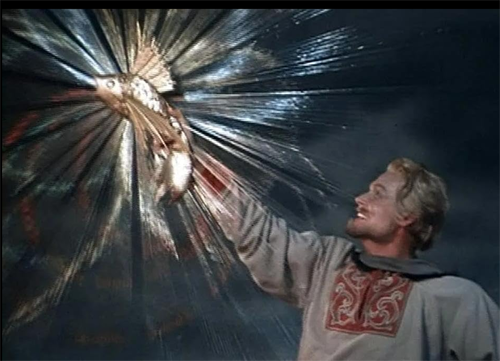
The Magic Voyage of Sinbad, the adventurous captain (played by “Edward
Stolar,” really Russian actor Sergey Stolyarov) returns home to exotic Copasand
with only his harp to his name. His last
voyage was prosperous, but he gave away all of his goods, even his ship, to
needy people he met along the way. Now
back in Copasand, he finds the city changed since his last visit, and not for
the better. The people are “dressed
poorly, and [seem] hungry and tired,” while the greedy oligarchical merchants
who run things are “richer than ever,” as the narration discloses. This political jab at capitalism and
exploitation of the masses probably passed over the heads of most
youngsters. And anyway, in whatever
culture, aren’t merchants in fairy tales and folk legends usually grasping and
predatory?
Dispirited
by the poverty of Copasand, Sinbad decides to restore harmony and equity by
sailing across the sea, finding the legendary “Bird of Happiness,” and bringing
it back with him. The complacent merchants regard him as a troublemaker and
have no intention of providing the wherewithal for a ship. Sinbad makes a wager with them. If he can catch golden-finned fish from the
harbor, they must agree to open their storehouses, share their goods with the
poor, and enable him to build a ship for his quest. If he loses, he’ll forfeit his head. “Everybody knows there are no golden-finned
fish in the harbor,” the oligarchs gloat, certain they have the deal in the
bag; one of them even brandishes an executioner’s axe in anticipation. But Sinbad succeeds, thanks to Morgiana,
Neptune’s daughter, who has a crush on him. Sinbad’s crew unlocks the warehouses, but there isn’t enough to go
around for everyone, so the need for a voyage to restore “happiness” remains.
The
quest takes Sinbad and his crew first to the north, where they fight off an
attack by barbarians, for whom “happiness is killing,” and then to India, where
he’s assured that the Bird of Happiness, also called the Phoenix, resides in a
tower jealously guarded by the king. The
Phoenix has the head, face, and neck of a woman atop the body of a large
bird. Sinbad is in for disappointment
when he finds that the Phoenix has a different definition of happiness than he
does, just like the barbarians at his last port of call. Hers is based on feeling good by abdicating
responsibility instead of using it to benefit others. The creature lulls the captain and his men
to sleep with a soothing song, but Sinbad rallies and they escape.
Eventually
a storm drops the captain into the underwater kingdom of Neptune, where the God
of the Sea and his wife are a plump, humorously bickering couple like Ralph and
Alice Kramden. Mrs. Neptune is
infatuated with a melancholy tune Sinbad sings, and she wants to keep him there
indefinitely as the palace singer, but Sinbad escapes on a sea horse with
Morgiana’s help. In Copasand, the
mariner admits he’s returning without the Bird of Happiness, but he enlightens
the townsfolk on what he’s learned about the true meaning of happiness. Happiness is finding joy in what you
have. In the original Soviet version,
his lesson was intended to assure audiences in bleak circumstances in the 1950s
U.S.S.R. that they weren’t so bad off. If your apartment in Moscow was cold, cramped, and threadbare, at least
you had an apartment. The take-away
message for American viewers may have been the same as Dorothy’s discovery at
the end of The Wizard of Oz, that there’s no place like home.
Where
The Seventh Voyage of Sinbad offered a showcase for Ray Harryhausen’s
stop-motion cyclops, dragon, and sword fighting skeleton, the effects devised
for Sadko/The Magic Voyage of Sinbad were the meticulous work of
Alexander Ptushko, a director sometimes referred to as the Walt Disney or
George Pal of the Soviet Union. There
were no stop-motion creatures in Ptushko’s portfolio of illusions. Instead, he worked wonders with
double-exposures, puppetry, time-lapse, tricks of perspective, mattes, and
other techniques that moviemakers have used since the infancy of cinema
(although hardly at all if ever these days, CGI having largely taken their
place). As such, combined with Ptushko’s
lavish sets, the special effects are fully as accomplished as the same
techniques used by Disney and Pal in Hollywood’s rare excursions into
big-budget, family-oriented fantasy movies of the time like tom thumb
(1958), Babes in Toyland (1961), and The Wonderful World of the
Brothers Grimm (1962). If small-town
audiences in 1962 were able to get past the absence of stop-motion, they may
have appreciated Ptushko’s charming fairy-tale ambiance left basically
undisturbed by Filmgroup.
The
Magic Voyage of Sinbad currently streams on Shout!TV in a print credited to Retromedia Entertainment,
apparently from a 2005 Retromedia DVD. Retromedia’s product appears to have been sourced in turn from an older
television print with less-than-optimal visual quality for modern TV
monitors. The low-resolution image may
not bother nostalgic viewers who first encountered the movie on local TV
matinees as kids in the 1970s. For those
who want a crisper version, YouTube offers a fine print from much better
elements, as well as the original version of Sadko, helpfully subtitled
in English.
Note:
A Mystery Science Theater 3000 episode that spoofs The Magic Voyage
of Sinbad is widely available on the internet. The episode, originally broadcast on August
14, 1993, also uses a blurry second-generation copy of the movie to heighten
the jokes by Servo, Crow, and the other MST3K gang at the film’s expense. If you’re under 40, you may need a lexicon to
understand the wisecracks, which are mostly based on now-obscure ‘90s pop
culture references. (The MSTK3K version can also be found on YouTube.)

(Fred Blosser is the author of "Focus on the Spaghetti Western #1:The Films of Tony Kendall". Click here to order from Amazon.)