A dissatisfied housewife brings home a stranded alien and
gradually falls in love, high school students live in fear after a beautiful student
is found dead, her back snapped across the gymnasium balance beam, a young teen
dates the enigmatic daughter of a mad scientist, in one town aliens have
actually become part of the community and started attending the local school, a
late-night DJ picks up signals from across space which appear to be from his
recently abducted wife, the real Creature from the Black Lagoon finds himself
working in Hollywood and falling for Julie Adams, teens on Lover’s Lane find
themselves fighting back against a potential alien invasion, and mysterious
video tapes show the real Bela Lugosi in films made by Ed Wood that cannot
possibly exist, given that he had died years before.
This new collection of stories by Dale Bailey (some of
which were previously published in magazines including Asimov’s Science
Fiction and Lightspeed) draws on his own memories of half-watched movies
on late-night TV and reading articles in Fangoria. Perhaps because of
this many of the stories are told as if distant, troubling memories are being
reluctantly recalled. Although the cover art may suggest a fun,
nostalgia-tinged trip back to the fifties, these are stories infused with loss,
grief and melancholy; one man recalls visiting his dead brother’s apartment in
Hollywood, trying to understand how they drifted apart, another, whose wife has
been missing since he claims to have witnessed her being taken up into the sky,
can no longer fully connect with the people around him, a young wife lives in a
trailer park struggling to overcome the tragedy of her baby daughter dying just
minutes after birth, and the Creature tries to reconcile his feelings for Julie
Adams with his desperate need to return to the swamps. These are people whose
lives have not turned out the way they had hoped, trying to understand and come
to terms with their frightening, life-changing experiences. Yet at the same
time, Dale, not forgetting what most of us are here for, combines B-movie
tropes and titles such as ‘Invasion of the Saucer-Men', ‘The Ghoul Goes West’, ‘Night
Caller from Outer Space’ and ‘I Was a Teenage Werewolf’, with humour,
real-world heartbreak and longing.
This hardback collection, published by Electric
Dreamhouse, is a wonderful read for any classic movie fan. Each story is
accompanied by a suitably pulpy illustration (dome-headed aliens, slavering
werewolves and pulchritudinous heroines appear to be Sheady’s specialty), and
the book cover is a work of art in itself, packed with imagery from many
drive-in movies, and not just those referenced in the book. These are stories
that will linger in your mind long after reading, much like the tragic tales
themselves have lingered in the minds of their respective narrators.
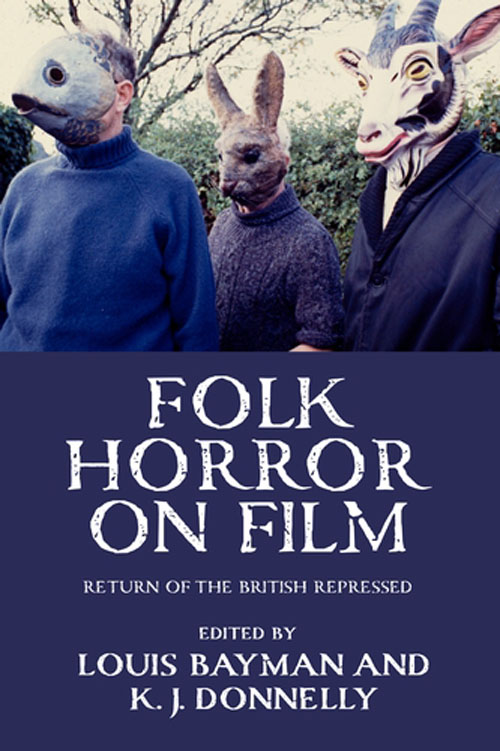
Some credit director Piers Haggard with coining the term
‘Folk Horror’ during an interview to set his film The Blood on Satan’s Claw
(1971) apart from the more traditional horror offerings by the likes of Hammer
Films and Amicus. As the term has taken hold, such films have become more
closely aligned with a European arthouse style of filmmaking. The genre has
since been retrospectively assigned to many films including the aforementioned
film, alongside the other two points of the ‘Unholy Trinity’ of British Folk Horror;
Witchfinder General (1968) and The Wicker Man (1973). This is a
‘wyrd’ genre, where the films are often unsettling rather than outright
horrifying, although in the case of modern folk horrors such as Kill List (2011),
both things can be said to be true.
When director Ben Wheatley went into the woods to shoot In
the Earth (2021), not only was he returning to the tone and style of his
earlier films Kill List and A Field in England (2013), but he was
also with the title addressing the very essence of Folk Horror: as this new
book discusses in detail, Folk Horror is something with its roots in ancient
(pagan) times, something in the earth, just below the surface - perhaps in an
English field - that once disturbed seeps out, terrifying some, whilst bringing
others together with its community rituals and human sacrifice.
In this new collection of academic essays, the old and
new British examples of the genre are explored in detail from a range of
fascinating perspectives; studies of history, folklore and Britain’s
non-Christian past, the close-knit communities often at the heart of Folk
Horror films and their clashes with modernity, Celtic Folk Horror, the way in
which female filmmakers have subverted tropes and shifted generic conventions,
the recurring use of drums in pagan ceremonies and rituals, the evils of the British
landscape, social and political influences on the films across the decades, and
the relevance and influence of certain British writers such as Arthur Machen on
the genre. As well as the three films of the ‘Unholy Trinity’, each of which
gets a fair amount of analysis here, other films under discussion include Ken
Russell’s wildly entertaining The Lair of the White Worm (1988), based
on the Bram Stoker novel which itself is based on the north-eastern legend of
the Lampton Worm, The Company of Wolves (1984), Doomwatch (1972),
Cry of the Banshee (1970), Psychomania (1973), and many more
including several modern films which this writer was previously unfamiliar but
has to now seek out.
As with all academic collections, the caveat must be
added that the hardback price is because this edition is aimed at libraries,
and a more affordable paperback edition will be available in due course. This
is a worthwhile collection for anyone interested in this ‘wyrd’ sub-genre of
the British horror film, particularly now that Spring is here and soon ‘Summer
is icumen in’.
After
Woody Allen’s early, zany comedies made between 1969-1975, the filmmaker began
making personal works more akin to those of European auteurs. Art-house
pictures, really. He seemed to have taken his cue from the likes of Ingmar
Bergman, certainly, but also Federico Fellini and others. To this reviewer, though,
Allen’s movies, be they comedies or dramas from Annie Hall (1977)
onwards, almost always deal with the fragility of flawed human relationships—the
same kinds of pictures made by French director François
Truffaut. Truffaut’s films are full of extramarital affairs, love gone wrong,
and sometimes the murder of someone who has gotten in the way of a central
character’s goals.
Now,
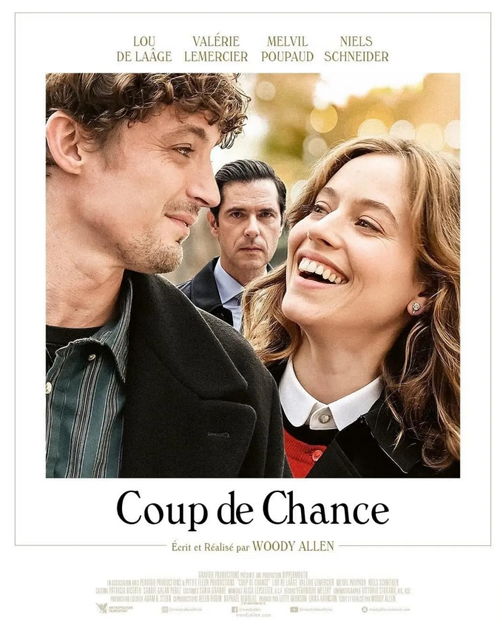
Allen’s 50th motion picture, Coup de chance (“Stroke of
Luck”), shot in France with a French crew and cast, and with dialogue entirely
in French (with English subtitles), demonstrates that the director really has
become Truffaut and made his own little European art-house picture like The
Soft Skin or The Woman Next Door (two of Truffaut’s dramas). Or is
it just another Crimes and Misdemeanors or Match Point or Irrational
Man, to name some of Allen’s own dramas that deal with the same subject
matter?
Even
though much of the new film is very familiar Woody Allen territory, Coup de
chance is undoubtedly his most engaging piece since, say, Blue Jasmine.
Is it as good? Not really. And it doesn’t touch Match Point, which is
easily one of the director’s greatest thrillers, which Coup de chance attempts
to be.
Fanny
(the radiant Lou de Laâge) is married to wealthy Jean (the handsome
but appropriately cold Melvil Poupaud). They live in Paris and enjoy an
upper-class, privileged life due to Jean’s work as some kind of financier (“He
makes rich people richer,” Fanny explains). Fanny works at an auction gallery
but is somewhat bored by the couple’s high society social life and especially
by Jean’s continual insistence of going to the country to hunt game with his
friends. Every so often, Fanny’s mother, the wise but somewhat fussy Camille (Valérie
Lemercier), comes to visit for a few days. Camille gets along well with Jean
and even enjoys going hunting in the country with him and his pack while Fanny
stays at the cottage with a book to read. One day on a city street during her
lunch break, Fanny, by happenstance, runs into a former high school
acquaintance, Alain (Niels Schneider). Alain, a divorced writer, immediately
gushes how he had a crush on her back then and would enjoy taking her to lunch.
Fanny agrees. And then she agrees again. Before long, Fanny and Alain are
having an affair. Jean, however, is the jealous type. Extremely so.
To
reveal more would spoil the rest of the story, but most viewers of Woody
Allen’s films can likely predict how it’s going to go. There is an unusual
twist in the third act… and indeed there is a “stroke of luck” that occurs
which emphasizes the film’s themes of coincidence, luck, and fate and how these
concepts can be intertwined. These were common ideas that Polish director Krzysztof
Kieslowski imbued in his pictures, too.
Allen’s
direction here is top form and he is aided by the editing of Alisa Lepselter.
The film moves at a rapid pace with brief vignette-like scenes. The actors are
all superb, despite working with roles that unfortunately do not have much
depth in such a picture of brevity and briskness. The photography by veteran
Vittorio Storaro is gorgeous, and the imagery makes one want to plan an
immediate trip to visit Paris.
The
problems are that we’ve been down this road too many times with Woody Allen.
Yes, there are a few differences in the structure and storytelling, but the
familiarity still nags at the viewer. The novelty of an Allen picture being
entirely in French and in Paris does distinguish it from the others… but then
there’s the issue of whether or not American audiences will relate to these
upper-class French people or care about them at all. (One might have the same
argument about Allen’s portrayal of upper-class New Yorkers in previous
movies!) Another issue is the overuse of upbeat, lively jazz music (mostly
Herbie Hancock’s “Canteloupe Island”), which in some scenes feels highly
inappropriate for a thriller, and ultimately becomes tiresome.
That
said, there’s no question that Coup de chance is an improvement over the
last few Woody Allen titles, but it likely will not be included among the
fifteen to twenty of the filmmaker’s most respected works. But when there are
fifty titles from which to choose, landing somewhere in the middle isn’t bad.
Will
there be future pictures from Allen, who at the time of writing is 88 years old?
Who knows… but if he goes out with Coup de chance then it will be considered
an admirable effort.
As
a huge fan of Stanley Kubrick’s 1980 film version of Stephen King’s 1977 novel The
Shining, which I saw at the age of fifteen and was completely terrified by,
it is a daunting task indeed to watch any other (excuse the pun) incarnation of
this fantastic story as seen through the eyes of another filmmaker without
being drawn back to Mr. Kubrick’s much-maligned interpretation that was
initially criticized but subsequently revered by some as the greatest horror
film ever made. The Shining is a film that has affected me profoundly in
ways that only a handful of other films ever have. I felt a compelling
obsession with it that was nearly impossible to verbalize. It was my second
Jack Nicholson film, and it made me a lifelong fan of his; it introduced me to
pre-existing music and its use in a contemporary film; and perhaps, most
significantly, it was my introduction into the world of Mr. King’s writings.
Having read the novel a mere two months after seeing the film for the first
time, I was completely surprised to see how much Mr. Kubrick altered the source
material. Much has been written about his decision to jettison nearly all but
the bare bones plot of a former alcoholic schoolteacher-turned-writer taking on
the position of the caretaker of a Colorado hotel during the winter months with
his wife and young son. The film’s most vocal critic is perhaps the author
himself who, while acknowledging Mr. Kubrick’s genius as a film director, has
never held back his disdain for The Shining for which he wrote a
screenplay that was subsequently rejected by the director in favor of his own
collaboration with novelist Diane Johnson. Mr. King’s disappointment in the
film made him vow to make his own version one day, and The Shining, as
presented in a three-part mini-series on ABC in April and May of 1997 and
directed by Mick Garris, is the result.
Jack
Torrance (Stephen Webber) is a recovering alcoholic who has been fired for beating
up a student following the latter cutting the former’s car tire after an
argument. To say that Jack is skating on thin ice would be an understatement,
even after many AA meetings. His marriage is on the rocks with his wife Wendy
(Rebecca De Mornay) following him breaking their son Danny’s (Courtland Mead)
arm after a drinking bout. All he really wants is quiet time to write his play.
Taking care of the remotely located Overlook Hotel during the brutal winter
months is his opportunity to do just that. Stuart Ullman (Elliott Gould), the stern
and surly hotel manager, has been apprised of Jack’s past and is not too
pleased to have to offer him the job as a favor. Dick Halloran (Melvin Van
Peebles), the Overlook’s head chef, gives Wendy and Danny a tour of the
kitchen, and discovers that he shares
the gift of the Shining with Danny, a force described as a “psychic ability to
see visions of the past, present, and future, as well as communicate
telepathically with others who possess similar abilities.”
Once
on their own following the hotel’s seasonal shutdown, the Torrances spend time
acclimating themselves to the quiet solitude of the hotel and their quarters. It
does not take long for them, however, to realize that strange things are going
on in their midst. Unfortunately for Jack, there are evil forces at work that
threaten to unravel the very fabric of his family unit as well as his sanity. Evidence
of past horrors that occurred within the hotel begin to emerge in the form of an
undead and decaying woman in room 217, an anthropomorphized topiary, a hornet’s
nest of not-quite-dead wasps, and a scrapbook of news articles providing
evidence of the hotel’s sordid history. Wendy’s attempts to seduce her husband
into a night of lovemaking while dressed seductively are spurned multiple times
by a distracted Jack who is thinking of incorporating elements of the Overlook
into his play while also dealing with the demons of his alcoholism. In the
midst of this is their seven-year-old son Danny who plays referee between them while
trying to make sense of all that conspires to destroy his family. It isn’t long
before the ghosts of the Overlook’s past begin to show up in their evening
gowns and Jack loses his grip on reality, attempting to destroy his family
while Danny telepathically summons Mr. Halloran who comes to their rescue.
At
four-and-a-half hours, this version of The Shining is highly faithful to
Mr. King’s story and, except for the genuinely frightening woman in Room 217,
there is little in the way of tension and scares. Steven Webber does an
admirable job of portraying a man modeled after Mr. King himself who is trying
to go sober and keep his temper in check. Rebecca De Mornay, who was just
twenty years-old when she was cast in late 1980 as an understudy in Francis
Ford Coppola’s extravagant One from the Heart (1982) and found overnight
fame as Lana in Paul Brickman’s highly successful Risky Business (1983)
opposite Tom Cruise, plays Wendy much closer to Mr. King’s original vision in
his novel. She is a strong-willed mother fiercely protective of her young
charge against the adversity unfurling within the family unit. The film is
ultimately undone by the not-ready-for-prime-time computer-generated imagery
effects (CGI) that come off as silly and unfinished.
It
is impossible to avoid comparisons between this and Mr. Kubrick’s film, the
scariest film I have ever seen and which has only become more revered,
iconoclastic, studied and analyzed in the years since its original release, so
I will tread lightly. There are many areas that make Mr. Kubrick’s version,
which was faked on backlots and massive sets at Elstree Studios in England, a
standout. In his film, the Overlook, as represented by Oregon’s Timberline
Lodge, became a character of its own. The Torrance’s, as played by Jack
Nicholson, Shelly Duvall, and Danny Lloyd, felt as though they were really and
truly snowbound and had absolutely no recourse from the outside world. The same
cannot be said for the hotel in this version which, ironically, is the very
hotel that inspired the story: the Stanley Hotel in Estes Park, Colorado.
The
one area that neither film version touches upon that is a big fear of Danny’s
in the novel of the notion his parents will divorce, which is further
italicized to emphasize innate fear. The other words that do make their
way into both films are, of course, REDRUM and MURDER.
The
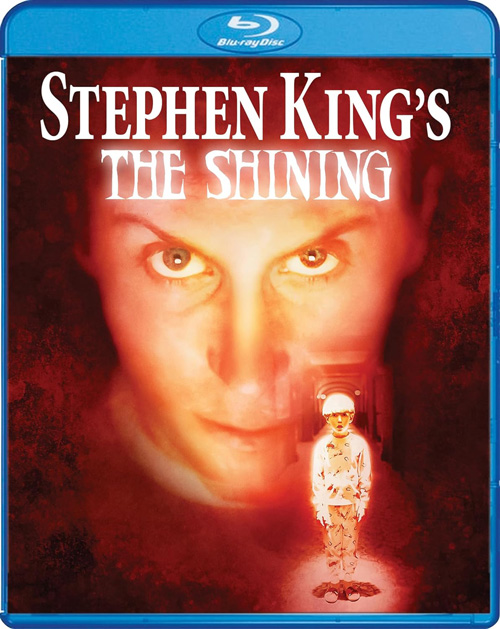
miniseries is now available on a double disc Blu-ray from Scream! Factory. Blu-ray
Disc One contains Parts One and Two, and Blu-ray Disc Two contains Part Three
and additional scenes that were cut from the film. The film begins with a
disclaimer: “To provide the most complete version of the film, a few scenes
have been upgraded from the best available, non-Interpositive source.” This
verbiage will go over the heads of the uninitiated, and as such it merely
states that the folks at Scream! Factory did their best to locate the best
available film elements for this high-resolution transfer. I must admit that
even to my trained eyes, I had difficulty differentiating between the best film
elements and whatever less-than-stellar footage was used in the transfer, which
is excellent. There is a highly enjoyable audio commentary by author Stephen
King, director Mick Garris, actor Steven Weber, actress Cynthia Garris, visual effects
supervisor Boyd Shermis, makeup supervisor Bill Curso, and cinematographer
Shelly Johnson that is worth the price of the movie alone. They give great
insight into how the film came to be, especially author King who discusses
staying at the Stanley Hotel in October 1974 with his wife. He explains that,
had the concierge not asked the Kings if they could pay cash to stay overnight,
the book would never have come to be. Talk about a fortuitous exchange. He also
talks about his own experiences and struggles with alcoholism and his relation
to Jack Torrance.
Director
Garris discusses how his version is not intended as a remake of Stanley
Kubrick’s film (which would have been a fool’s errand) but instead a filmed
representation of author Mr. King’s novel, and discusses the challenges of
making a film of a beloved book and working with a child actor, made easier
thanks to Dawn Jeffory-Nelson, an acting teacher. She appears as an unwitting
victim in David Schmoeller’s ultra-creepy Tourist Trap (1979), and worked
extensively with young actor Mead. Steven Weber provides his insights into
working with Ms. De Mornay and how the most difficult scene they did consisted
of nine pages of dialog and had to be in the can in one day.
The
film was originally released on DVD in 2003 and the commentary and additional
eleven scenes that run a total of sixteen-minutes appear to have been ported
over from that release. The image quality of this new double-disc Blu-ray,
however, easily bests that DVD so if you are a fan of this film this is a
worthy upgrade.
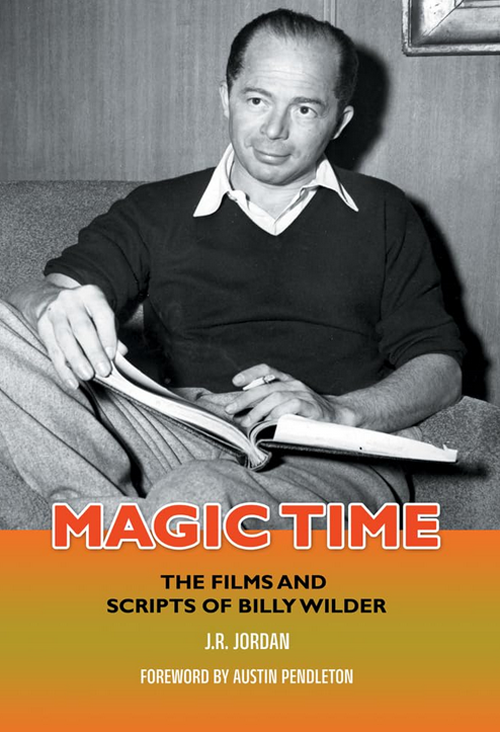
Joe Jordan, the writer and
film historian who applied his prodigious research and keen analysis to acclaimed
books on the movies of Robert Wise and William Castle, has now focused his
critical acumen on one of Hollywood’s most legendary directors in “Magic Time:
The Films and Scripts of Billy Wilder.” (BearManor Media, 2023)
Born in 1906, Wilder worked
as a journalist before turning to film. He initially made his mark writing film
scripts in Germany before emigrating to America and pairing up with screenwriter
Charles Brackett on such classic pictures as “Midnight” (1939), “Ninotchka”
(1939) and “Ball of Fire” (1941). The two continued working together as Wilder
graduated to the director’s chair on “Double Indemnity” (1944), “The Lost
Weekend” (1945) and “Sunset Boulevard” (1950), before terminating their
partnership upon completion of the latter. Wilder then teamed with screenwriter
I.A.L. Diamond on another run of classics, inclusive of “Ace in the Hole”
(1951), “Some Like it Hot” (1959 and “The Apartment” (1960).
From the beginning to end of
his directing career, Wilder was an authentic auteur, one whose films were
easily identifiable by their visual elegance, sardonic wit and often-dark take
on human nature. Few were his equal at blending cynicism and romanticism. Wilder
maintained this distinctiveness over an extraordinary range of material—film
noir, screwball comedy, wartime thriller, courtroom drama, Cold War satire.
“Magic Time” is another
standout addition to the body of critical literature devoted to the great
filmmaker. Following the recipe of his book “Robert Wise: The Motion Pictures”
(2020), Jordan treats each film to its own chapter. Chapters 1 through 10 cover
the films Wilder worked on as screenwriter only; chapters 11 through 35 on
those he made as a director/writer. Jordan briefly describes the historical and
social context at the start of each new production—including Wilder’s personal
and professional circumstances, his state of mind, his thoughts about the
actors and crew—before launching into a lengthy comprehensive synopsis, leaving
out no detail or plot point. The effect is almost like watching the film unfold
in one’s mind, so if it’s been awhile since you’ve seen, say, “A Foreign
Affair” (1948), Jordan brings you up to speed as he touches on narrative, theme,
tone, performance—the total fabric of the film, liberally interspersed with
classic quotes courtesy of Wilder–Bracket or Wilder–Diamond.
Despite including an amazing
amount of exposition, detail, observation and analysis about each film, the
chapters are relatively brief, with Jordan’s insights and information delivered
in clear, user-friendly language. Thanks to its structure, one can read the book
straight through from start to finish, or simply open to a random chapter to get
a fun, fresh slant on a favorite Wilder film.
Even if you’ve seen a
particular film many times, Jordan can still surprise and enrich you with his
critical acumen. I thought I was on familiar terms with every narrative aspect
of “Sunset Boulevard,” which is in essence the story of three aspiring writers,
but I never gave much thought as to the myriad ways in which those three
narratives contrast and compete with one another, or the degree to which they
inform and direct the film’s overall narrative.
There are many such examples
embedded within this book. One cannot come away from reading it without having
gained new insight and appreciation for the classic Wilder films that we almost
know by heart. But if Jordan helps us see familiar favorites through new eyes,
he also makes a strong case for getting to know lesser-regarded Wilder films
such as “The Emperor Waltz” (1948) and “Fedora” (1978).
Jordan amusingly ends “Magic
Time” with an extended addendum titled “101 Motifs, Catchphrases and More (From
A to Z)” that rounds the book off in an offbeat manner, listing numerous recurring
narrative, object and dialog tropes—including Bolsheviks, catchphrases, card
games, cities in Ohio, close calls, monocles, sharing of cigarettes and more—that
can only be termed Wilderian.
A
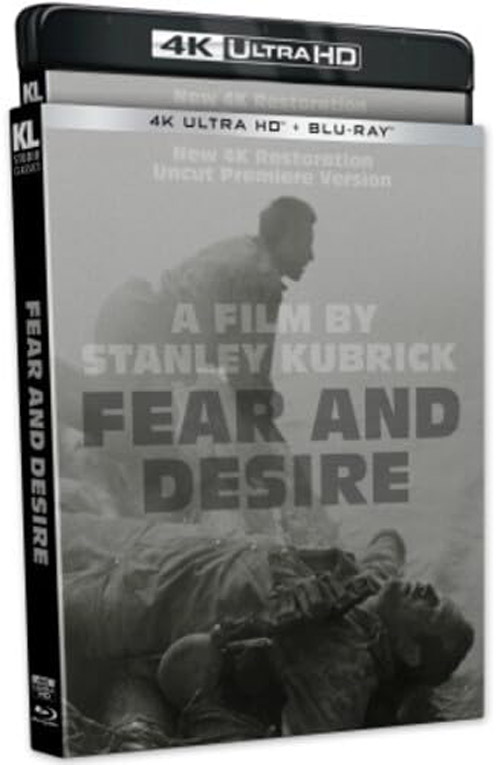
very young Stanley Kubrick made his first feature film, Fear and Desire (called
The Shape of Fear during production and until it found a distributor),
at the age of twenty-two. It was very much a DIY production. In many ways
it is the epitome of early independent filmmaking, the kind in which a fellow
with a camera goes out to make a movie and then worries about finding a
studio to release it. The picture was financed by family and friends, written
by a school pal (future Broadway playwright Howard Sackler), and cast with
young, struggling New York actors who were willing to work for peanuts. Kubrick
produced and directed the movie, but he also photographed and edited it
himself, too. It took a year-and-a-half to finish, and then he went about
marketing it himself.
The
astonishing thing about all this is that Kubrick was operating on chutzpah.
While he had already made two documentary shorts, he was simply “winging it”
when it came to making a feature length fiction narrative film. What he had on
his side was his cinematographic capabilities. He knew cameras, lighting, and
composition like the back of his hand, for he had spent four years after high
school working as the youngest staff photographer for Look magazine in
New York creating narrative “photo essays,” almost the equivalent of
storyboards. Editing a movie, directing actors, and telling a good story was
another matter… and something he would eventually learn how to do.
Unfortunately, while Fear and Desire looks gorgeous and is indeed a
lesson in photographic composition and lighting, it fails on all the other
aspects of movie making.
Kubrick
himself disowned Fear and Desire not long after its release in 1953. In
fact, he attempted to acquire all existing prints, including the negative, and
burn them. Luckily for film historians and Kubrick aficionados, he was
unsuccessful. The copyright in the movie was owned by Kubrick’s uncle, Martin Perveler,
a fairly wealthy pharmacy owner in California who put up most of the money and
received Associate Producer credit. The feature had disappeared for decades and
was sometimes available on poor quality bootleg VHS tapes and DVDs. It was only
since Kubrick’s death in 1999 that today’s copyright owners and the Library of
Congress made the movie available. In the USA, Kino Lorber distributed
excellent quality DVD and Blu-ray editions several years ago. Now, Kino has
released new 4K UHD and Blu-ray versions of the film, including the original
70-minute premiere cut that hasn’t been seen since 1953. (After its premiere,
Kubrick cut about nine minutes for the theatrical release, limited as that was.
It was this 62-minute cut that has been the more familiar one to film buffs.)
Another
remarkable aspect about Fear and Desire is how ambitious it was.
Kubrick’s later, more mature works are often extremely existential in theme and
tone—they are big budget art films that challenge audiences to actually think
about what they’ve seen. Kubrick is big on ambiguity, symbolism, and metaphor
in all of his later, more well-known features. Right out of the gate, Kubrick
embarked to make an extremely non-commercial art film that deals with the
meaning of existence and the futility of war. While he would later succeed with
this kind of art house contemplative head scratcher, Fear and Desire unfortunately
comes off amateurish, pretentious, and painfully like a student film.
That
said, one who knows Kubrick’s work can see glimpses of the genius underneath
this early effort. What he was attempting is quite “Kubrickian,” and there are
moments and images that are indeed striking.
The
story is thus… A four-man platoon are fighting an unnamed war in an unnamed
country. They are lost in a forest behind enemy lines. The goal is to get back
to their side. When enemy combatants are spotted in a structure, the men decide
to strike one for the team and kill off the opposition. Weirdly, the enemy
general and his sidekick look just like the platoon’s lieutenant and private
(they’re played by the same actors). Whoa, profound! And, in typical
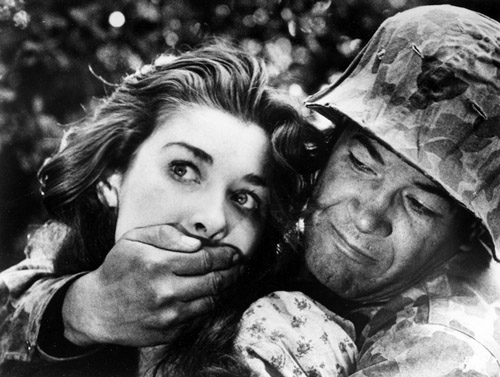
Kubrickian fashion, one man, another private (played by young Paul Mazursky,
who would go on to be a director of note himself) goes mad, nearly rapes a
civilian (Virginia Leith), and runs off like a banshee from hell. Will the
others make it back to “civilization?” Maybe. Maybe not. As the lieutenant
says, “We have nothing to lose but our futures.”
The
same could be applied to Stanley Kubrick’s first endeavor.
Besides
Mazursky and Leith, the other actors are Frank Silvera as the sergeant (if
anyone is the protagonist here, it’s him), Kenneth Harp as the lieutenant, and Steve
Coit as the first private. Silvera would go on to play the villain in Kubrick’s
next, also independently made, feature, Killer’s Kiss (1955). Kubrick’s
first wife, Toba, has a cameo as a fisherwoman (she and Kubrick had been high
school sweethearts). Toba also worked on the crew, but the stress of making a
first film with Stanley Kubrick destroyed their already unstable marriage.
Kubrick
had flown the cast and tiny crew from New York to California in the spring of
1951 and shot the film in the San Gabriel mountains. It then took him over a
year to raise the money to do all the post-production (mostly post-sync sound).
He submitted the 70-minute cut to the Venice Film Festival in August 1952,
where an unofficial premiere took place (he wasn’t present). Only in late 1952
did Kubrick meet the international film distributor Joseph Burstyn, perhaps the
important figure of art house cinema in America at that time. Burstyn agreed
to release the movie, and it had its official premiere in March 1953. It
received mostly negative reviews, which prompted the director to delete nine
minutes to tighten the feature. There were, however, a handful of very positive
notices from the likes of critics such as James Agee and Mark Van Doren, both
of whom recognized that there was undeniable talent buried within this strange,
unsettling movie.
Kino
Lorber’s new 2-disk release of the 4K restoration comes with a UHD disk and a
Blu-ray disk of both the 70-minute and 62-minute cuts. The longer cut is
accompanied by an audio commentary by film historian Eddy Von Mueller. The
shorter cut has an audio commentary by film historian/screenwriter Gary Gerani.
Von Mueller’s commentary is quite informative about the tortured history of the
film; however he makes several odd mistakes (he says the fisherwoman is
Kubrick’s sister, not wife; he says the star of Barry Lyndon is
“Patrick” O’Neal; and 2001: a Space Odyssey is from 1966, not 1968).
Gerani’s commentary covers much of the same ground with a different
perspective. Sadly, neither pinpoints the bits that were actually cut from the
longer version of the film. It’s up to us to figure it out (this reviewer finds
that some scenes in the first half of the movie were merely shortened… there
are no full scenes missing in the theatrical cut).
The
real treasure trove in this release is that for the first time, in the USA,
that is, we get Kubrick’s early short documentaries in high definition. Day
of the Fight (1951) and Flying Padre (1951) were only available as
bootlegs in bad quality. Only The Seafarers (1953) had been released on
home video prior. Now we have all of Kubrick’s early work on one gorgeous
release.
Kino’s
new Fear and Desire package is a must-have for Stanley Kubrick fans,
because looking past the feature’s shortcomings will reveal what would come
from the master filmmaker. It’s a fascinating step back into the auteur’s
young mind.
I’ve always loved action cinema. It’s one of
my all-time favorite genres. When I was a teenager in the mid-1980s, I saw a
VHS copy of the action film Bucktown
and I’ve been a huge fan of its star, Fred “The Hammer” Williamson, ever since.
A former pro football defensive back for
(amongst others) the Kansas City Chiefs (1965-1967), Williamson, who holds
black belts in Taekwondo, Kenp? and Shotokan karate, later moved on to acting.
Some of his first appearances was guest starring on TV shows such as Star Trek and Ironside. He quickly graduated to features, appearing in Robert
Altman’s M*A*S*H and Otto Preminger’s
Tell Me That You Love Me, Junie Moon.
In 1970, Williamson starred in the
appropriately titled action movie Hammer (the
nickname was given to him during his football days). The film was a success and
it began his long and entertaining career as an action movie superstar. Standing
at 6ft. 3 inches tall and rarely seen without a prop cigar in his hand, Williamson
would go on to appear in a plethora of action classics (many of which were
distributed by major Hollywood studios) such as Black Caesar, Take a Hard Ride, Black Eye, Three the Hard Way,Mean Johnny Barrows (which he also
produced), and 1978’s Inglorious Bastards.
In 1976, the Hammer created his own company,
Po’ Boy Productions, which would not only see him star in, but also direct, a
ton of action films the likes of Death
Journey, No Way Back, Mr. Mean, Foxtrap, and The Kill Reflex. Williamson is also a veteran of Italian
exploitation cinema. He has appeared in the cult classics The New Barbarians, The New Gladiators, and Black Cobra 1-4. Just to name a few. In later years, he would act
in films such as From Dusk till Dawn
(for cinema titans Robert Rodriguez and Quentin Tarantino) and Original Gangstas (directed by the
legendary Larry Cohen and co-produced by Williamson) and he shows no signs of
slowing down.
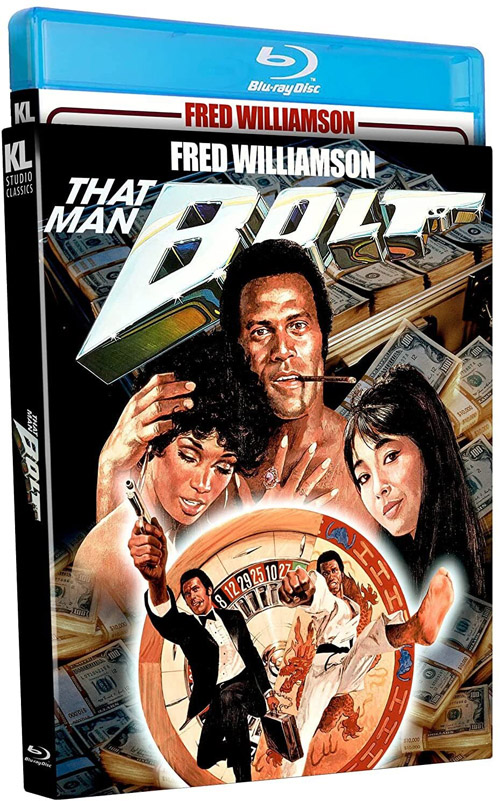
Recently, the Hammer’s somewhat forgotten,
1973, action-packed, James Bond-like film
That Man Bolt was released on Blu-ray.
Solidly directed by David Lowell Rich and Henry
Levin from an entertaining screenplay by Ranald MacDougall and Charles Eric
Johnson, That Man Bolt tells the tale
of courier and martial arts expert Jefferson Bolt who is hired to transport a
million dollars from Hong Kong to Mexico City. However, Bolt soon realizes that
he’s been set up and now he’s dead set on paying back everyone who double-crossed
him.
Produced by Universal Pictures and released
in December of 1973, That Man Bolt,
aka Operation Hong Kong, is an
exciting adventure flick (sort of a 007/martial arts combo) which not only
contains well-crafted action sequences, but also some memorable characters
played wonderfully by its talented cast.
Leading the way, of course, is the always
charismatic Fred Williamson who convincingly plays the intelligent and capable
Jefferson Bolt. There are also appearances by familiar faces such as Byron
Webster, Miko Mayama, Teresa Graves, John Orchard, Jack Ging and Paul Mantee;
not to mention martial arts champions Mike Stone, Emil Farkas, David Chow and Kenji
Kazama. Enter the Dragon fans will
recognize Geoffrey Weeks who appears in a brief role, as well as the voice of
the great Keye Luke (who not only dubbed Shih Kien in Enter, but also performs the same duty here).
The fun film which was shot in L.A., Las
Vegas, Macau and Hong Kong, also features some terrific cinematography by Emmy
Award winner Gerald Finnerman, and a cool, Lalo Schifrin/John Barry-like musical
score by composer Charles Bernstein.
That Man Bolt has been released on
Blu-ray by Kino Lorber. The region one disc presents the movie in its original
1.85:1 aspect ratio. The 2K transfer looks gorgeous. The disc not only contains
the original theatrical trailer, but also
That Man Hammer, a short, but entertaining interview with Fred Williamson.
Overall, this is a highly enjoyable, early 70s action-adventure that definitely
deserves to be re-discovered. It’s also a very nice addition to your Fred
Williamson collection. And if you’re just beginning to get into the Hammer’s
filmography, That Man Bolt is a great
place to start.
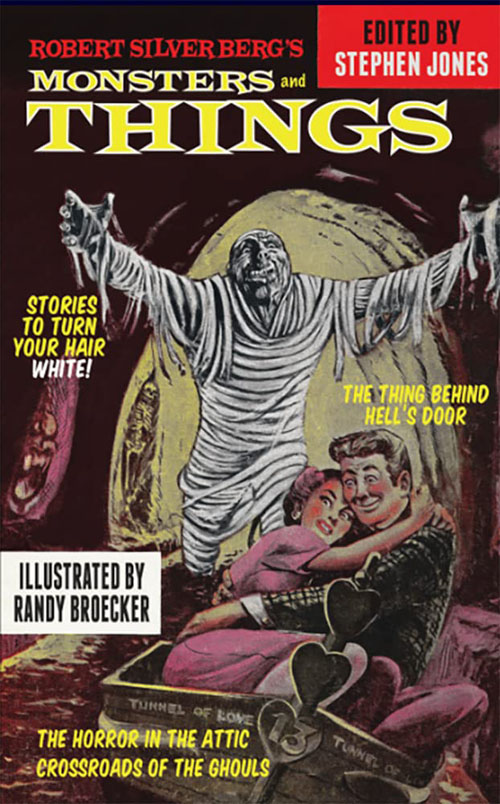
Published by Drugstore Indian Press (imprint
of PS Publishing)
May 2023
512 pages
Paperback
ISBN: 9781786368997
RRP: £15.99
Review by Adrian Smith
If, like me, you love old movies, the chances are high
that a love for the thrilling pulp magazines of the 1950s can’t be far behind.
Robert Silverberg, now an award-winning science fiction author, was one of the
most prolific writers (allegedly averaging around 1 million words a year) for
dozens of magazines throughout that decade including Super-Science Fiction,
Monster Parade, Fantastic and Monsters and Things, amongst
many more. Capable of seemingly churning out stories in any genre he turned his
hand to (including pornography when required), these short tales were designed
to be read once and then forgotten once the next issue came along. Of course,
what was once disposable is now highly sought-after and original copies of many
of these short-lived magazines are out of reach to us mere mortals. Thankfully
the almost equally prolific writer and editor Stephen Jones has compiled a representative
sample of Silverberg’s horror and sci-fi stories published between 1957 and
1959 for this excellent new collection published by Drugstore Indian Press,
accompanied by suitably retro illustrations from American artist Randy Broeker.
Most of the stories are just a few pages long, so no time
is wasted before the thrills and chills set in. From premature burials, mad
doctors, demons, werewolves, vampires and ghouls to aliens, global conspiracies,
sinister cults and outer space adventures, the stories pack a pulp punch and
are all very enjoyable, especially the ones with twist endings that would not
be out of place in an episode of The Twilight Zone. With titles
including ‘Secrets of the Torture Cult,’ ‘Beasts of Nightmare Horror’ and ‘Vampires
from Outer Space’ (a precursor to Colin Wilson’s The Space Vampires
perhaps?), Silverberg's imagination was extraordinary, producing a continual
stream of stories, often published under pseudonyms so that it didn’t look like
he’d written the entire magazine. In his introduction to this collection (he’s
still with us, at the ripe old age of 89!), he discusses his early career and
his need to keep the [were]wolf from the door by writing anything he could get
paid for, and it was clearly good preparation for the highly-respected novels
which would earn him fame later on.
Given the sheer number of short stories Silverberg
produced, one can only hope that another collection from Drugstore Indian Press
is on its way. These are really fun, pulpy stories that remind us of all of another
era; when guys called Skip drove hot rods, when Big Jack hosted late-night talk
shows about the occult on stations like WYXD, and when teenage librarians like
Marty could accidentally raise the old gods using a stolen copy of the
Necronomicon. Robert Silverberg’s Monsters and Things belongs on the
shelf of any discerning 1950s nostalgia junkie.
One of the UK’s most beloved film franchises
has been somewhat neglected of late. Despite decades of television reruns,
since the DVD boxset release over a decade ago there has been no sign of any
sort of upgrade of the ‘Carry On ‘films, which, if there were any justice,
would have been raised to Criterion levels by now. Remarkably this is still the
case in the UK, so thankfully Australian company Via Vision Entertainment have
taken a firm grip of the baton and begun releasing the ‘Carry On’ films in
series order, four at a time. The first eight films in the series were mostly shot
in black and white and based around everyday life, such as military service,
the healthcare system, schools, the police, cruise holidays, and the beginnings
of second-wave feminism (Carry On Cabby (1963), if you’re wondering). But
then Peter Rogers, the producer and brains behind the series, had the fabulous
idea to begin making period dramas and spoofs of current hits. Carry On Jack
(1964), about pirates, was the first of these, and with that move, in my
opinion, the ‘Carry On’ films really hit their creative and comedic peak.
This means that ‘Carry On... Collection 3’
contains arguably the four best films in the entire franchise (although I know some
fans would beg to differ): Carry On Spying (1964), Carry On Cleo
(1964), Carry On Cowboy (1965) and Carry
On Screaming (1966).
Carry On Spying
(1964), the last one shot in black-and-white and the first to directly spoof
genre conventions, has perhaps been forgotten in favour of the more smutty ‘Carry
On’ films that followed later. Starring regulars Bernard Cribbins, Kenneth
Williams, Charles Hawtrey, and introducing newcomer Barbara Windsor as Daphne
Honeybutt, a name even Ian Fleming would have been proud of. Far from being the
giggling saucepot she would later be known for, Windsor’s character here is
brave, intelligent and forthright, more than once saving the mission and her
hopeless compatriots. Hot on the heels of From Russia with Love (1963), the
film is a hilarious and almost spot-on spoof of the budding James Bond
franchise (Cubby Broccoli objected to one character being called Agent 009½ so they
were reluctantly renamed 000), coming before the flood of Eurospy films that
would take all sorts of liberties with Bond a couple of years later. Shot at
Pinewood Studios, already the home of Bond, it is unsurprising that the sets here
are very close to Ken Adam’s designs, especially the secret underground
headquarters of STENCH, led by the evil Doctor Crow, and were probably built
and lit by many of the same technicians. The cast, with Kenneth Wiliams taking
a rare lead role, are a joy. Williams, who would often be cast as pompous,
arrogant authority types in later films, plays here his idiotic character made
famous in Hancock’s Half Hour, complete with his catchphrase “Stop
messing about!” The comedy is hilarious,
and as a Bond spoof it works very well as a standalone film for those who may
be unfamiliar with the charms of the ‘Carry On’ franchise. Naturally, given
that it is now sixty years old, some of the humour is a little painful,
reflecting some of the post-colonial attitudes of the time. But the odds are
that if you are Cinema Retro regular, you can probably handle it.
Carry On Cleo is
probably the franchise’s most lavish and high budget production, thanks to the
genius decision of Peter Rogers to move in on the abandoned Cleopatra sets
left behind at Pinewood when the disastrous Elizabeth Taylor production was
shipped off to Cinecittà in Rome to start again. With full access to sets,
props and costumes, Carry On Cleo looks a million dollars, and is also a
million times more entertaining than Joseph L. Mankiewicz’s Cleopatra. The
cast are fabulous, with Kenneth Williams in full arrogant mode as Caesar, Sid
James as the lecherous Mark Anthony, Jim Dale as an escaped English slave, but
most importantly with Amanda Barrie, who had an important role in Carry On
Cabby, as the beautiful and mesmerising Cleopatra. Whether in costumes
originally created for Liz Taylor, or bathing naked in ass's milk, she's simply
stunning. It has always been my favourite ‘Carry On’ film, packed with sight
gags, brilliant nods to the original film (20th Century Fox were
particularly furious at the original Carry On Cleo poster design which
mercilessly spoofed theirs) and wonderful sets and matte paintings. This was
the heyday of Pinewood Studios, and the skill and expertise on show here sets
it apart from the later, cheaper ‘Carry On ‘films shot mainly in muddy fields.
Carry On Cowboy
arrived just as the Spaghetti Westerns were getting started in Italy but owes
more to the prevalence of American western films and TV shows (Bonanza, Gunsmoke,
etc.), and is another clear spoof in the Carry On Spying mode. Genre
conventions are milked for all their comic potential, and the cast are
uniformly excellent, from Jim Dale’s accidental sheriff, Sid James as the
villainous Rumpo Kid, Charles Hawtrey as the whisky-addled Big Chief Heap, Joan
Sims as a prostitute with a heart of gold, Kenneth Williams as a cowardly mayor
and, in a reference to actual history, Angela Douglas as the first-rate shot
Annie Oakley. This is great fun, and not far removed from what Mel Brooks would
do less than ten years later, but without the fourth wall breaking.
The last film in the set is possibly the most
well known outside of the UK – Carry On Screaming. This time they had
Hammer Films firmly in their sights, with references to Frankenstein, Jekyll
and Hyde, spooky mansions and the sexiest of sexy vamps, all mixed together
with plenty of gags and a plot which borrows heavily from House of Wax
(1953), meaning Vincent Price gets a bit of a nod as well. In the lead role as Police
Sargeant Bung is Harry H. Corbett, making his only ‘Carry On’ appearance, but
he was an extremely popular comedy actor in the UK at the time thanks to his
starring role in the sitcom Steptoe and Son. Kenneth Williams plays the
undead Dr Watt (his name allowing for some “Who’s on first?”-type comedy confusion),
alongside Jim Dale, Angela Douglas, Joan Sims, Charles Hawtrey and the stunning
Fenella Fielding, who vamps for all she’s worth in a red dress so tight fitting
that she was unable to sit down between takes.
Across the films are appearances from other
‘Carry On’ favourites including Bernard Bresslaw, Kenneth Connor, Peter
Butterworth and a pre-Doctor Who Jon Pertwee, who in the early 1960s was
probably best known for doing funny voices on radio comedy shows like The
Navy Lark.
It’s wonderful to see these films restored
and available in HD at last. They look fantastic and remind us of what great
craftsmanship there was in British cinema in the 1960s, even at the cheaper end
of the production scale. This boxset also comes with a lovely booklet which
reproduces in full colour the original pressbooks for the first twelve ‘Carry
On’ films. They’re fascinating to look at, although you might need a magnifying
glass if you want to read some of them! Bonus features-wise, the sets are a bit
light, simply including original trailers for each film and the commentary
tracks which were recorded for the original DVD releases more than a decade
ago. Whilst it’s great to have these, and they are very entertaining (Fenella
Fielding has the kind of voice you could listen to all day), it would be great
to see some of the archival documentaries and interviews that have been shown
on TV over the years included too, or even commission the official ‘Carry On’
historian Robert Ross, whose new co-authored book Carry On Girls is also
excellent, to produce some new documentary material.
However, we physical media collectors are
spoiled these days and often expect too much! For the price, this boxset
delivers what we really want, which is excellent restorations of much-loved
British comedy gems. These really are the best of the series, and if you don’t
agree, in the immortal words of Sid James: “Knickers!”
You can order ‘Carry On Collection 3’ direct
from Via Vision here:
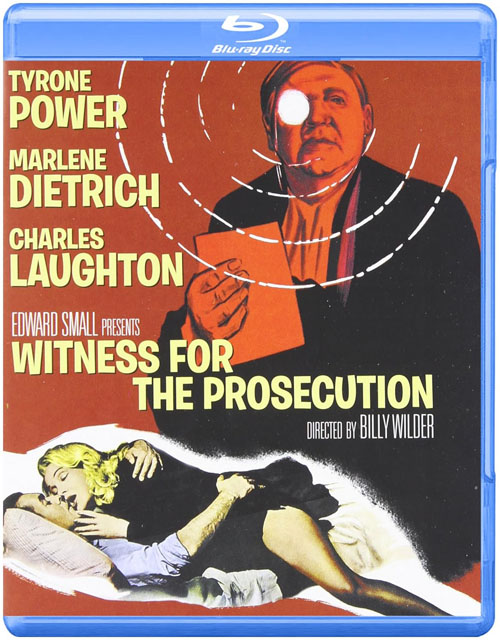
Director
Billy Wilder was on an incredible streak during the decade of the 1950s. Some
of his most notable works were made between 1950-1959, and his 1957 courtroom
drama, Witness for the Prosecution, is one of the high points.
Based
on the 1953 stage play by Agatha Christie (which, in turn, was based on one of
her short stories), Wilder’s film version actually improves a bit on the
already engaging theatrical work. (By the way, the stage play is currently
enjoying a long and successful run in London at County Hall’s old courthouse
and actual courtroom, and this reviewer can attest that it is a magnificent
production, definitely worth seeing in those authentic environs.)
Tyrone
Power received top billing as Leonard Vole, the accused (Power, an American,
plays the role as one as well). The fabulous Marlene Dietrich is Christine, the
“witness for the prosecution.” But make no mistake—this movie belongs to
Charles Laughton, who received third billing. Laughton plays barrister Sir
Wilfrid Robarts, who is the senior counsel for Vole. As his private nurse, Miss
Plimsoll (Elsa Lanchester) declares during the trial when Wilfrid makes a
slam-dunk move, “Wilfrid the Fox! That’s what they call him, and that’s what he
is!”
The
nurse character is something that screenwriters Wilder and Harry Kurnitz
(adapted for the screen by Larry Marcus) added to the story, as well as turning
Sir Wilfrid’s character to be more of a protagonist. Seeing that Laughton and
Lanchester were married in real life, their chemistry and constant bantering
together is priceless, providing the film with comedic elements that the play
never had.
Vole
is accused of murdering a wealthy widow that he befriended. She had become
besotted with him and made him a beneficiary of her will. Vole is married to
German immigrant Christine, who at first provides an alibi for Vole. Sir
Wilfrid, despite recovering from a heart attack and is not in the best shape
for a highly publicized trial, takes the case of defending Vole. It’s a shock
to Wilfrid when the prosecution calls Christine to testify against her husband—because
she is actually married to someone else back in East Germany, dodging the law
that a wife can’t testify against a spouse. To reveal any more of the twists
and turns—and especially the surprise ending—would spoil the fun. (In fact, a
voiceover announces at the end of the movie that the “management of this
theater” suggests that the secret of the ending not be revealed to friends!)
All
three of the leads are particularly outstanding, and they are strongly
supported by not only Lanchester, but also John Williams, Henry Daniell, Torin
Thatcher, Una O’Connor, and Ian Wolfe. Wilder’s direction is a lesson in
pacing, the rise and fall of tempo and suspense, and his guidance of the
actors. Dietrich, in fact, would not agree to do the picture unless Wilder was
hired as director.
The
film was popular in 1957. It received Academy Award nominations for Best
Picture, Best Director, Best Actor (Laughton), Best Supporting Actress
(Lanchester), Best Editing, and Best Sound. Curiously, the screenplay wasn’t
nominated. Lanchester did receive the Golden Globe award for her stellar
performance.
Kino
Lorber Studio Classics has issued a Special Edition Blu-ray that replaces their
earlier 2014 release. The contents are exactly the same except an audio
commentary by film historian Joseph McBride (author of Billy Wilder: Dancing
on the Edge) has been added. Previous supplements included are a short
piece of Wilder discussing the film with director Volker Schlöndorff,
and the theatrical trailer. The restoration itself looks marvelous in glorious
black and white.
Witness
for the Prosecution is
a must-have for fans of Billy Wilder, Charles Laughton, Marlene Dietrich,
Agatha Christie, and courtroom thrillers. Great fun all around.
(A
previous edition of this film was released in 2017 by Classic Flix and was
reviewed on Cinema Retro in 2020. The film has been re-issued as a
“Special Edition” from Kino Lorber Studio Classics in 2024. Much of the
following review is repeated, but updated, from the earlier piece.)
A
sub-genre of film noir is that of the so-called “docu-noir,” a
crime drama usually based on a true story and told as a Dragnet-style
procedural. Most likely there is an omniscient voiceover narrator, a focus on
the lawmen who are investigating the case, and all the other stylistic and
thematic elements associated with film noir in general: starkly
contrasting black and white photography, urban locations, shadows, gritty
realism, angst and cynicism, and sometimes brutal violence.
Eagle-Lion
Films was a British/American production company that existed for only a few
years in the late 40s, disbanding in the early 50s. There was some talent
involved, and they produced a variety of genres and pictures of varying quality
(Powell and Pressburger’s The Red Shoes was a rare Best Picture
nominee). Many of the studio’s pictures were films noir that were shot
as B-movies with low budgets and barebones casts and crews. Anthony Mann
directed a couple of their classic crime movies—T-Men and Raw Deal,
both of which fall into the “docu-noir” category. Unfortunately, due to bad
management or negligence, many of Eagle-Lion’s titles fell out of copyright and
currently reside in the public domain. Hence, one can often find bargain bin,
cheap knock-off DVDs and Blu-rays of these films.
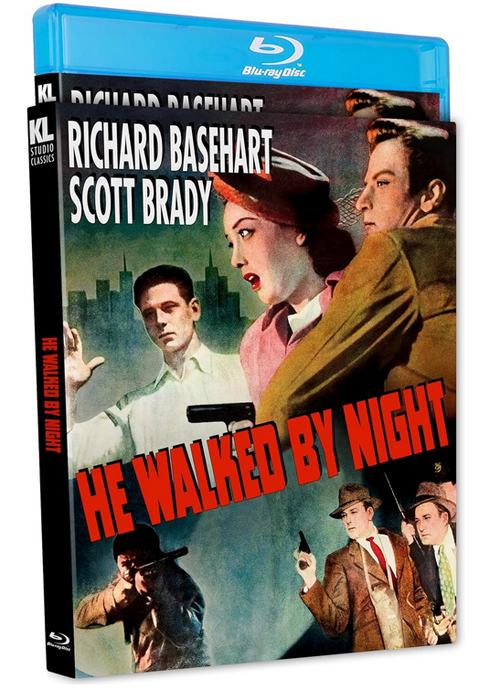
He
Walked by Night
is a prime example of a quality presentation of an equally impressive little
movie. Made in 1948, Walked is a true story loosely based on the crime
spree by Erwin “Machine Gun” Walker, who shot cops and committed burglaries and
armed robberies in Los Angeles in the mid-40s. In real life, Walker was
arrested and sentenced to prison, but he was paroled in the 70s. This is not the
ending to the story that is depicted in the film.
A
young Richard Basehart portrays disturbed war veteran Roy Morgan, a habitual
burglar and armed robber. An off-duty cop on the street suspects Roy of being a
burglar. Roy shoots and kills him. The POV switches to the police, especially
Lt. Marty Brennan (Scott Brady), who is based on the investigator of the true
case. He is assisted by Captain Breen (Roy Roberts), and forensics man Lee
Whitey (Jack Webb, in an early screen appearance). The story follows the police
investigation juxtaposed with Morgan’s eccentric and lonely existence, and the
criminal’s increasingly violent crimes. The big break comes when a stolen item
is recovered by an electronics pawn dealer (Whit Bissell), who has been
unwittingly fencing for Morgan.
It’s
all engaging stuff, and Basehart delivers an outstanding, creepy performance as
Morgan. The police procedural sequences are done well, such as when a composite
drawing of the suspect is created by all the witnesses to the crimes. The
climactic set piece of a chase in LA’s sewer system is exciting, atmospheric,
and pure noir. Oddly, it is similar to the ending of The Third Man,
which was released a year later.
Even
though Alfred Werker is credited as director, audio commentary speculates that
Anthony Mann stepped in to helm some of the movie. Is it one of those Christian
Nyby/Howard Hawks (The Thing) or Tobe Hooper/Steven Spielberg (Poltergeist)
controversies? No one seems to know. He Walked by Night, however, does
contain several sequences—including the final sewer chase—that are stylistic
stamps of Mann. That said, much of the credit for the picture’s success goes to
celebrated noir cinematographer John Alton.
Another
sidebar related to the picture is Jack Webb’s meeting and further networking
with the picture’s technical adviser Detective Sergeant Marty Wynn. This led to
the ultimate creation of Dragnet as a radio and television show.
Kino
Lorber’s new Special Edition Blu-ray presents a 16-bit 4K scan of the 35mm fine
grain, and it looks quite wonderful, a remarkable step-up from other public
domain transfers that are out there. It comes with English subtitles for the
hearing impaired, as well as an audio commentary by biographer and producer
Alan K. Rode and writer/film historian Julie Kirgo. New to this Special Edition
is a second audio commentary by film historian Imogen Sara Smith.
Unfortunately, the Kino Lorber edition does not contain other supplements that
the previous Classic Flix edition did, nor the 24-page booklet that accompanied
that packaging.
For
fans of film noir, police procedurals, and gritty crime dramas, He
Walked by Night is a good time at the movies.
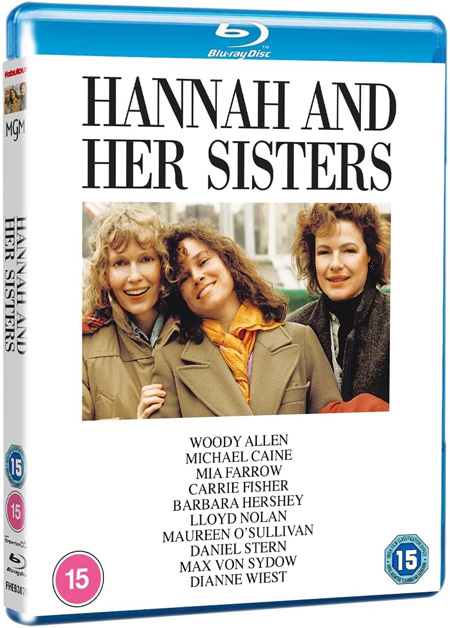
Woody Allen’s Chekhovian-titled Hannah and Her Sisters
(1986) is reportedly only twenty percent of what he actually wrote for the film
on his Olympia SM-3 typewriter, which he has owned for decades and written all
of his films on. Given how extraordinary this outing is, one can only wonder what
the remaining projected film would have looked like. Conceived of as his answer
to Ingmar Bergman’s Fanny and Alexander (1982) which ran three hours
theatrically and nearly five-and-a-half hours on Swedish television as a
mini-series, Hannah is considered by many to be Mr. Allen’s finest hour,
although I am in the minority as I view Another Woman (1988) as his best
film, with Hannah coming in at a very close second.
Hannah is a sumptuous film, the first Woody Allen outing to be
photographed by the late great cinematographer Carlo
Di Palma who would go on to work on eleven more films with Mr. Allen. He
captures the visual splendor of New York and all its beauty and ugliness over a
two-year period between Thanksgiving holidays. It is also a family affair. Hannah
is a housewife/actress and is played wonderfully by Mia Farrow. Her parents are
her real-life mother, Maureen O’Sullivan, and actor Lloyd Nolan, who used to be
actors as well. Hannah is married to businessman Elliot (Michael Caine) and
they have a good number of children who are all played by Ms. Farrow’s and Mr.
Allen’s real-life adopted offspring. Hannah’s sisters consist of the
emotionally adrift Lee (Barbara Hershey), who is in a relationship of sorts
with the hermetic painter Frederick (Max von Sydow) and the actress-wanna-be Holly
(Dianne Weist) who always appears to be on the verge of a breakdown between
bouts of ingesting nicotine and alcohol following auditions. As with previous
Allen outings, especially his 1979 film Manhattan, Hannah revolves
around myriad romantic entanglements, but it is not all fun and games. Elliot
is intensely attracted to Lee who is a lost soul and is pulled to him thanks to
Frederick’s older age and insouciance. Holly and her actress friend April
(Carrie Fisher), with whom she runs a catering company to make ends meet, battle
it out for the affections of David (Sam Waterston), an erudite architect who
uses opera and fine wine as his tools of choice to woo them both.
As if this were not enough, Mickey (Woody Allen) is a television
producer/hypochondriac and is Hannah’s ex. He has a near-death experience when
he becomes convinced that he has a brain tumor and ponders the meaning of life,
questioning his parents and his co-worker played by Julie Kavner while also
looking to religion for answers, but stopping short after speaking with a Hare
Krishna, confirming the absurdity of shaving his head, wearing long robes, and
dancing around at airports. Though most of the action is that of a serious
theme (Crimes and Misdemeanors would take this to even further horrific
heights in 1989), the film also balances it with outright hilarity. The ending
is perhaps one of the most hopeful and positive in all the Woody Allen
filmography.
Hannah boasts two celebrated cinematic moments. The first occurs in a
restaurant among the sisters as Lee tries desperately to hide her affair from
Hannah who simultaneously attempts to talk Holly off the ledge when she announces
her decision to take off a year to try and find herself. The camera circles the
triumvirate in a 360-degree maneuver that illustrates Lee’s increasing
discomfort with the situation at hand as the tension mounts.
The second comes near the film’s end when Mickey notices Holly
perusing titles in Tower Records and engages in a humorous and heartfelt exchange
with her. The scene is done in one take and is a highlight.
Among Woody Allen fans the question has usually been which do they
prefer: Annie Hall (1977) or Manhattan (1979). They can add Hannah
to the mix. This was Ms. Farrow’s fifth outing with Mr. Allen and she does a
wonderful balancing act of being the confused wife of an adulterer and the
sister of a neurotic.
After being lensed in the fall of 1984, Hannah opened
nationwide on Friday, February 7, 1986 to near universal acclaim, leaving Mr.
Allen wondering how had he failed, the idea being that if you make something
that just about everyone loves, you must be making something that fails to be interesting
or challenging!
Hannah won Oscars for Best Original Screenplay for Woody Allen, Best
Supporting Actor for Michael Caine (who will never live down his unavailability
to accept the Oscar in person as he was away filming Jaws IV), and Best
Supporting Actress for Dianne Weist. It is one of his best-scored films,
boasting a soundtrack of both upbeat and melancholic tunes.
The film is available in a Region B Blu-ray from Fabulous Films, the
fine company that released Manhattan. The
source material is terrific and the film’s warmth shines through.
Click here to purchase this from Amazon’s UK site.
(A
previous 50th Anniversary edition of this film was released in 2018
by Kino Lorber and was reviewed on Cinema Retro in 2020. The film has
been re-issued on Blu-ray as a “Special Edition” in 2024. Much of the following
review is repeated, but updated, from the earlier piece.)
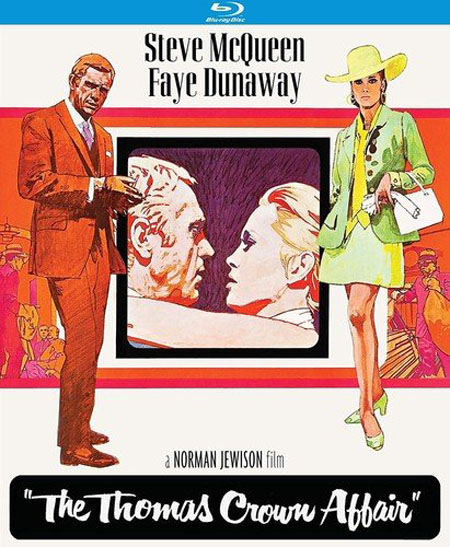
The
late director Norman Jewison, who passed away on January 20, 2024, was on a
roll in the late 1960s. After a handful of well-received small romantic
comedies, he directed The Cincinnati Kid (1965) featuring Steve McQueen as
a Depression-era poker player, followed by the Oscar Best Picture-nominated The
Russians are Coming, the Russians are Coming (1966), and then the brilliant
In the Heat of the Night (1967), which did win the Best Picture
Oscar and landed Jewison a Director nomination.
His
next project became a heist picture/romance, the story of which was pitched to
him by Alan R. Trustman, a lawyer with no screenwriting experience. Jewison was
intrigued, so, according to the excellent interview with the director that
appears as a supplement on Kino Lorber’s new Blu-ray edition of The Thomas
Crown Affair, he gave Trustman a crash course in how to write a movie
script. When it was completed, Jewison got the film green-lit.
When
Jewison’s agent—who also represented Steve McQueen—read the screenplay, he
suggested McQueen for the part. Even though the actor and director had gotten
along on Cincinnati Kid, Jewison admits that he didn’t think McQueen was
right for the role because the actor never wore suits. McQueen then met with
the director—wearing a suit—and convinced him that he could be Thomas Crown.
The
Thomas Crown Affair is
a stylish, twisty-turny, clever piece of 1968 pizazz. It emphasizes the
ultra-cool cosmopolitan and fancy lifestyle of the rich during the Mad Men era
when it was actually happening. The flashy camerawork and then-innovative
split-screen/multi-screen display of simultaneous action scenes was snappy and
unique. The brilliant main title designer, the late Pablo Ferro, is credited
for much of this work, and it is this visual technique that gives the movie its
pulse.
Crown
is a former banker in Boston, a happily wealthy playboy-sportsman who decides
to pull off a complicated bank heist simply because he can. He puts together a
team of individuals (including getaway driver Jack Weston) who don’t know each
other or him, and the gang meets only at the time of the robbery inside the
bank. Crown himself isn’t there. The heist is successful, and the mastermind
gets away with $2.6 million. Detective Malone (Paul Burke) is determined to
catch whoever was responsible, but the crime was too well thought out. No evidence
or clues were left behind. An insurance investigator, Vicki Anderson (Faye
Dunaway, in her first role post-Bonnie and Clyde), is brought in and she
immediately takes control of the operation, much to Malone’s chagrin. It
doesn’t take long for Crown to come under Vicki’s suspicions—so she sets out to
entrap him by, well, having an affair with him.
That’s
the plot in a nutshell. While much of it is seemingly improbable, the story is
told with conviction and such technical prowess that it’s hard not to go along
for the ride. Jewison’s handling of the heist itself and the romantic sequences
between the dual eye candy, McQueen and Dunaway, is masterful. Both actors are
fine in their roles; McQueen especially continues to exude the 60s cool that
was his trademark.
Kino
Lorber’s brand new 4K restoration looks quite good, and it comes with two audio
commentaries—one by Jewison himself, and the other by film historians Lem Dobbs
and the late Nick Redman. Supplements
include the previously mentioned interview with an aging Jewison, who was still
sharp and talkative, an interview with title designer and split-screen maestro
Ferro, and a vintage on-the-set featurette from 1967 with the cast and crew.
The original theatrical trailer, along with other Kino Lorber releases,
complete the disk.
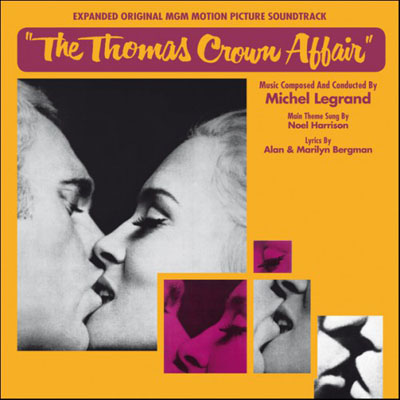
The
Thomas Crown Affair was
remade by John McTiernan in 1999 with Pierce Brosnan and Rene Russo. Was it
better than the original? Maybe yes, maybe no. Only you can decide; but
consider this—the 1968 version has Steve McQueen, a young Faye Dunaway, a
variety of really hot and nifty sports cars, and an Oscar-winning title song,
“The Windmills of Your Mind” (remember that?)! Recommended.
I
have never understood religious cults, and I still don’t. How someone can
permit themselves to be brainwashed into following a self-appointed “religious
leader” and hang on their every word represents, to me, a soul searching for acceptance
or love that they believe has been denied them. My initiation into the existence
of cults was in the December 4, 1978 issues of both Time Magazine and Newsweek
Magazine. Their reports about the Jonestown murders in Guyana, which completely
shocked my sensibilities with images of dead adults and children lying face
down in filth, were the stuff of nightmares. This horrific event has spawned
books, documentaries, and jokes about “drinking the Kool Aid” when referencing one’s
blind commitment to a ridiculous situation. An article two months later in my
local newspaper about “witches,” pagan practices, bowls of blood and animal
ribcages in the woods less than ten miles from where I lived did little to assuage
my fears about them. David Koresh, the leader of the religious sect
referred to as the Branch Davidians, led his followers into the Mount Carmel
Center, a compound in Waco, Texas, which culminated in a standoff with law
enforcement in April 1993 with most of them dying in a storm of bullets and
fire. NXIVM, the organization founded by Keith Raniere five years later
masquerading as a self-help and personal development program group, came under
fire for being a cult following reports of sex trafficking of branded women.
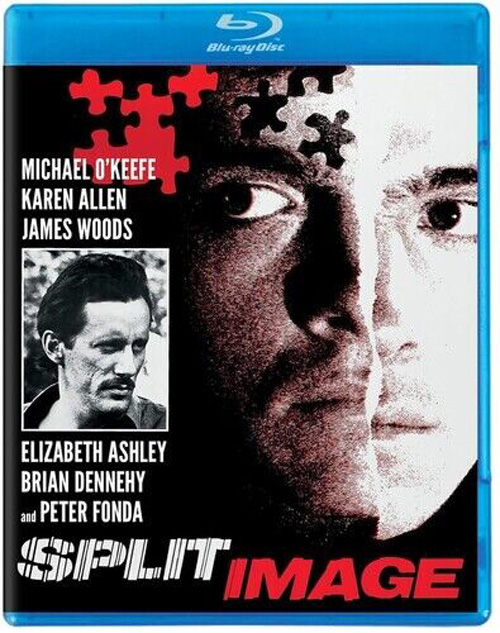
Hollywood is no stranger to films about such
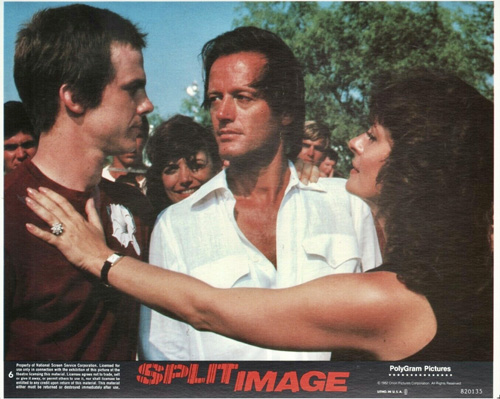
subjects. Most of them are cut from the cloth of genre and horror films. Split
Image (1982) is a bit of a different take on this terrifying subject as
seen through the eyes of suburbanites and therefore is far more relatable. Directed
by Ted Kotcheff between April and June in 1981 just before he unleashed John
Rambo on the world with his phenomenal First Blood, also released in
1982. Split Image was originally reported on under the title of Captured
when it was featured in the wonderful but short-lived bi-monthly movie magazine
published in 1982 called “Coming Attractions.” I saw the film on CED Videodisc nearly
40 years ago and was amazed at how little I recalled of it.
Danny Stetson (Michael O’Keefe of Lewis John
Carlino’s 1978 film The Great Santini) is a parallel bars athlete eyeing
college. He lives with his parents Kevin and Diane (Brian Dennehy and Elisabeth
Ashley) and younger brother Sean (Ronnie Scribner of Tobe Hooper’s 1979 TV-Movie
Salem’s Lot) in a sprawling house like the killer’s in Dario Argento’s Tenebrae
(1982), complete with large see-through windows and a built-in pool. By chance
he meets a beautiful young woman named Rebecca (Karen Allen of Steven
Spielberg’s Raiders of the Lost Ark in 1981) who engages in small talk about
big subjects. Accompanying her to a weekend outing, he is introduced to scores
of people at a retreat called Homeland who welcome him with open arms –
literally – and who all chant and engage in reciting positive affirmations while
discussing Jungian archetypes such as the duality of man. The happy and joyous
atmosphere completely rubs him the wrong way when he meets the group’s leader,
Neil Kirklander (played wonderfully by Peter Fonda), but he stays and sleeps on
the premises and one night makes a break for freedom. Bill Conti’s score here
is recognizable as the precursor to his wonderful score to Robert Mandell’s
thriller F/X (1986). Confronted by Kirklander, he eventually falls under
his spell and informs his mother that he will not be coming home. He undergoes
a ritual whereby he renounces his identity as Danny and is reborn as “Joshua,”
prompting a visit from his parents that results in a near donnybrook
precipitated by his temperamental father.
Split Image, which opened in New York on Friday, November 5,
1982, does a decent job of exploring the practice of capturing and “deprogramming”
an individual who has fallen under the spell of a cult and this is done by
Charles Pratt (played by the incomparable James Woods) who, somehow, makes his
living “deprogramming” people. After kidnapping “Joshua” with his parents’
permission, he forces him to undergo “treatment” to bring “Danny” back to life.
Many of these scenes look as though they came out of a horror film, and it
makes one wonder how much of this was imagined by the writers and how much is
based on factual circumstances such as this. The film looks at the ethics of “interventions”
and how it can alter a person’s free will and their ability to make their own
choices. Like Irwin Winkler’s At First Sight (1992), it waivers between
being compelling and occasionally feels a little “TV Movie of the Week”-ish by
today’s standards.
The film is now available from Kino Lorber on
standard Blu-ray. Some of the shots within the house appear to be a little
darker than they should be, but it is probably just how the film was shot. Mr.
Kotcheff does an expert job of framing the film for 2.35:1 anamorphic
photography, which is a huge step up from the pan-and-scan transfer of the
early 1980’s.
This is a sparse disc in the way of extras, however
the major one is the feature length audio commentary by film historian and filmmaker Daniel Kremer who
mentions his own movie, Raise Your Kids on Seltzer (2015), which is
about retired “deprogrammers”. When I was in middle school, Ralph L. Thomas’s
1981 film Ticket to Heaven appeared in my Weekly Reader issue and
I had a much different idea of what that film was about. It turns out that
deprogramming is the theme, and Mr. Kremer also mentions Blinded by the
Light, which was released in 1980, and starred both Kristy and Jimmy
McNichol, directed by cinematographer John A. Alonzo. This is a very
entertaining and informative commentary which also touches on Mr. Kotcheff’s
other films and placing him into the auteur category.
The
Blu-ray also comes with the following trailers: Split Image, Gorky
Park, 52 Pick-Up, The Bedroom Window, The Wanderers,
and The Hard Way.
(A previous edition of this Blu-ray title from Kino Lorber was reviewed at Cinema Retro in 2020. This review covers a new edition released in 2024, repeating much of the previous writeup but with new material.)
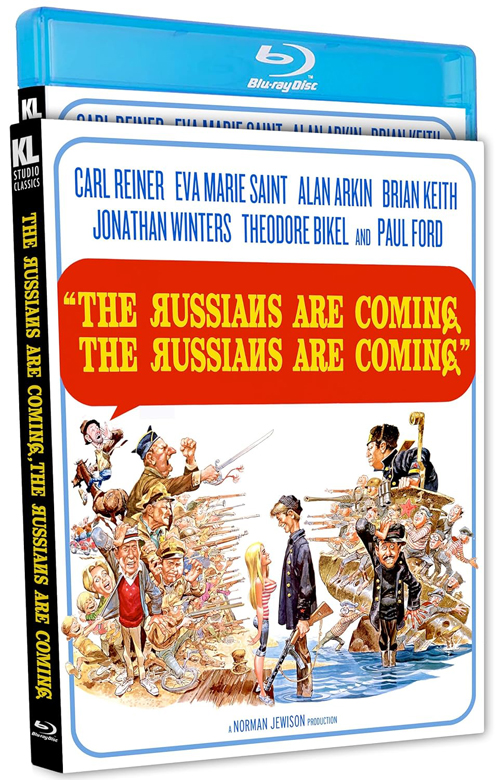
The late Carl Reiner received top billing in this magnificent comedy that was released in the middle of the 1960s, when relations between the United States and the Soviet Union were tentative at best. Détente was at play, but there wasn’t much trust between the two countries. Two years after Kubrick’s Cold War black comedy, Dr. Strangelove, Norman Jewison tried his hand at a picture with a similar theme, only it was one that was much lighter in tone.
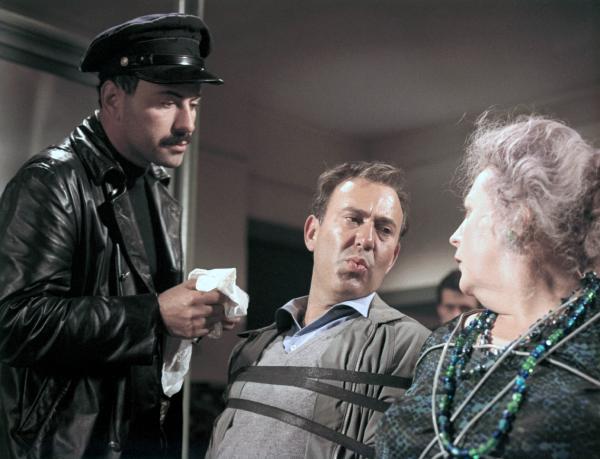
Reiner shares the movie with another acting master who recently left us. Alan Arkin made his feature film debut with his portrayal of a Russian submarine political officer. He and Reiner are joined by a marvelous supporting cast of character actors who all have comedic turns. Penned by Oscar-nominated William Rose (who had written or co-written The Ladykillers and It’s a Mad, Mad, Mad, Mad World, and would win the Oscar the following year for Guess Who’s Coming to Dinner), The Russians are Coming, the Russians are Coming focuses on the conflict between a group of misplaced Soviet submariners and the panicky townsfolk of a New England island off the coast of Massachusetts after the summer tourists have left. What it’s really about, though, is communication, or rather, the lack of it, and how a series of incidents that are lost in translation might lead to misunderstandings. Director Jewison delivers that message to the audience wrapped neatly in a barrel of laughs.
Reiner is Walt Whittaker, a playwright who has spent the summer on the island with his wife (Eva Marie Saint) and two children, and the family is ready to depart. His rented house on the coast happens to be near where the Russians’ submarine accidentally runs aground. The captain (Theodore Bikel) sends Lt. Rozanov (Arkin), officer Alexei Kolchin (John Phillip Law), and seven other men to go find a boat, commandeer it, and bring it back so they can tow the sub away from the island. Things begin promisingly, and then all hell breaks loose as one mishap after another foils the Russians’ scheme. Police Chief Mattocks (Brian Keith), his deputy Norman Jonas (Jonathan Winters), and, ultimately, war veteran and head of the citizens militia, Hawkins (Paul Ford), receive conflicting reports of the “invasion” and set about investigating it in their own misguided ways (although Mattocks is indeed the sensible one). Throw in a sudden romantic attraction between Alexei and the Whittaker’s babysitter, Alison (Andrea Dromm), the antics of phone operator Alice (the splendid Tessie O’Shea), and Luther, a drunk “Paul Revere” who spends the entire film trying to catch his horse (Ben Blue), and you’ve got a recipe for a comedy classic. The climax, however, is surprisingly suspenseful when the Russians and Americans finally reach a standoff at the harbor—until an unrelated crisis occurs that shakes everyone out of the mob mentality.
The straight man role was something Carl Reiner could do well; he always brought a heightened intensity to his parts that was simultaneously boisterous and believable, and yet amusing, too. Arkin, whose dialogue is 85% authentic Russian throughout the picture, immediately proved to the world what an amazing actor he is (he received an Oscar nomination for his performance and won a Golden Globe). Winters and Ford both provide much of the insane humor. O’Shea is hilarious, especially in the scene in which she and Reiner are gagged and tied together and attempt to escape. Law, a newcomer at the time, is a striking and likeable presence, and he masters the Russian language and the accented English with aplomb.
It’s all great stuff, punctuated by Johnny Mandel’s score of American patriotic music mixed with Russian folk songs. Along with Arkin’s nomination, The Russians are Coming… was also nominated for Best Picture, Best Adapted Screenplay (Rose), and Best Editing (Hal Ashby was co-editor).
Kino Lorber’s high definition restoration looks good enough, despite some washing out of color in some places, as well as blemishes and artifacts that can be seen in many of the images. This new 2024 edition has added an audio commentary by film historians Michael Schlesinger and Mark Evanier, who complement the onscreen action with informed background. The earlier supplements of an informative and entertaining “making of” featurette with an interview with Jewison and the theatrical trailer remain on the disk.
In short, The Russians are Coming, The Russians are Coming is grand fun, and it’s a fitting showcase for the late, great Carl Reiner and Alan Arkin.
So… a novel by Émile Zola published in 1890 has been made into a movie no less than five times. La Bête humaine(“The Human Beast” or “The Beast Within”) is a gritty psychological crime thriller centered in the world of railway yards and train engineer life, and nearly every character, including the protagonist, Jacques Lantier, is someone with a dark soul. It wasnoir before that term was used to describe art.
A film adaptation was first made in Germany in 1920 by Ludwig Wolff. A more celebrated remake by Jean Renoir and starring the great Jean Gabin as Lantier was released in 1938. The Hollywood version, retitled Human Desire andreviewed here, was made in 1954 by Fritz Lang, the brilliant filmmaker who had fled Nazi Germany in the 30s and resumed what was already a stellar career in Tinsel Town. Two more pictures, a 1957 Argentinian version and a more well known British television reworking in 1995 entitled Cruel Train(directed by Malcolm McKay), also revisited the well-worn tale.
While Renoir’s 1938 rendition of La Bête humaineis generally considered the definitive depiction of Zola’s novel, Lang’s Human Desire is an excellent example of the kind of rough-and-ready films noir that Hollywood had been churning out through the 1940s and 50s. Lang himself had already made several that fit within the trend and style of these often cheap, always black and white, mostly cynical thrillers—Ministry of Fear (1944), The Woman in the Window (1944), Scarlet Street (1945), Secret Beyond the Door (1947), and The Big Heat (1953), among others. The hallmarks of film noir are there—cinematography patterned after German expressionism, contrasting light and dark, shadows, nighttime, smoking, drinking, violence, and, most assuredly, a femme fatale.
This time the Lantier character, now called Jeff Warren (Glenn Ford), is a much nicer fellow. The violence and rage that existed in earlier versions of the protagonist are not here.He’s a train engineer, recently discharged from the Korean War and back at his old job in the railway yards somewhere not unlike Pennsylvania. He’srather sweet on the daughter of a colleague, a “good” girl andperhaps the only innocent and squeaky clean character in the story. Carl Buckley (Broderick Crawford) also works for the railroad, but he’s a mean drunk and is fired. He has a younger wife, Vicki (Gloria Grahame), who has a questionable past. Carl gets Vicki to visit a wealthy railway customer, Owens (Grandon Rhodes), to try and get him to influence the railway boss to rehire her husband. Carl doesn’t realize Vicki has some history with Owens. Carl gets his job back, but now he’s terribly jealous. He forces Vicki to help him murder Owens during a train ride. They don’t count on Jeff also being on the train and unwittingly becoming involved in the scheme. Jeff falls for Vicki and begins an affair with her, even though he knows she’s likely “no good.” And then Vicki has plans of her own for Jeff to do something about Carl. She believes that if Jeff had killed in the war, then he could do it again. But that, as he says, is “a different kind of killing.”
Yes, it’s quite a typical adultery-murder plot that floats around films noir. We can predict the events of the story before they occur, but we don’t care. Why? Because Fritz Lang’s direction is tight, interesting, full of striking imagery, and straddles the right balance between campy and heightened melodrama. The performances, especially by Grahame, are quite good. The only problem is an ending that might be considered unresolved.
Kino Lorber Studio Classics’ new Blu-ray release of Human Desire is top-notch with a gorgeous restoration that accents the cinematography by Burnett Guffey (who had won an Academy Award for From Here to Eternity and would win another for Bonnie and Clyde). The only supplements on the disk are a nine minute video discussion about the film by, curiously, actress Emily Mortimer, the theatrical trailer, and trailers for other Kino Lorber releases.
Human Desire is for fans of film noir, Fritz Lang, and the trio of stars—Ford, Grahame, and Crawford. Oh, and if you happen to like trains, there are a lot of those in the movie, too!
After the dramatic, Ingmar Bergman-esque directorial turn he took
with Interiors (1978) which came unexpectedly on the heels of
his masterfully hilarious Oscar-winning film Annie Hall (1977),
Woody Allen turned back to contemporary New York for a daring film that was
shot in black-and-white and scored with the music of George
Gershwin. Proclaimed as the only truly great American film of the 1970s by
film critic Andrew Sarris, Manhattan is a joy to behold from
start to finish and is quite simply one of the most romantic-looking films of
all-time (though its subject matter in the era of the MeToo movement will
indubitably raise more than a few eyebrows with the allegations of sexual
molestation launched against Mr. Allen). Gordon Willis’s beautiful
photography married with the sumptuous Gershwin music makes me wish that
filmmakers would make black-and-white films today. There are some who do, admittedly,
but they appear to only do it within avant-garde and independent circles.
Manhattan, released on Wednesday, April 25, 1979, stars Mr.
Allen as Isaac Davis, a television writer who is unfulfilled with his life as a
comedy writer. His second ex-wife Jill (Meryl Streep) has left him for
another woman and is writing a book about their marriage. Isaac is 42 and
is dating Tracy (Mariel Hemingway) who is 25 years younger than he is and is
still in high school. He feels very guilty about this, but genuinely cares
for her (this plot point was reportedly inspired by Mr. Allen’s affair with
actress Stacy Nelkin on the set of Annie Hall which was
shooting in 1976, though her part was eventually cut from that film). His
friend Yale (Michael Murphy) is writing a book about Eugene O’Neill and is
married to Emily (Anne Byrne) but has started an affair with high-strung and
neurotic Mary Wilkie (Diane Keaton) whom Isaac initially cannot tolerate but
increasingly grows fond of. Throughout the film we are confronted by these
characters who cannot seem to put their finger on what they want and stick with
it. They are not inherently bad people. They just keep making questionable
decisions. By the end of the film, the only person who seems to have their
head on straight is Tracy and the film ends, like Mr. Allen’s Hannah
and Her Sisters (1986), on a very positive and upbeat note.
The real star of the film is Manhattan itself, with its pulsating
and bustling people and automobiles. Rarely has the city looked so
luminous and beautiful onscreen (if ever). Gordon Willis, the revered
cinematographer of The Godfather films and a good number of Mr.
Allen’s early works, captures Gotham in all its beauty even during an era
when the city was beset by social decay. For the first time in his career,
Mr. Allen forgoes the relative constraints of the 1.85:1 flat ratio to the far
more accommodating 2.35:1 anamorphic Panavision vista and the results makes one
ache for further use of this format.
Manhattan was penned by Mr. Allen and Marshall
Brickman, who also co-wrote Annie Hall. The dialogue in Mr.
Allen’s films has always been a strong point, but here it really shines. His
use of long, uninterrupted takes that first surfaced in Annie Hall
shine here Rarely have onscreen walks and chats been so fascinating.
Manhattan was also one of the first movies to appear
on home video in the widescreen format, which retained much (but not all) of
the film’s original image. I have owned Manhattan on
letterboxed VHS, letterboxed laserdisc with a gatefold, letterboxed DVD, and I
must say that this Region B anamorphically-enhanced Blu-ray courtesy of Fabulous Films is beautiful.
It would be wonderful if Mr. Allen would be open to providing
commentary tracks on his older films, specifically this one which,
unbelievably, he reportedly was so displeased with that he imposed on United
Artists to shelve it and offered to do another movie for free.
Thankfully, they did not take him up on it.
Click here to purchase this from Amazon’s UK site.
Would
you go see a horror film billed as “Makes Night of the Living Dead Look
Like a Kids’ (sic) Pajama Party! Scream so they can find you!!!” Somebody did.
Released in New York City on Wednesday, March 7,1973 as the second feature on a
double bill with Mario Bava’s R-rated 1971 film Twitch of the Death Nerve
(the U.S. title of A Bay of Blood), Amando de Ossorio’s The Blind
Dead actually was given a theatrical release in a watered down, PG-rated
version minus blood, gore and nudity. It is also a tighter cut of the original
(known as Tombs of the Blind Dead) as it also dispenses with some
prolonged meandering that gets old real fast. Does the truncated Stateside
version triumph over the longer original Spanish cut of the film? That depends
on the viewer. As a purist who prefers a director’s original vision, I applaud
the efforts of the uncut version.
Lensed
in 1971 in Spain and Portugal at some truly creeping locales, Tombs of the
Blind Dead, clearly influenced by George A. Romero’s aforementioned highly
successful Night of the Living Dead (1968), is one of the better Spanish
horror films to come out of the 1970s, so much so that it spawned no less than
three follow-ups all written and directed by the original’s writer/director: Return
of the Blind Dead (1973), The Ghost Galleon (1974), and Night of
the Seagulls (1975). The madness begins when Virginia White (María Elena
Arpón) encounters her old college lover Betty Turner (Lone Fleming) at a public
pool. Their congenial attitude quickly becomes strained when Virginia’s friend
Roger Whelan (César Burner) shows up and immediately takes a more-than-platonic
liking to Virginia, inviting her on a train ride that he is taking with Betty.
Female resentment ensues and Virginia takes it upon herself to jump off the
train midway, baggage in hand, and goes off into the ruins of a town named
Berzano that the train deliberately bypasses due to an unsavory past. Making
creepy and effective use of the Monasterio de Santa Maria la Real de
Valdeiglesias, Pelayos de la Presa, Madrid, Spain, the director follows
Virginia through the decrepit structures and, unbelievably, camps out solo
overnight! Her presence awakens the buried corpses of the Knights Templar from
their crypts who attack and kill her, her body found by the train conductor the
next morning when on the return trip. Betty and Roger look for Virginia in
Berzano, and out of nowhere, two police detectives emerge to question them about
their relationship to Virginia. It’s a peculiar entrance into the scene, as
though they were standing “stage left” and issued in front of the camera by the
offscreen director. Betty and Roger make their way to the requisite
know-it-all, The One who comes in at the eleventh hour to explain the goings-on
to them, in this case Professor Candal (José Thelman), who explains to them
(and the audience) who manipulates them into finding his son, and the this
leads to a showdown with the Knights and sets up the film for a continuation.
Spanish horror films of this era were on a par with their Italian giallo
counterparts as both genres flourished with exemplary outings from both
countries. Narciso Ibáñez Serrador’s La Residencia (1969), aka The
Finishing School and The House That Screamed, while not a zombie
film, is beautifully lensed and ends with a creepy and original denouement. Francisco
Lara Polop’s La Mansión de La Niebla (1972), known here as Murder
Mansion, boasts beautiful artwork that belies an otherwise pedestrian
thriller. Jorge Grau’s The Living
Dead at Manchester Morgue (1974), known also as Let Sleeping Corpses Lie
and here in the States as Don’t Open the Window, is, on the other hand,
a key zombie film from this era and is generally regarded quite correctly as
one of the best, and has received stunning Blu-ray treatment from Synapse
The
film noir movement/trend in Hollywood was fading away by the end of the
1950s decade. Orson Welles’ Touch of Evil (1958) is often cited by film
historians and film noir aficionados as the “last true film noir.”
However, one picture released in 1959 could very well take that honor,
for it indeed exhibits many of the traits of pure film noir (black and
white photography, gritty realism, cynical and edgy characters, a heist,
and an ending that is, well, not a happy one).
Odds
Against Tomorrow was set up by actor and musician Harry Belafonte and
was made by his production company. Is it the first film noir with a
Black protagonist? This reviewer can’t think of another that preceded
it. Basing it on a novel by William P. McGivern, Belafonte hired
blacklisted Abraham Polonsky to write the screenplay. Polonsky (who had
written the great Body and Soul, 1947) had been caught up in the HUAC
investigations in Hollywood, refused to testify in the hearings, and was
subsequently blacklisted along with many other writers, producers,
directors, and actors. Polonsky, working with co-writer Nelson Gidding,
wrote the script under a front-pseudonym, John O. Killens, a living
Black novelist. It wasn’t until 1996 that the Writers Guild restored
Polonsky’s real name to the credits.
Belafonte
apparently had wanted to make a movie that was not only a gripping heist
drama but also a statement about prejudice. Of the trio of robbers who
attempt a bank robbery in the film, one is Black (Belafonte), the other
two are White, and one of the latter is terribly racist… a factor that
plays into how the caper ultimately plays out.
New York
City. Dave Burke (Ed Begley) is a disgraced former cop who needs money.
Earl Slater (Robert Ryan) is an embittered, racist war veteran and
ex-con who needs money. Johnny Ingram (Belafonte) is a musician in debt
to a gangster because of a gambling addiction, so he needs money, too.
Slater lives with needy Lorry (Shelley Winters, in one of her whiny
roles) but he has the hots for apartment building neighbor Helen (Gloria
Grahame). Johnny is separated from his wife, Ruth (Kim Hamilton) and
daughter Edie, but he desperately wants to make good and reunite the
family. When Dave learns about an upstate smalltown bank with a
vulnerability, he enlists Earl and Johnny in a scheme to steal $150,000,
split three ways. Johnny doesn’t want to do it, but the pressure from
the mobster and threats to his family force him into it. Earl is not
happy that a Black man is part of the plan, and this tension is a major
conflict in the heist proceedings. To reveal more would spoil the
excitement.
Robert Wise, a filmmaker who seemed to be
able to make a great film out of any genre, is at the helm, and he does a
terrific job. He had worked with Ryan before in the film noir, The
Set-Up (1949). Wise, of course, won Oscars for directing The Sound of
Music (1965) and co-directing West Side Story (1961), but also made such
diverse classics as The Day the Earth Stood Still (1951), The Haunting
(1963), and Star Trek: The Motion Picture (1979)!
This
is an intense, engaging picture that generates suspense and has
something to say. The script is top-notch, and the performances are
heightened just enough to fit firmly into the film noir style. The
music, composed by John Lewis and performed by the Modern Jazz Quartet,
is phenomenally good, adding another level to the tone and feel of the
movie.
Kino Lorber Studio Classics’ new Blu-ray
presentation is sharp and clean in glorious black and white. There is an
accompanying audio commentary by author/film historian Alan K. Rode.
Supplements include Post Screening Q&A interviews with Harry
Belafonte (in 2009) and Kim Hamilton (in 2007), plus the theatrical
trailer for this and other Kino Lorber film noir titles.
Odds
Against Tomorrow is for fans of film noir, heist movies, Robert Wise,
Harry Belafonte, Robert Ryan, and other members of the sparkling cast.
Highly recommended.
The
seventh and last entry in the Road to… motion picture series is often
cited as the weakest of the Bing Crosby and Bob Hope musical romps, but it’s
actually perhaps somewhere more in the middle. This reviewer found many of the
comic bits and one-liners to be quite funny, and despite their aging personas
(especially Crosby), the duo are in good form.
The
series began in 1940 with Road to Singapore and continued through the
forties. They were huge successes for Paramount Pictures. The single title made
in the fifties (and the only one shot in color), Road to Bali (1952),
seemed to be the swan song. It wasn’t until the early sixties that Crosby and
Hope decided to do another, this time for United Artists and shot in the UK.
Interestingly, fans of the James Bond film series will spot familiar faces and
names either on camera or in the credits behind the scenes (Walter Gotell, Syd
Cain, Bob Simmons, Maurice Binder, Wally Veevers).
More
significant is that The Road to Hong Kong, directed by Norman Panama,features a spy adventure plot that is not unlike the early 007 pictures,
and its release preceded the premiere of Dr. No by a little less than
seven months! There is a SPECTRE-like villainous organization (the “Third
Echelon”) and a caper involving nuclear weapons and space travel (shades of Dr.
No and You Only Live Twice). The villains even operate from an
underwater laboratory and control room that resembles that of Dr. No's. (When
Bob Hope’s character sees all the men and women in lab coats sitting at
terminals and monitors, he quips, “Oh, look, a school for television
repairmen!”)
As
usual, Crosby and Hope are conmen, Harry Turner and Chester Babcock, who
unwittingly become involved in a MacGuffin plot to steal plans for Russian
rocket fuel so that the Third Echelon and their leader (Robert Morley) can
launch nuclear missiles at earth from the moon. Echelon agent Diane (Joan
Collins) at first works with the villains, but of course the wacky pair of
Harry and Chester win her over to their side.
Oddly,
longtime costar Dorothy Lamour is relegated to helping the boys in a small
sequence and musical number near the end of the film. It’s a shocking example
of how Hollywood viewed aging female stars. A much younger Collins was cast as
the lead this time, with Lamour pushed into what amounts to a glorified cameo.
Never mind that both Crosby and Hope are much older than Collins and are
Lamour’s contemporaries!
It's
almost impossible in this day and age not to view the film through the lens of
cultural misappropriation. Despite the movie mostly taking place in British
Hong Kong, there are very few Asian actors to be seen (and they are mostly
extras). Too many white men and women are costumed and made up to be “Asian”
(and even Harry participates thusly as part of a disguise). This kind of thing
occurred in every Road to… picture, from Singapore to Morocco to Bali.
But, as classic film aficionados know, one must approach older films within the
context of when they were made and released. In 1962, this sort of thing was
commonplace.
An
old-school audience will certainly enjoy The Road to Hong Kong. The
singing and dancing, the slapstick hijinks, the snappy and silly dialogue, and
the references to the previous Roads are enough to delight. Another fun
aspect are the many cameos from the likes of Peter Sellers, David Niven, Frank
Sinatra, Dean Martin, Jerry Colonna, and others.
Kino
Lorber Studio Classics presents a sharp-looking Blu-ray restoration in glorious
black and white (this one surely would have benefited from color). An
insightful audio commentary by film historian/filmmaker Michael Schlesinger and
archivist/historian Stan Taffel accompanies the feature. Rounding out the disk
are theatrical trailers from this movie, other Road titles, and other
Kino releases.
The
Road to Hong Kong is
for fans of the series, of Bing Crosby and Bob Hope, and for vintage Hollywood
and British films of the early 1960s. Fun stuff.
Franco Nero was too young to take the lead role as the titular Django (Sergio Corbucci, 1966), a grizzled Civil War veteran dragging a coffin across the mud flats of the southern US-Mexican border, but some clever makeup and several days of stubble added at least ten years to the then 25-year-old and a star was born. His piercing blue eyes dazzled audiences, and he hasn’t stopped stealing the screen from his co-stars ever since. Whenever he appears on screen he leaves an impression, whether he’s mowing down an entire western town with a machine gun in Django or playing the Pope to Russell Crowe’s exorcist in, er, The Pope’s Exorcist (2023).
UK label CultFilms have restored and released Nero’s career-making Italian western Django, available for the first time in the UK on Blu-ray, alongside two other hugely entertaining westerns, Keoma(Enzo G. Castellari, 1976), also starring Nero, and A Bullet for the General (Damiano Damiani, 1967), which sadly doesn’t star Nero, meaning this collection doesn’t quite add up to a Franco Nero boxset. However, A Bullet for the General does star a magnificent Gian Maria Volonté alongside Klaus Kinski and Martine Beswicke, and could arguably be the best film of the three. Rounding out this fantastic set is the documentary Django & Django (2021) which, perhaps inevitably, focuses on Quentin Tarantino’s relationship with the original Django and Spaghetti Westerns in general, and it is a great deep dive into why these films continue to resonate with audiences in the 21st Century.
Each of the films in this set is accompanied by a terrific set of bonus features too: there are new and archival interviews with many of key players, including Franco Nero himself, but this reviewer’s favourite addition is the introductions to each film by Alex Cox; writer, director and former presenter of Moviedrome, the influential late-night cult film slot back in the mid-1990s. He knows a thing or two about Italian cinema, and having seen Cox appear on other discs introducing and discussing films as well, I would like to argue for his inclusion on all film releases from now on. He is authoritative and has an encyclopaedic knowledge, and he is also witty and likeable. Watching him on these discs really makes me miss Moviedrome. Each of his three introductions here are worth their weight in stolen Mexican gold.
The boxset comes in a card case with three poster reproductions and is an essential addition to any western aficionado's library. CultFilms have also released Django as a standalone 4K UHD set which comes complete with a 64-page bound book written by Kevin Grant, who has written some excellent books on European westerns, published by FAB Press.Truly we live in a golden age. (The discs are region-free).
In 1965 a huge brightly-painted sculpture of a reclining woman, called ‘Hon – enkatedral’ (She – a cathedral), was displayed in a gallery in Stockholm. Visitors would enter the sculpture by walking through an open vagina, and inside they found two floors of amusements including a slide, a vending machine, silent film screenings, a public telephone and a ‘lovers' bench’ whose romantic conversations were secretly transmitted via microphone to a bar. This massive artwork was created by an art collective lead by French artist Niki de Saint Phalle and was a perfect melding of pop art and second wave feminism.
‘Hon - enkatedral’ was clearly an inspiration to Italian television director Piero Schivazappa, who having had success on a number of different dramas (including the epic adaptation of Homer’s Odyssey in 1968, which also featured episodes directed by Mario Bava), drew on this sculpture and what it represented for his first feature film Femina Ridens. A life-size recreation of the sculpture features throughout the film, with the addition of sharp, jagged vaginal teeth that snap sideways as men queue to enter its dark interior. The film’s title, which translates from the Latin as ‘The Laughing Woman,’ suggests that this new power that women have found has come at the expense of men, who have become the butt of a great joke (the alternate title ‘The Frightened Woman’ makes for a more marketable thriller but is very misleading).
This is a film where it is best not to know too much going in, but the setup is essentially: “What if Christian Grey was also an incel who was afraid that feminism would result in a society entirely consisting of women reproducing through parthenogenesis?” Starring French actor Philippe Leroy and German actress DagmarLassander, both speaking English on an Italian production, Femina Ridens is essentially a two-hander about the powerplay between a man who seeks to dominate women and his chosen victim, who may be more than she first appears. With its fantastic pop-modernist design, the dreamlike imagery of men being eaten by Niki de Saint Phalle’s vagina dentata, and the two sexy leads, Femina Ridens is the perfect evocation of late sixties Italian cinema and popular culture and is well worth seeking out.
Thanks to Shameless Entertainment, we now have a new 4K restoration of the preferred director’s cut available in the UK on Blu-ray. It features a fascinating new interview with Dagmar Lassander, who admits that it’s often true that German’s have no sense of humour (her character is involved in a hilarious visual gag that she needed explaining to her afterwards), and also an archival interview with Piero Schivazappa. He discusses his career at length, his inspirations for the film and the production itself, and both of these interviews alongside the restored film (available to watch in English or Italian) make this disc a must-have for all fans of cult Italian cinema.(This release is region-free.)
William Friedkin’s The French Connection(1971) swept the 1972 Academy Awards ceremony and went on to become a smash hit with both critics and audiences alike. During promotion of the film months earlier, Mr. Friedkin received a copy of The Exorcist from William Peter Blatty, a writer whom he had met five years earlier and whose script of a project he was offered he brushed off. Fascinated by this new novel, The Exorcist, Mr. Friedkin agreed to direct the film.
Revered the world over as the scariest movie ever made, The Exorcist is staunchly referred by both its writer and director as a detective story about the nature and mystery of faith. Neither gentleman was interested in making a horror film, but given the film’s marketing campaign in 1973, few could have believed that it was anything but a horror film. My late grandmother had recalled more times than I care to admit that when she was seventeen, she was terrified to go and see James Whale’s Frankenstein (1931) because the film’s poster provided this warning as such: “If you have a weak heart and cannot stand intense excitement or even shock...We advise you NOT see the production...If, on the contrary, you like an unusual thrill, you will find it in "Frankenstein". A bit of reverse psychology never hurt anyone…certainly not the box office anyway! The new documentary, The Exorcist Untold, which does not appear to be licensed by Warner Brothers, is directed by Robin Bextor, runs 70-minutes and provides us with a glimpse of the hysteria that gripped the world as unsuspecting audiences stood for hours in less-than-comfortable weather to see the film adaptation of the best-selling novel. The book initially went unknown upon its 1971 publication as there was little publicity surrounding it. There is a case to be made that actor Robert Shaw’s drunkenness prior to his scheduled 1971 appearance on The Dick Cavett Show resulted in him being cancelled and replaced with author Blatty. This interview made such an impression on Mr. Cavett’s audience that The Exorcist became the number one best-selling novel the following week.
The documentary, which features anecdotes and comments from experts in diversified backgrounds, makes one thing plain: no one today who did not see The Exorcist during its initial December 1973 release can come close to comprehending what it was like to see it theatrically at that time. In the absence of social media and the constant interconnected nature of contemporary life, major newspapers of that era reported on audiences vomiting or passing out in the theatres. The film was a major shock to their systems and gave rise to debates, both publicly and privately, on God and the Devil. Experts weigh in and generally agree on the film’s power while collectively repudiating the much-maligned and fast-tracked John Boorman sequel four years hence. HoweverExorcist III: Legion (1990) receives praise from Mr. Blatty’s family. There is also a discussion about how Mr. Friedkin discovered Mike Oldfield’s Tubular Bells, the first album release on Sir Richard Branson’s Virgin Records label and used the opening of the album as a counterpoint to the action on the screen. Instantly recognizable now and referred to as “The Exorcist Theme,” this led to millions of copies of the album selling on the basis of its use in the film.
Mr. Friedkin’s biographer, the always eloquent and erudite Nat Segaloff, speaks at length about Mr. Friendkin and the film. He is the author of The Exorcist Legacy: 50 Years of Fear and is an excellent authority on the subject.He discusses Mr. Friedkin’s unorthodox methods of getting a natural reaction from an actor, which would probably not go over well today! Here’s hoping that an expanded version of his excellent Hurricane Billy: The Stormy Life and Films of William Friedkin (1990) gets an update and reissue.
One portion of the documentary that I found delightful and was news to me is a section discussing the iconic stair steps in the film. As a film fanatic, I enjoy seeking out the locations to favorite films of mine and seeing how they have changed in the years since. The French Connection, being my favorite film, was the first film’s locations that I sought out in July 1990. Many of these locales are now gone, but I was lucky enough to visit them back then. I have made my way to The Exorcist steps twice since 2008, and in October 2015 a ceremonial plaque was dedicated and unveiled at the base of the steps to commemorate the film’s location. Both the writer and director were on-hand at the unveiling. This event is included in the documentary.
There is also a good deal of behind-the-scenes footage, discussions of what was left on the cutting room floor, mentioning the Manson killings coming on the heels of the end of the “Flower Children” era and the on-going Vietnam War, and a lot of footage of first-time audience reactions and their impressions.
The film refers to The Exorcist as “a compelling supernatural murder mystery with a moral theme.”
A must-see for fans of the film.
(Note: this review is derived from a screener link.)
Click HERE to view online or purchasethe DVD of The Exorcist Untold on Amazon.com. Click here to order from Amazon UK.
(UK: Faber & Faber; ISBN: 978-0571370368; January
2024)
(US:
Pegasus Books; ISBN: 978-1639366248; February 2024)
“ANATOMY
OF AN ARTIST”
By
Raymond Benson
Several
biographies of filmmaker Stanley Kubrick have been published, as well as numerous
books on the director’s filmography, works on specific movies, and pieces of ephemeral
studies. It is said that more has been written about Stanley Kubrick than any
other important cinema artist except for Alfred Hitchcock.
Now
comes the hefty, superb tome by Robert P. Kolker and Nathan Abrams, Kubrick:
An Odyssey. As someone who has been a Kubrick aficionado since the late
1960s, having read nearly all the existing titles about him, been to his estate
in England, visited his archives at London’s University of Arts, and currently know
members of his family, I can confidently say that Kubrick: An Odyssey is
the most outstanding biographical work on this enigmatic and challenging
filmmaker to date.
Previous
biographies, while admirable, suffered from the lack of enough material, due to
inaccessibility, about Kubrick’s personal life. Granted, Stanley Kubrick was an
extremely private individual and he guarded his privacy as if it were a fortress.
Most of the books out there are simply examinations and analyses of Kubrick’s
films (and many are excellent). The closest we got to an intimately personal
look at Stanley Kubrick was the 2012 memoir by his trusted driver and
assistant, Emilio D’Alessandro (co-written with Filippo Ulivieri), Stanley
Kubrick and Me.
The
new book by Kolker and Abrams changes that. With access to Kubrick’s archives
and to family members, the authors have penetrated the mountains of
correspondence and the treasure troves of boxes that Kubrick left behind after
his sudden passing in March 1999, four-and-a-half months before the premiere of
his final feature, Eyes Wide Shut.
It’s
a big book, one that covers every aspect of Kubrick’s life from childhood to death.
Thankfully, it is not written in an academic style; Kubrick: An Odyssey is
immensely readable, it moves through the years with surprising details that
many fans have never seen before. Want to know more about Kubrick’s first two
marriages or who he dated in-between them? You can find out here! Additionally,
the authors do not fawn over their subject; they are not afraid to uncover the
warts, such as his curious battles with co-screenwriters over ownership. And
yet, overall, Stanley Kubrick comes off as a human being who was devoted to his
family, his home, and above all else, his work. This biography is an anatomy of
an artist who insisted on carving a career path according to his own rules,
convention be damned.
Devotees
of the filmmaker will learn more about Kubrick’s unrealized projects throughout
the years. Many of these we knew about, but we perhaps didn’t have insight into
how he might have made such possible films as Burning Secret, based on a
Stefan Zweig novel about a rich baron who seduces a woman at a hotel spa by
befriending her twelve-year-old son. Its themes of jealousy, illicit affairs,
and confidences might have been an early take on what much later became Eyes
Wide Shut. Kubrick had always had an interest in the subject of marital
jealousy and had wanted to create something on that topic as far back as the
1950s.
Another
tantalizing tidbit, first mentioned by biographer John Baxter, is that in 1960,
Kubrick may have been speaking to executives at MCA about adapting for
television a detective series, Dr. Brilliant, created by none other than
Ian Fleming!
The
usual tropes of Kubrick’s perfectionism and obstinate penchant for multiple
takes on movie sets are discussed, and many are put to rest as myths. The
authors cannily peel back the façade that the press and PR have painted of
Kubrick. Underneath is a man of extraordinary intellect who deeply cared about
his art. He took great pains—and lengthy amounts of time—to first choose and
then come to grips with a project in order to develop the passion he required
to invest the energy into seeing them through to fruition. Coupled with this
fervor for cinema is Kubrick’s family man persona—once he had settled into his successful
third marriage, he was surrounded by women (his wife and three daughters) and
an abundance of dogs and cats (he was an animal lover, and that says a lot
about Stanley Kubrick’s personality).
For
the films themselves, there is plenty here about the morsels that generated
Kubrick’s cult of followers—Dr. Strangelove, 2001: A Space Odyssey,
A Clockwork Orange, Barry Lyndon, The Shining, Full
Metal Jacket, and all the others are discussed in depth.
For
anyone interested in cinema history, exceptional filmmaking, and a director who
rightly earned the label of auteur, Kubrick: An Odyssey is an
exceptional, thorough biography of one of the most renowned and controversial
names in motion pictures.
Due to the financial success of the highly
enjoyable 1985 martial arts/actioner American
Ninja, a sequel was quickly put into production which would feature the
return of stars Michael Dudikoff and Steve James as well as director Sam
Firstenberg.
Written by James Booth and Gary Conway (from
a story by Conway), American Ninja 2: The
Confrontation finds our heroes—US Army Rangers Sergeant Joe Armstrong
(Dudikoff) and Sergeant Curtis Jackson (James)—travelling to the Caribbean in
order to search for a group of Marines that have gone missing. Once there, they
find that an evil drug lord known as the Lion (Gary Conway) has been
brainwashing and genetically enhancing soldiers, transforming them into
superhuman Ninja killers. Are the Ninjitsu skills of Armstrong and Jackson
enough to stop the Lion from turning the missing Marines into deadly Super
Ninjas?
Filmed in South Africa and released by Cannon
Films on May 1, 1987, American Ninja 2:
The Confrontation, while not as solid or as successful as its predecessor,
is still a very fun, 80s adventure. It’s no surprise that veteran action
director Firstenberg expertly handles the film’s many exciting action sequences,
and the cast, led by the talented Dudikoff and James, is a joy to watch. The
film clocks in at a brief 90 minutes and features familiar faces such as
Conway, Jeff Weston and karate champion Mike Stone; not to mention legendary
actor/stuntman Kane Hodder (Jason from the Friday
the 13thfranchise) in a brief role as a thug. If, like me,
you’re a fan of super fun 80s action flicks, Dudikoff, James, or all three, you’ll
find plenty to enjoy here.
American Ninja 2: The
Confrontation has
been released on a region one Blu-ray by Kino Lorber and is presented in its
original 1.85:1 aspect ratio. As with the KLedition of the 1985 film, the
sequel looks and sounds fantastic. The special features include two informative
audio commentaries: one by director Firstenberg (moderated by filmmaker/editor
Elijah Drenner) and another by Firstenberg and Stunt Coordinator BJ Davis.
There is also the featurette: An American
Ninja in Cape Town: The Making of American Ninja 2 as well as the original theatrical
trailer. The Blu-ray also comes with an eye-catching slipcover.
If Stanley Kubrick’s 2001: A Space Odyssey
(1968), Joseph Sargent’s Colossus: The Forbin Project (1970), Sir Ridley
Scott’s Blade Runner (1982), Simon Wincer’s D.A.R.Y.L. (1985),
and the television show Small Wonder (1985 – 1989) are all about
anything that we can be absolutely sure of, they are about prescience and the
coming of “Artificial Intelligence.” Following Stanford University professor John
McCarthy’s 1955 Dartmouth workshop and his introduction of the term “Artificial
Intelligence,” or “AI” as it is generally referred to now, AI means many things
to many different people today. When these outings reached audiences, they were
merely regarded as science fiction, though today there is an argument to be
made that they should be reappraised as science fact. AI was not a term used
when those films were released and has only come into universal parlance with
the release of OpenAI’s ChatGPT in November 2022. One wonders how Alan Turing,
Marvin Minsky, Allen Newell, and Herbert A. Simon, the four men all regarded as
the “founding fathers” of Artificial Intelligence in the early 1950s, would
have regarded these stories and if they were in line with their notions of AI.
Richard Colla’s The Questor Tapes is a
made-for-TV movie that was largely ignored by audiences despite its interesting
premise of a scientist named Emil Vaslovik (Lew Ayres) and his desire to build
a superhuman android named Questor, expertly portrayed by veteran actor Robert
Foxworth. Filmed in 1973 and intended to be the pilot for a projected NBC
series, Questor was the brainchild of Gene Roddenberry, a television
screenwriter and producer who is best known for both being confused with author
Ray Bradbury as well as being the creator of the initially unsuccessful but
later wildly popular sci-fi television series Star Trek. Broadcast on
Wednesday, January 23, 1974, Questor begins with a team of scientific
and electronic experts who, following the disappearance of Vaslovik, attempt to
bring his vision to fruition despite being unable to decode the programming
tape while also accidentally erasing most of the tape’s contents – a nod to the
Watergate scandal of the time?
Geoffrey Darrow (John Vernon) is the new head
of the project, and he butts heads with Vaslovik’s assistant, Jerry Robinson
(Mike Farrell), who interrupts the data transfer and insists that the
programming should be done with the partially erased tapes. When the android
fails to respond, the “experts” leave the facility, dejected. While alone,
Questor, bald and naked, whirrs to life and, in a positively ridiculous
sequence, begins to transform itself from an “it” to a “him” (wait until you
see how it adds hair to its chrome dome), managing to dress itself in clothing
that perfectly fits. Questor sets off on a journey to search for Vaslovik and
hopes to understand his purpose while attempting to fill in the blank spots due
to the erased portions of his memory tapes. To do this, he enlists the help of a
reluctant Robinson. Questor begins by talking the way that a robot would be
perceived to speak, but through his travels with Robinson he begins to sound
more and more human. There is a humorous sequence after the duo make their way
to London and need to obtain more money. Questor solves this issue by using programmed
intelligence to gain the upper hand in a casino sequence that would be later
used by Tom Cruise and Dustin Hoffman in Barry Levinson’s Rain Man
(1988) and by Jessica Alba in the “Cash Rules Everything Around Me” episode
from October 2000 of the James Cameron-created series Dark Angel.
They make their way to a wealthy Lady Helena
Trimble (Dana Wynter) who worked with Vaslovik and he gleans more info from her
as to his creator’s whereabouts, though he is shot in a park by a soldier and is
summarily returned to the laboratory. Following his repair, Questor sets off to
Mount Ararat, allegedly the location of Noah’s Ark, and locates Vaslovik in a
cave thanks to some nifty matte work by the late great Oscar-winning artist
Albert Whitlock. Vaslovik, as it turns out, is also an android – shades of Blade
Runner? Who can forget the revelatory stuttering of Felix Flankin at the
end of Jules Bass’s 1967 outing Mad Monster Party? I will leave it up to
you, the reader, to have a look at the film to explain the rather involved denouement
but suffice it to say Mr. Roddenberry had a knack for creating projects that
initially went nowhere, then revisiting them and turning them into hits. While Questor
was initially conceived of as a series, with the movie intended as the series
pilot, creative differences between Mr. Roddenberry and NBC forced it to be nixed
and promoted as a one-off movie-of-the-week (known in the industry as an MOW)
which, I feel, explains the film’s abrupt ending. Many of the ideas touched
upon, including the notion of automatons and androids, made their way into the
highly successful Star Trek: The Next Generation (1987 – 1994).
Questor explores themes common to other films
of a similar ilk: What gives us our identity and what constitutes humanity? How
do we, as humans, quench our thirst for knowledge and curiosity? Both Mr. Foxworth
and Mr. Farrell possess good chemistry and it would have been nice to see where
the series went.
The laboratory portions of the film were shot
at the California Institute of Technology in Pasadena. While the technology of
1973 was considered to be “state-of-the-art” and then destined to become
“soon-to-be-obsolete” as all technology inevitably does (at least according to
Moore’s Law), it’s a kick to see how the experts reach their conclusions as to
how Questor will react to the environment. The special effects are, as you can
well imagine, dated, however the ideas are just as thought-provoking and
visionary and never more topical than when viewed now in an era when robots are
poised to man 18-wheelers, serve customers at fast food joints, and perform
minimum wage tasks deemed repetitive and boring.
Kino Lorber has released the film on Blu-ray,
and it looks great. There is an informative and spirited commentary track by
film historian and screenwriter Gary Gerani. Extraordinarily
knowledgeable and enjoyable to listen to, I will seek out other films that he
speaks on. His commentary encompasses brief but thorough bios of the leading
performers and makes comments on much of the onscreen action, how the sequences
were accomplished, while also delving into matters of the plot and how they
relate to the here-and-now. A first-rate commentary that easily lends itself to
repeated playback.
Rounding out the extras are trailers for the
film, as well as for Fear No Evil (1969), Scream, Pretty Peggy
(1973), Buck Rogers in the 25th Century (1979), The Groundstar
Conspiracy (1972), The Black Marble (1980), and Fuzz (1972).
The
British production, The Edge of the World, was acclaimed director
Michael Powell’s first important feature film. Released in 1937, it was
well-received in the U.K. and it also made something of a splash in the USA
among the more discerning critics and audiences who appreciated non-Hollywood
fare.
Powell
had been working in cinema in various capacities since the silent days as a
still photographer, scriptwriter, and director of short films. Through most of
the 1930s, he helmed over twenty pictures that had diverse levels of success, but
it wasn’t until 1936-37 that he had the chance to make a truly personal film. This
was the “big bang” breakthrough in his movie career.
The
Edge of the World is
based on a newspaper article Powell had read that documented how a remote
island, St. Kilda in the Scottish Outer Hebrides, was losing its population due
to the land’s inability to support the people, and because younger generations were
fleeing to Scotland and England for better opportunities. Powell wrote an
original script involving two families on such an island and how dramatic circumstances
change their lives.
Unable
to film on St. Kilda, Powell chose the northern island of Foula in the Shetland
Islands group. It was suitably similar in both the landscape and the people’s geo-political
issues. With a handful of known actors and by casting many characters from the
locals, Powell and cinematographers Monty Berman, Skeets Kelly, Ernest Palmer,
and Powell himself, captured (even in black and white) the beauty and awesome
grandeur of the cliffs-dominated island.
Two
dominant families on the fictional island of Hirta, the Mansons and the Grays, are
united by an upcoming marriage between Andrew Gray (Niall MacGinnis) and Ruth
Manson (Belle Chrystall). Ruth’s brother, Robbie (Eric Berry) is Andrew’s best
friend. Conflict arises when Robbie announces that he’s leaving the island to
go “see the world” because there’s nothing left on Hirta for him. Losing
someone like Robbie hurts the economy because there aren’t that many strapping
young men to do the fishing and crofting. Andrew attempts to convince Robbie to
stay, but Robbie will have none of it. Andrew’s father (Finlay Currie) is
somewhat sympathetic to Robbie and believes that the islanders’ way of life is
indeed diminishing and that they should all evacuate for the good of their
children’s children. Robbie’s father (John Laurie) disagrees and is determined
to stay, despite his son’s wishes. Andrew and Robbie challenge each other to an
age-old tradition of racing up one of the cliffs to determine if Robbie should
stay or not. The results of the contest are tragic… and this deeply affects the
futures of the two families and the rest of the story.
Michael
Powell appears at the beginning of the film as a yachtsman escorting Andrew
Gray back to the island for reminiscing (the rest of the movie is a flashback).
Short
and tight (at 75 minutes), The Edge of the World is a slice of life to
which few of us today can relate, but it is a well-made, touching depiction of
the story that Powell wanted to tell. Perhaps more important than the movie
itself is the fact that the picture’s reception enabled Powell to go on to
bigger and better projects, such as Thief of Bagdad (1940) and the
eventual brilliant partnership with co-director Emeric Pressburger.
In
fact, the making of The Edge of the World meant so much to Powell that
he returned to Foula in 1978 with a camera crew and some of the surviving
actors to make a short documentary, Return to the Edge of the World.
This half hour program is in full color and is a warm reunion between the
filmmakers and the people who still reside on the island.
Milestone
Film and Video presents a beautifully restored high definition of the feature
film (distributed by Kino Lorber) with an audio commentary by Powell’s widow,
Oscar-winning editor Thelma Schoonmaker, film historian Ian Christie, and
Oscar-winning actor Daniel Day-Lewis reading from Powell’s book on the making
of the film (200,000 Feet on Foula).
Supplements
include alternate scenes; the original trailer; the documentary Return to
the Edge of the World; Powell’s short 1941 film, An Airman’s Letter to
His Mother; and Powell’s home movies shot on Foula, narrated by
Schoonmaker.
The
Edge of the World is
recommended for fans of Michael Powell, Scotland history, and early British
cinema.
The late, great Rutger Hauer was an amazingly
talented actor. Named the Best Dutch Actor of the Century by the Dutch public,
the Saturn Award nominated thespian had an extremely entertaining career where
he memorably played both heroes and villains in classic films such as Nighthawks, The Hitcher, Blade Runner,
Ladyhawke, Wanted: Dead or Alive, and Buffy
the Vampire Slayer. Just to name a few. Recently, Hauer’s wonderful turn as
Nick Parker in 1990’s action-packed film Blind
Fury was released to Blu-ray.
Written by Charles Robert Carner and directed
by Phillip Noyce, Blind Fury deals
with Nick Parker (Hauer), a soldier who was blinded in Vietnam, but developed
his remaining senses and, through intense training, becoming an expert with a
samurai sword before returning to the States. When Parker’s best friend and
fellow soldier, Frank Deveraux (Terry O’Quinn), is kidnapped by ruthless
criminals, Parker decides to take Frank’s young son, Billy, (Brandon Call) to
Nevada in order to find and rescue his dad. However, the deadly thugs want
Billy so that they can use him to convince Frank to make their illegal drugs.
With the help of Frank’s girlfriend, Annie (Lisa Blount), Nick does everything
he can to protect young Billy from the homicidal hoods and save Frank before
it’s too late.
Filmed around the Midwestern United States
and released by Tri-Star Pictures in March of 1990, Blind Fury, which was produced by Daniel Grodnick and actor/director
Tim Matheson, is a highly enjoyable action adventure/martial arts film with
well-drawn characters and just the right amount of comic relief and heart.
Based on the Japanese character Zatoichi—a blind swordsman who was created by
Kan Shimozawa in 1948 and appeared in 26 films—Blind Fury is basically a loving remake of the seventeenth Zatoichi
film Zatoichi Challenged (1967).
Clocking in at a brief 86 minutes, Blind Fury moves along pretty quickly
and not only features excellent direction by Phillip Noyce, but also a
well-known, veteran cast who do a terrific job. Naturally, Rutger Hauer is
excellent in the role of Nick Parker. Trained by blind judo champion and
Paralympic silver medal winner Lynn Manning, Hauer has said that playing a
blind swordsman was one of the most difficult jobs he’s ever had to do.
Besides the super talented Call, O’Quinn and
Blount, the exciting film also features wonderful performances from Noble
Willingham, Nick Cassavetes, former pro boxer Randall “Tex” Cobb, comedian Rick
Overton, the immortal Sho Kosugi, the lovely Meg Foster, former professional
wrestler Tiger Chung Lee and former pro football player Jay Pennison.
Blind Fury has been released on
a region one, two and three Blu-ray, and is presented in its original 1.85:1
aspect ratio. The entertaining film looks excellent and sounds just as great.
Special features include a very informative audio commentary by screenwriter
Charles Robert Carner (moderated by filmmaker Douglas Hosdale)as well as the original theatrical
trailer. The Blu-ray also comes with a slipcover which contains some
fun-looking artwork of Nick Parker in action. If you’re a fan of old school
action/martial arts cinema; Rutger Hauer; samurai films or all of the above,
then definitely check this one out.
The 1980s were chock full of amazing action
franchises and action stars. The stars were legendary: Charles Bronson, Clint
Eastwood, Sylvester Stallone, Arnold Schwarzenegger, Chuck Norris, Mel Gibson,
Danny Glover, etc. The franchises were just as legendary: Death Wish, Dirty Harry, Rambo, Terminator, Missing in Action, Lethal Weapon, etc. Not to mention the
beloved James Bond series which produced five blockbuster movies throughout the
80s, three starring Roger Moore and two starring Timothy Dalton. Then, there
were the great one-shot action films of which there are way too many to list
here. Of course, martial arts/action; especially those featuring ninjas, were
just as popular with cinemagoers. Yes, it was an exciting decade.
In 1985, Cannon Films, led by immortal
producers Menahem Golan and Yoram Globus, decided to start a new action movie/martial
arts franchise titled American Ninja.
Cannon, who were responsible for the popular
Missing in Action and Death Wish
series of films as well as several well-loved ninja movies which starred the
fantastic Sho Kosugi and partly started the ninja craze, wanted Chuck Norris to
play the lead role of Private Joe Armstrong. However, Norris declined. Cannon
then went on a worldwide search and, after auditioning over 400 candidates, they
chose up and coming actor Michael Dudikoff. The well-made movie would go on to
spawn four sequels, two of which (parts 2 and 4) would see Dudikoff return as
the silent, but deadly Armstrong. Thanks to our friends at Kino Lorber, the
original film has now been released on Blu-ray.
Written by Paul De Mielche (from a story by
Gideon Amir and Avi Kleinberger) and directed by action veteran Sam
Firstenberg, American Ninja tells the
story of Joe Armstrong (Dudikoff), a US Army private who uses his Ninjitsu
skills when a supply convoy is ambushed by rebels led by a Black Ninja Warrior
(Tadashi Yamashita). Now marked for revenge by the Black Star Ninjas, Joe, with
the help of his friend, Corporal Curtis Jackson (played by the late, great
Steve James), must do everything in his power to rescue the kidnapped Patricia
Hickock (Judie Aronson)—daughter of Joe’s commanding officer—and take down the
Black Star Ninjas for good.
Made for one million dollars, American Ninja (aka American Warrior and American
Fighter) is a solid and entertaining 80s action film with an engrossing
enough story, a terrific cast, and exciting action sequences which are more
than competently handled by director Firstenberg (who already had some Ninja
experience directing the Sho Kosugi martial arts/action classics Return of the Ninja and Ninja III: The Domination for Cannon).
The fun, 95-minute movie also features John Fujioka, Don Stewart and Richard
Norton.
Trained by 10th degree black belt
and martial arts champion Mike Stone, American
Ninja instantly made Michael Dudikoff an action movie star. Over the next
two decades, Dudikoff would appear in a plethora of action films. He would also
reunite with Steve James two more times in American
Ninja 2: The Confrontation and Avenging
Force; both directed by Firstenberg. James, who I believe would have become
a major action star if not for his untimely death, went on to reprise his role
as Curtis Jackson a third time in American
Ninja 3: Blood Hunt.
American Ninja has been released on
a region one Blu-ray. It is presented in its original 1.85:1 aspect ratio and
the film looks and sounds incredible. The special features include an
informative audio commentary by director Sam Firstenberg (moderated by
filmmaker/editor Elijah Drenner) as well as a second commentary with
Firstenberg and Stunt Coordinator Steven Lambert. We are also treated to Rumble in the Jungle: The Making of
American Ninja, the original theatrical trailer and TV spot, and a very
cool-looking slipcover. This is pure 80s goodness. Don’t miss it.
One
of the more under-seen and underrated films from 1985 is John Boorman’s
impressive The Emerald Forest, which gave us an ecological message long
before that was much in the public consciousness.
Of
a more cinematic significance, this picture is a grand adventure full of action
and spectacle, much like Boorman’s Deliverance (1972) or Excalibur (1981)
before it. The production values also indicate that this was no easy feat of a
movie to make.
The
Emerald Forest was
shot in and near São Paolo, Brazil, right smack by the Amazon
River and in the rain forest. Native extras populated much of the movie, which
possibly for the first time provided to audiences of a mainstream motion
picture depictions of how indigenous tribes in the jungle live. The result is
fascinating, and the National Geographic lesson is enhanced by an
exciting tale of kidnapping, exploration, survival, and human trafficking!
Powers
Boothe is Bill, a high-ranking engineer with a corporation that is building a large
hydro-electric dam on the edge of the rain forest. He’s moved his family of a
wife and two young children—a boy and a girl—to the city. One day while
overseeing the work of clearing the area of trees, Bill and his family have a
picnic at the edge of the jungle. Little does he know that the “Invisible
People,” a tribe that has not had contact with civilization, has dared to get
close to what they refer to as “the edge of the world.” When Tommy wanders off,
he is kidnapped by the tribe. Bill thus embarks on a long process to search for
his son, but to no avail.
Ten
years later, Tommy (Charley Boorman) has assimilated into the tribe and become
one of the Invisible People. His “father” of the tribe (Rui Polanah) loves him
like a son, and Tommy loves him back, although he has dreams of “Daddy.” Now
Tommy is ready to take a mate, and he chooses young and beautiful Kachiri (Dira
Paes). Meanwhile Bill and a photographer embark deep into the jungle to look
for Tommy again. They encounter the hostile “Fierce People,” who force Bill to
become prey in a hunt through the jungle. Tommy ends up saving Bill, and the
real father and son reunite. Tommy, however, refuses to accompany Bill back to
his first home. And then the human traffickers enter the story. To say more
would spoil the tale!
There
is a lot of “Tarzan movie” aspects to this picture, but without the
unintentional racism. There is also a lot of nudity of all the indigenous
people on display, which received some criticism when the picture was released
(Dira Paes was only fifteen years old). However, this was not exploitation.
Boorman and his team took great pains to be accurate and truthful in the
depiction of the tribes’ customs and ways. Yes, the Fierce People are portrayed
as the villains and the Invisible People are ultimately shown to be good at
heart (even though they kidnapped a young white boy). There is indeed some idealism
and moral ambiguity going on in The Emerald Forest, especially when it
comes to the film’s climactic raid on a human trafficking center in the jungle.
Finally, there is the message that indigenous people are being wiped out by the
actions of white people who are cutting down rain forests.
Powers
Boothe does an admirable job here, but it is Charley Boorman (son of the
director) who steals the movie. He was around eighteen when the picture was
made, and he manages to speak the indigenous language, perform jungle stunts,
and carry on with his native costars as if he were one of them. Boorman’s
direction is notable, too, given the locale and the cast with whom he had to
work. Philippe Rousselot’s cinematography is also quite commendable.
Kino
Studio Classics’ new Blu-ray release is a welcome one, and its 1920x1080p
presentation is colorful and rich. There is an audio commentary by filmmaker
Edgar Pablos and film historian Nathaniel Thompson that sheds light on the
production. Supplements include the theatrical trailer and other Kino trailers. There is also reversible sleeve artwork.
The
Emerald Forest is
for fans of director John Boorman and of jungle exploration adventures.
Recommended.
(Three
Ages: 1923; Directed by Buster Keaton and Eddie Cline)
(Our
Hospitality: 1923; Directed by Buster Keaton and John G. Blystone)
(Cohen
Film Collection)
“KEATON
CLASSICS DOUBLE FEATURE”
By
Raymond Benson
The
availability of Buster Keaton on Blu-ray can be a head-scratcher. Kino Lorber
seems to have the monopoly on Keaton’s features and shorts, but the puzzlement
comes with more than one release of certain titles in Kino’s catalog of disks for
sale. Add to this befuddlement is the Cohen Media Group and their Cohen Film
Collection’s ownership of Keaton’s library. Cohen has also released Keaton
Blu-ray disks—and they’re distributed by Kino Lorber! (And still others
are released by Eureka Entertainment, licensed by Cohen!) Which editions are we
supposed to get?
A
new Cohen Film Collection release, available from Kino Lorber, is The Buster
Keaton Collection, Volume 5, which includes a double bill of the master
filmmaker’s 1923 features—Three Ages and Our Hospitality. (Also
available from Cohen Film Collection are Volumes 1 – 4, which likewise
contain double bills of Keaton’s features from the 1920s.)
Here
on the Cinema Retro site, I reviewed the Kino Lorber release of Our
Hospitality in 2019. Apparently the Kino versions are different
restorations from the Cohen’s restorations. The latter are performed by Cineteca
di Bologna as part of Cohen’s “Keaton Project.” Long ago, Cohen Media Group
acquired the rights from the Keaton estate, even though other companies have
had access to them. I won’t even attempt to sort out the rights issues here. Just
know that the Kino Our Hospitality disk had bonus features, whereas the
Cohen Film Collection double bill discussed here does not contain any
supplements aside from Cohen’s own trailer of Our Hospitality release
and other Cohen releases.
That
said, the Cohen restorations by the Keaton Project are likely the best to come
about. They look marvelous. Bonus features? Who needs supplements when the
feature films are the best quality available?
Three
Ages was
Buster Keaton’s first feature film (not counting The Saphead, 1920, in
which he only starred). Co-directed with Eddie Cline, Keaton presents the
“story of love,” i.e., courtship, in three different time periods—the stone
age, the Roman age, and modern times (the 1920s, of course). The same cast
portrays the same character types in each story, and the film narrative jumps
back and forth between these time periods throughout the run of the picture. Keaton
stars as the “lesser” man when compared to his more attractive, manly, and
wealthier rival played by Wallace Beery. The woman who is the object of both
men’s affection is played by Margaret Leahy (the actress made only one film,
and this is it). Beery’s character is a bully, and Keaton must overcome the
man’s physical strength and social standing with cunning and trickery. There is
certainly amusement and clever bits here, but Three Ages could be called
baby steps for Keaton as a feature filmmaker when compared to later works. Three
Ages was perhaps the Keaton film most in need for preservation, as there
are many instances—a few seconds here and there—in which visual elements are
deteriorated. The restoration folks have done the best they could, and this is
probably the finest you will ever see Three Ages. The lively score for
this release is composed and conducted by Rodney Sauer.
Of
more importance and interest is Our Hospitality, considered one of
Keaton’s greatest works, and it was only his second feature (it is co-directed
by John G. Blystone). The story takes place in the early 1800s and draws upon a
rural family feud like the Hatfields and McCoys—in this case the McKays and
Canfields. When patriarch John McKay is killed by James Canfield (and vice
versa), Mrs. McKay flees with little baby Willie McKay (played by Buster’s
real-life infant son, Buster Keaton Jr.). Twenty years later, Willie inherits
the old family estate in the south and returns to claim it, only vaguely aware
of the feud that has existed for decades. On the way he meets Virginia (played
by Keaton’s wife at the time, Natalie Talmadge), who happens to be a Canfield.
Upon arrival at home, Willie continues to court Virginia, but her brothers
won’t have it. The rest of the picture is a cats-and-mouse game of Willie
avoiding being killed and at the same time wooing the woman he wants to marry.
There
are many striking aspects about the picture. Keaton’s paid great attention to
detail in the design and location shooting. Apparently, he took great pains to
create realistic locomotives and tracks that depicted early train development
in America (although he played with time period accuracy for the sake of more
interesting visuals). The final act contains some spectacular and hair-raising
stunt work by the star, including an incident of falling into rapids and almost
drowning on camera. Mostly, though, the story is well-constructed, the
characters have more depth than in the other silent comedies of the day, and,
in the end, Our Hospitality is one of Keaton’s most satisfying movies.
Interestingly,
it’s the only Keaton film to feature three generations of Keatons—Buster
himself, his previously-mentioned son, and his father, Joe Keaton, as a train
engineer.
The
Cohen presentation here is gorgeous and near perfect. Carl Davis supplied the
wonderful musical score that accompanies it.
For
Buster Keaton fans, you can’t go wrong with this double bill release (nor with
the Cohen Film Collection’s other four volumes). Highly recommended.
The
celebrated filmmaker Elia Kazan’s last picture, The Last Tycoon, was
adapted from celebrated writer F. Scott Fitzgerald’s last novel (published
unfinished in 1941). Released in 1976, the film features a stellar cast,
Oscar-nominated Art Direction, and a respectful, intelligent screenplay by
playwright Harold Pinter.
And
yet, The Last Tycoon is a noble and interesting failure. That is not to
say it’s not worth seeing. There is a lot to admire in the movie, especially
for audiences interested in Hollywood history.
Robert
De Niro plays Monroe Stahr, the production chief and creative head of one of
the biggest studios in 1930s Hollywood. Anyone who knows anything about this
era of Tinsel Town will realize instantly that the character of Monroe is
inspired by Irving Thalberg, the genius producer who held the same jobs at MGM
during its golden age. He’s young, handsome, smart, and has some health
problems… but he has a way dealing with talent and executives.
Robert
Mitchum is the head of the studio, Pat Brady, perhaps something of the Louis B.
Mayer of the story. His daughter, Cecilia (the radiant Theresa Russell in her
first film) would like nothing more than to be with Monroe, but the
moody and melancholic Monroe, a widower, has his eyes and heart set on the
enigmatic Kathleen (Ingrid Boulting in her first film), a woman of beauty and
mystery who is not part of the Hollywood scene.
Throw
in a supporting cast—the likes of Tony Curtis, Jack Nicholson, Jeanne Moreau,
Ray Milland, Donald Pleasence, Dana Andrews, Peter Strauss, Jeff Corey, John
Carradine, and even a young Anjelica Huston in a small role—and you’ve got
classic Hollywood on the screen.
So
what’s the problem? Pinter’s script does a splendid job of emphasizing the
themes of the novel and Kazan manages to present a gorgeous-looking canvas of
star power and fine acting… but the movie ends up being, well, flat. There’s
something missing.
Guess
what… the missing element is the source material. Fitzgerald’s unfinished novel
is about dreams and ambitions left “unfinished.” Monroe’s “lonely at the top”
persona is because his life and work is unfulfilled, just like the house he’s
building on the beach—it’s unfinished. It’s not even clear that he wants to
finish it.
The
main love story thrust of the movie—that of Monroe pursuing Kathleen—is
ultimately unsatisfying, even if what does occur is what naturally
should. Once again, the issue is that we are left with threads that are vague,
uncertain, and unsettled.
In
a wonderful bit in which a famous novelist played by Donald Pleasence is having
difficulty adapting his style of excessive dialogue to the movies, Monroe
improvises a scene without characters speaking by describing what a character
“sees,” and in turn, what the audience sees. When Monroe stops without
completing the scene, Pleasence asks, “What happens next?” And Monroe has made
his point that the pictures are a visual medium.
What
happens next? Exactly.
Unfinished.
There
is an intriguing subplot tease involving the possible formation of a writers
union (in which one of those “commie” organizers from New York, played by
Nicholson, attempts to come to terms with Monroe), but this, too, is never
resolved. The sequence is doubly ironic in that Kazan himself was embroiled in
the HUAC Red Scare witch hunts in Hollywood in the 1950s, and there was a large
faction in that town who had knives out for the director in later years for his
cooperation with the government.
It
was an honorable attempt to bring Fitzgerald’s The Last Tycoon to the
screen, though. Revisiting the picture after nearly fifty years, seeing these
actors again when they were young and vibrant, and delving into the myths and ambiguities
of the Golden Age of Hollywood is still very much worth the time.
Kino
Classics’ Blu-ray release features a handsome 1920x1080 restoration that shows
off Victor J. Kemper’s cinematography and the lush production design by Gene
Callahan, Jack T. Collis, and Jerry Wunderlich. There is an audio commentary by
film historian Joseph McBride, who shines light on the darkness of this strange
piece of cinema. Trailers of other Kino Lorber titles round out the
supplements.
The
Last Tycoon is
for fans of classic Hollywood, Robert De Niro, Elia Kazan, Harold Pinter, and
any of the other actors featured in this unusual presentation.
Paperback
Street Date: October 5, 2023
Size: 229mm x 152mm
Pages: 434
Illos: 64 B&W stills and ads
ISBN: 978-1-915316-09-7
RRP: UK£22.99
Review by
Adrian Smith
One
of the most important and influential television writers of the twentieth
century, Nigel Kneale has enjoyed something of a resurgence in popularity of
late. Headpress published the biography Into the Unknown by Andy Murray
(not the tennis player) a few years ago, Electric Dreamhouse published a lavish
collection of essays on his legacy called We Are the Martians, Comma
Press reissued his collection of short stories Tomato Cain last year,
and now Headpress again brings us this dense, information-packed study of his
1970s folk horror-inflected (before the term ‘folk horror’ had been invented) anthology
show Beasts. This attention is well deserved: Nigel Kneale wrote the
screenplay for the groundbreaking 1954 BBC production of 1984 before creating
The Quatermass Experiment, a show that was so popular that pubs across
the country would empty as people ran home to watch it. Quickly followed by Quatermass
II and what was arguably the best of the three, Quatermass and the Pit,
these shows were hugely important in the early history of television, and Nigel
Kneale’s name was forever associated with science fiction and horror. The
sixties proved to be a bit more difficult for him after some issues he had with
the BBC, but there was still some amazing work, such as The Year of the Sex
Olympics, which effectively predicted the rise of Big Brother and Survival-type
reality shows.
In
the mid-1970s he was commissioned by ATV, one of the independent commercial
stations that formed part of the ITV network, to write a show loosely connected
by a single theme. There were many such shows in the 1970s, often hung on one
writer’s work and with a horror focus, such as Roald Dahl’s Tales of the Unexpected
or Brian Clemens’ Thriller. The six episodes of Beasts, plus
pilot episode ‘Murrain,’ had some form of animalistic connection and explored
strange and unexplained phenomena; a couple besieged by rats, a ghostly
dolphin, an actor becoming obsessed with the monster he plays in a film, a pet
shop owner conducting werewolf experiments, a shopgirl whose telekinesis
manifests as a destructive rodent, and a family who discover a mummified animal
in the walls of their new home. These were unique, disturbing and memorable
television dramas that undoubtedly made for memorable viewing experiences, and
they have remained influential to this day.
Screen’s
new book on Beasts is a well-researched piece of work. The author has
had access to production records, scripts and other ephemera, and he also
covers the wider social and historical context around the subject of each
episode as well as the critical and public response. It’s an incredibly deep
dive and one which will keep fans of the show, and of strange 1970s British
television in general, thoroughly engrossed. It is not a book to read if you
have yet to see Beasts however, so do seek out the DVD collection, enjoy
its equal levels of nostalgia and creeping dread, and then dig into The Book
of Beasts to discover everything you could ever want to know about this
series and its impact on popular culture.
Horror films featuring either attached, murderous
hands with minds of their own or just a homicidal, disembodied hand on the
loose have been around since the early days of cinema. Classic films like The Hands of Orlac (1924), it’s 1935
remake, Mad Love, as well as The Beast with Five Fingers (1946) and Dr. Terror’s House of Horrors (1965) are
just a few that immediately come to mind.
After the phenomenal success of 1973’s The Exorcist, a plethora of demonic
possession films flooded theater screens, creating a popular cycle of movies
which consisted of, amongst other things, satanic possession and the power of
good (usually in the form of a Catholic priest) to stop it. Titles such as Beyond the Door (1974), Abby (1974) and The Omen (1976) quickly followed, with the first two, although
thoroughly entertaining, aping The
Exorcist quite a bit. Unfortunately, there were also many films that were
merely unenjoyable and stale Exorcist
cash-ins. However, in 1981, a low-budget filmmaker smartly combined the
homicidal hand idea with satanic possession and created a fun, little cult film
called Demonoid.
While in Mexico, Mark Baines (Chinatown’sRoy Jenson) unwittingly unleashes an ancient evil in the form of a
severed hand. The hand immediately possesses Mark and wreaks havoc until the
poor man is killed and the demonic hand is separated from his dead body. Once
free, the hand continues to possess anyone it comes across, leaving a trail of
blood in its wake. With the help of benevolent Irish priest, Father Cunningham
(Stuart Whitman from Eaten Alive), Mark’s
wife, Jennifer (The Brood’ sSamantha Eggar), does everything in her
power to try and stop the evil hand before more innocent blood is spilled.
The fun film features two Academy Award nominees:
Samantha Eggar (for 1965’s The Collector)and Stuart Whitman (for 1961’s The Mark). Needless to say, Eggar and
Whitman are both convincing due to taking their roles and the premise of the film
seriously. This only helps the audience to believe in it as well, therefore
making the film even more enjoyable. Fans of 60s/70s cinema and television will
also be happy to spot highly recognizable character actor (and sometime
stuntman) Roy Jenson from Our Man Flint,The Getaway, The Gauntlet, Kung Fu and
Star Trek, just to name a few. Last, but not least, actor/stuntman Ted
White (Starman), who is best known to
genre fans for playing our favorite hockey-masked slasher-killer, Jason
Voorhees in 1984’s Friday the 13th:
The Final Chapter, shows up as an unfortunate victim of the hand’s deadly
rampage.
Filmmaker Alfredo Zacarias’ idea for Demonoid sprang from a desire to make a
film about the good and evil that dwells within every person. Combining the
disembodied hand idea with demonic possession/Exorcist-like themes, Zacarias fashioned a somewhat original and
enjoyably cheesy drive-in film that grindhouse fans like me find extremely
pleasurable. The movie may be a bit silly in spots (certain scenes of the hand
moving around as well as the actors pretending that their left hands have a
mind of their own are unintentionally hilarious and quite charming; not to
mention the fact that Stuart Whitman goes in and out of an Irish accent
whenever he feels like it), but it’s still an interesting and entertaining
enough horror-thriller with a solid, likeable cast and a fun monster in the
form of the disembodied hand.
Demonoid has been released as
a Blu-ray/DVD combo from the fine folks at Vinegar Syndrome. The film, which
has been restored from the original 35mm camera negative and scanned in 2K, is
presented in its original 1.85:1 aspect ratio and, with the exception of a little
grain here and there, the transfer looks beautiful. Special features include
the theatrical trailer, TV spot, an artwork gallery, and an interesting and
informative video interview with writer/director/producer Alfredo Zacarias. The
disc also contains the international version of Demonoid titled Macabra,
which runs ten minutes longer than the US version and features a different
soundtrack (the US version uses music taken from the 1977 sci-fi classic The Incredible Melting Man). We are also
treated to a Macabra trailer and TV
spot. The eye-catching, original poster artwork for Demonoid can be seen on the Blu-ray sleeve and the Blu-ray disc
itself while the striking artwork for Macabra
shows up on the DVD disc as well as on the reversible sleeve. All in all, a
very well put together collection of a not very well-known, but extremely fun
film.
I
was introduced into the world of Billy Idol’s music in late 1983 when my
younger sister discovered his music. His signature hits “White Wedding (Part
1)” and “Dancing with Myself” from his self-titled 1982 album emanated from her
room daily and I found his energy to be infectious. At that time, his follow-up
album, the widely popular Rebel Yell, was just released (it’s now forty
years-old!) and it really put him on the map, setting him apart from the group
he burst on to the scene with in 1976: the short-lived Chelsea, and then later,
Generation X. With guitarist Steve Stevens, who has been with him ever since,
and a group of musicians, Billy Idol, whose surname was inspired by one of his
teachers labeling him as an “idle” student, began his Rebel Yell tour
and was Yours Truly’s first foray into the world of rock concerts. Since then,
he has toured the globe and garnered legions of fans the world over.
A
self-professed history buff and environmentalist, Billy teamed with then-New
York Mayor Bill de Blasio in February 2020 just weeks before the COVID-19
shutdown to promote a public awareness Anti-Idling campaign in New York City to
remind drivers that motor vehicles are forbidden to idle for no more than three
minutes, and no more than one minute in a school zone. So, he’s very
pro-environment.
In
April of this year, Billy did something that no artist has ever done before: he
performed a concert at the Hoover Dam in Boulder City, NV, which was filmed for
the new concert film Billy Idol: State Line, playing in theaters this
week. The first 20 minutes of the film reveal that Billy would have been a
history professor had he not been in a band (I for one am glad that he never
got his teaching license) and gives a brief history of the construction of the
modern engineering marvel. Amazingly, this is Billy’s maiden voyage to Hoover
Dam and you can tell that he is stunned by it.
He
plays an acoustic set at the foot of the dam with Steve Stevens of “Eyes
Without a Face” and “Rebel Yell” before taking the stage or, in this case the
Hoover Dam helipad, to belt out “Rock the Cradle of Love,” “Dancing with
Myself,” “Flesh for Fantasy,” “Eyes Without a Face,” his trademark cover of
“Mony Mony,” “Blue Highway,” “Rebel Yell,” “Hot in the City,” and “White
Wedding (Part 1).”
Will
this venue become a mecca for future bands?
This
is a must-see on the big screen for Billy Idol fans.
See
the press release below for more information:
BILLY IDOL: STATE LINE MAKES U.S. THEATRICAL DEBUT NOVEMBER
15
FILM
DOCUMENTS THE FIRST CONCERT EVER PERFORMED AT HOOVER DAM
IDOL
CONTINUES WATER CONSERVATION ACTIVISM WITH PUBLIC SERVICE ANNOUNCEMENTS IN
CONJUNCTION WITH U.S. DEPARTMENT OF THE INTERIOR
Billy Idol: State Line, a Vertigo Live concert film documenting the rock legend’s
April show at the famed Hoover Dam - the first ever concert performed at
the location - is set to make its U.S. theatrical debut on November 15, 2023.
The movie highlights the history and significance of Hoover Dam and includes
performances from two unique sets of Billy Idol’s iconic hits: a full band
concert at sunset with special guests that electrified and illuminated the
surrounding Black Canyon and an acoustic duo set on the roof of the powerhouse
at the foot of Hoover Dam straddling the Colorado River, directly on the
Nevada/Arizona state line. Tickets and additional info on film screenings can
be found at billyidolstateline.com, with additional screenings to be
added shortly.
For
both sets, Idol is joined by his collaborator and lead guitarist of over forty
years, Steve Stevens. Performed in front of only 250 fans, the full band
set features special guests Alison Mosshart (The Kills, The Dead
Weather), Steve Jones (Sex Pistols, Generation Sex) and Tony Kanal
(No Doubt). See the film’s trailer here.
“Our
show at Hoover Dam was a monumental and surreal career highlight,” notes Idol.
“I’m excited to get State Line out into the world. With this film we set out to
highlight the continued importance of one of the most inspiring infrastructural
achievements of the 20th Century, while also bringing the power of rock n roll
to a stunning, magical location. I think we more than succeeded on both
accounts.”
Idol’s
first-person experience of the Colorado River Basin drought conditions while
shooting the film at Hoover Dam inspired his ongoing efforts to promote the
importance of water conservation, including appearing in a series of public
service announcements being released by the U.S. Department of the Interior.
See Idol’s most recent P.S.A. with Secretary of the Interior Deb Haalandhere.
Of
his activism relating to water conservation, Idol adds, “The drought conditions
prevalent in the American West are severe and impossible to ignore. It takes
all of us conserving water in whatever ways we can to preserve the future of
our natural resources for our grandkids and beyond. I’m proud to help amplify
this issue in whatever way I can.”
Billy
Idol: State Line is
produced by Lastman Media for Vertigo Live in collaboration with the Waldorf Astoria Las Vegas and is distributed theatrically
throughout North America by Unbranded Events and U.K./rest of world via
Kaleidoscope Entertainment.
Idol
will also perform in Las Vegas the same day as Super Bowl LVIII in
February; see below for a complete list of tour dates.
For
46 years, Billy Idol has been one of the definitive faces and voices of
rock’n’roll. Between 1977 and 1981 Idol released three albums with Generation X
as their camera-ready frontman. In 1982 he embarked on a
transatlantic/trans-genre solo career that integrated the bold and simple lines
of punk and rock’n’roll decadence. Touring consistently around the world for
the last ten years and showing no signs of slowing down, Idol released both The
Roadside EP in 2021 and The Cage EP in 2022 on Dark Horse Records,
earning praise from fans and critics alike. In January, Idol cemented his name
among Hollywood legends with the first Walk of Fame Star of 2023.
Idol
recently wrapped the first-ever Generation Sex tour in the U.K. and E.U. The
punk supergroup is comprised of Idol and Tony James from Generation X, and
Steve Jones and Paul Cook from Sex Pistols. November 10 marks the 40th
Anniversary of Idol’s seminal record Rebel Yell, with an expanded
edition of the album due in early 2024.
Paramount Home Video has released a set of five horror films in 4K UHD format. Here is a breakdown of the films included in the set.
Rosemary’s Baby(1968)
I
was in the minority of those left unimpressed by Roman Polanski’s Rosemary’s
Baby (1968), based upon the 1967 novel of the same name by Ira Levin. I
never saw what the fuss was about and could not find it even remotely scary
when I originally saw it in the 1980s on VHS. I rewatched the film when the
Criterion Collection released it on the now-out-of-print Blu-ray in October
2012 (if you have that version, hold on to it) and I realized that I had an
incorrect reading of it. I believe that the terror that oozes from the screen is
directly attributed to Rosemary Woodhouse’s (Mia Farrow) new life in the
enormous Dakota Apartments (made famous by Mark David Chapman following his
murder of John Lennon in December 1980) which is surrounded by people who
initially make her feel safe and welcomed, but slowly begin to reveal their
true natures which are malevolent and evil. Her husband Guy (maverick
independent film director and actor John Cassavetes) is a struggling actor who understudies
for a Broadway play and is suddenly fast-tracked to the lead role by the
inexplicable blindness that befalls the play’s lead actor (portrayed by an
off-screen Tony Curtis over the phone) following a discussion with two nosy
neighbors (Sidney Blackmer and Ruth Gordon as Roman and Minnie Castavet,
respectively) who ingratiate themselves into their lives. Coincidence? Guy is often
short-tempered with his wife, but midway through the film he suddenly has a
burst of fatherhood when he suggests to her that they have a baby.
Overwhelmingly happy, Rosemary soon becomes suspicious of the people around her
during her pregnancy. They are revealed to be a coven of witches, and Rosemary
is carrying Satan’s child during a disturbing sequence of supernatural
impregnation that she believes was just a dream.
Rosemary’s
Baby is the ultimate gaslighting movie. It
is also a movie that, I would imagine, would work to great effect on the psyche
of female audience members for a variety of reasons, not the least of which is
due to knowing what the outcome of Rosemary’s pregnancy is, and knowing that no
one, not even the doctor (Charles Grodin) she has foolishly and naïvely
confiding in regarding her suspicions regarding the coven, can or is even willing
to help her. The film is set against a backdrop of complete normalcy, and when
that normalcy is slowly eroded by the Devil’s minions in sheep’s clothing, it’s
too much for us and Rosemary to bear. It’s also a film about betrayal, and it’s
shocking to see how Guy willingly confesses to her that he had no problem
selling her out to this life inorder to make an easy life for themselves,
something he sees as a bonus. Her reaction to him and to the (offscreen) face
of her baby is complete disbelief, and Ms. Farrow is more than capable of
carrying the film. Rosemary’s horrifically contorted face when she sees her
baby for the first time, Out of the Cradle Endlessly Rocking (sorry, Walt…), is
all that the audience needs to know that the evil has come full circle.
Rosemary’s
Baby turns 55 this year. Filmed in the
final four months of 1967 and released on Wednesday, June 12, 1968, it takes
place in 1965 and 1966. Ruth Gordon won a Best Supporting Actress Oscar for her
performance. It is widely considered to be one of the greatest horror films of
all time, and it was selected for preservation in the National Film Registry by
the Library of Congress in 2014. The film spawned a TV-movie follow-up in 1976
with Patty Duke.
(Photo: Cinema Retro Archive)
The
new package contains the film in 4K UHD on one disc, and the film on a standard
Blu-ray, the latter boasting the following extras:
Rosemary's
Baby – A Retrospective
– this piece, originally shot in 2000 for the DVD, runs just under 17 minutes
and includes comments from the late film producer Robert Evans, the late
production designer Richard Sylbert, and Roman Polanski.
Mia
and Roman – this piece runs
roughly 23 minutes and contains a lot of nice behind-the-scenes shots taken
during filming on location in New York City, with input from actress Mia Farrow
and director Roman Polanski.
Theatrical
Trailer
50th
Anniversary "Redband" Trailer
This
is a nice upgrade to 4K that will make you feel as though you’re watching it in
a cinema again, though the lack of a feature-length commentary by film
historians is disappointing given the film’s stature in the genre, making one
wonder if the director is just against this sort of thing. Steven Spielberg and
David Lynch do not offer commentaries on their works, sadly.
NOTE:
It has come to Paramount’s attention that there is an error on this pressing,
and they are going to correct it with a disc replacement program. Apparently
there is a line of dialog missing from the film! When you purchase this box
set, click on this link to request the replacement discs which
should become available in the next several months.
Pet Sematary(1989)
Stephen
King published two frightening and best-selling novels in 1983: Christine
and Pet Sematary. Attempting to sandwich these massive tales into films
that ran less than two hours is a near impossible task and neither film, the
former directed by John Carpenter and the latter by Mary Lambert, is completely
successful in this regard. Lensed between August and November 1988 and released
on Friday, April 21, 1989, Pet Sematary begins with a familiar nod to
Dan Curtis’s creepy Burnt Offerings (1976) as Dr. Louis Creed and his
wife Rachel (Dale Midkiff and Denise Crosby) leave the Windy City and arrive at
their new Ludlow, Main home with their young daughter Ellie (Blasé Berdahl) and
even younger son Gage (Miko Hughes). The house is located right in front of a
major road that trucks whiz by at a high rate of speed, setting up the roadway
as the imminent threat. Jud Crandall (Fred Gwynne), the family neighbor, takes
them to the Pet Sematary and explains how children bury their pets there. This
proves convenient when the family, sans Louis, visit Rachel’s parents
for Thanksgiving, and Ellie’s cat Winston Churchill (“Church” for short) is
killed by a truck. Jud takes Louis to a location beyond the Pet Sematary called
the Micmac Burying Ground dating back to ancient Native American days. Buried
pets have come back to life, though their personalities are different, and this
is no exception with Church. The idea is to save Ellie the grief of losing him.
Following
Ellie’s displeasure of the now-reanimated Church’s smell, Gage finds himself in
the path of a truck and, following his death, Louis digs up his corpse
and heads for the Micmac Burying Ground despite verbal warnings from Jud. Unfortunately,
Gage comes back as a meanie, killing those around him until a final showdown
with his father.
Despite
being written by author King, the screenplay never really manages to get above
the level of a gross-out horror film. The subject of grief is best left to
serious dramas (think Ingmar Bergman) as director Mary Lambert can only give us
what’s on the written page as a truncation of an oversized novel, is fairly
schematic at best. Whereas the novel is more of a deep-rooted mediation on the
nature of the overwhelming emotion of grief over the death of a child, the film
focuses more on the horrific aspects of the deaths at hand. It does seem to be
enough, however, to satisfy genre fans.
Bonus
Content (on both 4K UHD Blu-ray and Standard Blu-ray Disc):
Feature-length
commentary by director Mary Lambert
Pet
Sematary: Fear and Remembrance –
this piece is in high definition and runs about 7 minutes. Select members of
the film’s cast and crew look back on the film and its reception.
Pet
Sematary: Revisitation –
this piece is in high definition and runs about 10 minutes. The director discusses
the film’s production, how she came to direct the movie, and restoring the
film.
Still
Galleries – this is in high
definition and consists of a large selection of photos separated into four
sections.
Storyboards
Introduction by Mary Lambert
– this intro runs 1 minute in length. She explains how they derived the new
transfer from the original camera negative and how the storyboards came to be.
Storyboards – this feature is extensive and
recalls the image galleries of the laserdisc days. By using the left and right
buttons on the remote control, you can navigate what is essentially a visual
representation of the film. Very cool!
Behind
the Scenes – this is a
stills gallery that, like the storyboards, can be navigated in a similar
fashion, showing images on the set of shooting during the summer of 1988.
Marketing – nice section of stills containing
the marketing of the film for both theatrical and home video exhibition.
The
following extras are only on the standard Blu-ray, though I will never
understand why they do not replicate all extras on both discs as there is more
than enough room to do so:
Stephen
King Territory – this
is a nice piece from 2006 that is shot in standard definition for the then-DVD
release and runs about 13 minutes. It discusses the autobiographical genesis
for the story, which really happened to Mr. King’s family and daughter.
The
Characters – also from 2006
and shot in standard definition, this runs 13 minutes and looks at the
motivations behind the characters and the cats used on the set. They had an
ingenious method of making the cat’s eyes glow maniacally with an attachment to
the Panavision cameras.
Filming the Horror – running 10 minutes, Mary Lambert
discusses how the script came to her and while she read Stephen King’s novels, she
did not consider herself to be a horror film director. Miko Hughes, who was
two-and-a-half-years old when he played Gage, appears to have had a fun time on
the set!
Smile(2022)
David
Sandberg’s 2013 short film Lights Out is a brilliantly frightening,
just-under-three-minute film about a woman seeing a strange creature in her
kitchen and bedroom. It is widely available on Youtube and is one of the
scariest movies I have seen in my 42 years of watching horror films and
thrillers. It provided the basis for an unnecessary, feature-length film of the
same name three years later, also directed by the same person, who has gone on
to direct Annabelle: Creation (2017), as well as other projects. Likewise,
Parker Finn is a director who made a short film called Laura Hasn’t Slept
(2020), starring Caitlin Stasey and Lew Temple as her somnologist. It’s the
second short he made after his impressive and creepy The Hidebehind
(2018), a nearly ten-minute now-you-see-me, now-you-don’t bit of computer
trickery that will make you think twice about trekking solo in a forest. In Laura
Hasn’t Slept, which is just under twelve minutes, Laura tells her therapist
that she has a recurring nightmare wherein a frightening man is constantly
smiling at her. While I appreciated the effort of this film and experienced no difficulty
in determining the ending, the prospect of sitting through the theatrical
version entitled Smile simply did not sit well with me. My disappointment
with Lights Out nearly made me pass on Smile, and I am glad that
I reconsidered.
Unlike
most of the horror films marketed today, Smile is every bit as
terrifying as its marketing campaign has professed. Like The Blair Witch
Project (1999), Smile feels like the sort of film that would
emotionally bifurcate the audience into those who love it and those who hate
it. In terms of genre tropes, the film’s most obvious cinematic antecedent is
David Robert Mitchell’s superb It Follows (2014), and a nod to the
film’s title can be further traced back to the malevolent chauffeur, played
with icy stillness by the late Anthony James in Dan Curtis’s Burnt Offerings
(1976). While it is true that familiarity can often breed contempt, this does
not make Smile any less frightening. There is credence to the notion
that although the film might offer up a less-than-compassionate view of mental
illness and handle the subject flippantly, the movie should ultimately be
judged for what it sets out to do: scare you. It may not be completely
original, but it is no less frightening.
Sosie
Bacon, the daughter of Kevin Bacon and Kyra Sedgwick, gives a bravura
performance as recently engaged Rose Cotter, a psychiatrist who meets a new
patient, Laura Weaver (Caitlin Stasey, the actress from the short film), who fails
to convince Rose that she is being chased by a demon that possesses people by
smiling at them. Rose’s training misinterprets this as an episode of some sort
of psychosis until Laura screams and reacts violently to something in the
examination room invisible to Rose. Laura’s terror suddenly turns inexplicably serene
wherein she effortlessly cuts her own throat with a broken plant’s pot while
smiling maniacally at Rose, who reacts with complete terror. Unbeknownst to
Rose, a terrible curse that plagued Laura has now been transferred to her. It
takes Rose a while to make this realization. In the interim, she blames what
she experiences on overworking, reluctantly taking a week off at the urging of
her manager. Her fiancée (Jesse T. Usher) wants to help her but feels
powerless. Rose begins to have hallucinations, and as the audience we see what
she sees. Her mother’s painful death becomes a force that she needs to reckon with
and is a major reason why she works as hard as she does. The hallucinations
become more and more unnerving. With the aid of her ex-boyfriend cop Joel (Kyle
Gallner), she begins looking into murder cases wherein people having died by
suicide that they committed in front of another person, and they themselves
have also witnessed a suicide. A turning point occurs when Robert Talley (Rob
Morgan of Netflix’s Stranger Things, in a small but powerful role), a
murderer currently in prison, managed to escape the clutches of the entity.
With Joel’s help, Rose goes to the prison to see him. He tells Rose that the
entity feeds on other people’s trauma. Apparently, the only way to relieve
oneself of this curse is to murder someone else in front of a witness to thereby
transfer the trauma on to them (again, similarly like in It Follows). Rose
attempts to do this, yet it turns out to be another hallucination. By the end
of the film, Rose confronts her childhood trauma at her now-abandoned childhood
home in an unsatisfactory ending that paves the way for a sequel.
Thematically
similar to Rosemary’s Baby in that the protagonist knows the truth and
cannot seem to convince anyone around them that they are not crazy, Smile,
while certainly not original, manages to take a familiar horror genre trope and
seriously make it its own, packing a powerful emotional punch with several
genuine jump scares nearly on a par with Gary Sherman’s Death Line
(1972) and William Peter Blatty’s Exorcist III: Legion (1990). In order
for a film like this to work, the performances need to be believable and they
are all spot-on.
Bonus
Content (on 4K Ultra HD Disc):
Audio
Commentary by director Parker Finn
– this is a feature-length discussion by the film’s director who speaks about
the movie scene by scene regarding what he wanted in the scenes and what he
got. I normally shy away from such commentaries as I am not interested in a
blow-by-blow description of the film, but the director speaks so intelligently
about it that he is a constant pleasure to listen to.
Something's
Wrong with Rose: Making Smile
(HD) – at just under 30 minutes, this is a behind-the-scenes look at what it
took to make the film in the midst of the COVID-19 pandemic.
Flies
on the Wall: Inside the Score
(HD) – Smile has one of the creepiest scores that I have ever heard, and
it was composed by Cristobal Tapia de Veer. In under nine minutes, we are
treated to his vast studio and his methods of creating ungodly sounds for the
film.
Deleted
Scenes with Optional Commentary by director Parker Finn – there are two scenes provided here
with an optional commentary and add depth to Rose’s character. These run just
under 12 minutes. I would have loved to have had these scenes added as an
optional cut of the film viewable through seamless branching.
Laura
Hasn't Slept – Original Short with Introduction by director Parker Finn – this is the short film that
Paramount scouts saw at South By Southwest in Austin, TX that paved the way for
Smile. It runs about 11 minutes.
For
international audiences, the words “Australian comedy” probably conjures up
images of Dame Edna Everage, or the sexual adventures of Alvin Purple. What may
be less familiar is the work of the comedy group Double Take, led by former
child actor Des Mangan, who began performing live in the mid-eighties in
cinemas, screening the schlock horror classic Astro Zombies (Ted V.
Mikels, 1968) whilst lip-syncing an entirely new script. What had begun as a
group of friends throwing funny lines at the TV during late might screenings of
B movies developed into a successful series of live screenings that spread in
popularity throughout the country, and eventually overseas with an appearance
in 1987 at the Edinburgh Fringe. In 1989 they began a new show using the
relatively obscure Italian peplum film Ercole, Sansone, Maciste e Ursus gli
invincibili (Samson and the Mighty Challenge, Giorgio Capitani,
1964). This was coming from the tail end of the sword and sandal boom that had
begun with Le fatiche di Ercole (Hercules, Pietro Francisci,
1958) a few years and hundreds of films earlier, and as such was already almost
spoofing the conventions, particularly in having mythological heroes from
different backgrounds (Greece, Israel and Rome) fight each other. Double Take,
by this time consisting of just Mangan and comedian Sally Patience, took this
already amusing film and drastically rewrote the story so that Hercules, a
Sinatra-style crooner, falls in love with the beautiful Labia, whose mother runs
the Pink Parthenon nightclub in Climidia, and, well, you get the point. It’s
smutty, politically incorrect and hilarious.
The
success of the ‘Double Take Meets Hercules’ live show encouraged an American
business and wannabee film producer to provide funding to turn the whole thing
into a movie, so Mangan wrote a wraparound story about Brad (David Argue), a
disillusioned cinema executive who quits his job with one of the major
distribution franchises to restore and open his own reparatory cinema. With
publicist Lisa (Mary Coustas) and projectionist Sprocket (the legendary Bruce
Spence, a man so tall he probably wouldn’t fit in a real projection booth),
they plan a gala black tie event opening screening featuring the last film to
be screened at the venue before it closed down – Hercules. It is not
until the guests arrive that they realise the print they have been sent is in
Italian, so Brad and the gang must dub the film live, much the great delight of
the audience. This set-up is obviously just the excuse needed to be able to
present large sections of the original Hercules film with the new dubbing, and
it works very well. Unfortunately, despite successful film festival appearances
around the world, Hercules Returns did not stick around in cinemas for
very long and was largely forgotten. The Double Take team went back on the road
with shows based around, among others, Morgan the Pirate, (André De Toth
& Primo Zeglio, 1960) and Starcrash (Luigi Cozzi, 1978), and later
Mangan became a well-known face on Australian television through presenting
film screenings and Eurovision coverage.
This
new, fantastic blu ray release from Umbrella Entertainment features not only
the restored Hercules Returns, but also the full English-language
version of the original film, Samson and the Mighty Challenge. This is a
very entertaining and funny film in itself; a sort of Italian Carry On
film. However, the jewel in the crown of this release is the full original
recording of ‘Double Take Meets Hercules’. Whilst much of the script was used
in the rerecorded version for Hercules Returns, in my opinion this version
is purer and funnier, uninterrupted by the new narrative segments required to
make the Hercules Returns story work. It is witty and frequently
outrageous, and it’s easy to forget that there are only two people doing all
the voices. There is also a new audio commentary for Hercules Returns
with the cast and crew, which raises the slightly meta prospect of watching the
film, which is mainly a commentary, with another commentary over the top. This
deluxe, limited-edition package also comes a book which tells the complete
story of Double Take, the making of the film and the critical reaction, as well
as a copy of the wraparound story script. Housed in a hardbox with fantastic
new artwork, it also contains a complete set of lobby cards and a reversible
poster.
This
Collector’s Edition of Hercules Returns is only available from the
Umbrella Entertainment webstore, and is highly recommended.
Nick Martin (Joey Travolta, Hollywood Vice Squad, Normal People Scare Me), the leader of
a gang called the Nightcrawlers,dreams
of moving his girlfriend, mother and two brothers out of Sunnyside, Queens, but
becomes involved in a violent war against a rival gang called the Warlocks.
Beautifully directed by Night Gallery’s Timothy Galfas (who also co-wrote the screenplay with
Jeff King from a story by King and Robert Schaffel), and released by American
International Pictures, Sunnyside is
an engaging and entertaining drama/love story that carries an important message.
Although it never reached the popularity of other gang films like Walter Hill’s
The Warriors, Sunnyside is still an extremely well-done movie that I not only
feel is underrated, but that should definitely be seen.
Besides Travolta’s solid and likeable
performance, the movie also features an amazingly talented cast of actors such
as John Lansing (More American Graffiti),
Stacey Pickren (Runaway Train),
Andrew Rubin (Police Academy),
Michael Tucci (Grease), Talia Balsam
(The Kindred), Chris Mulkey (The Hidden), Joan Darling (The Troublemaker), Jonathan Gries (The Monster Squad), Peter Kwong (Big Trouble in Little China), Eric
Laneuville (A Force of One), John
Megna (To Kill a Mockingbird), Thomas
Rosales, Jr. (The Hunter), Mykelti
Williamson (Forrest Gump), John
Alderson (Against All Flags), Grand
Bush (Colors), Billy Jacoby (Bloody Birthday) and Robert Dryer (Savage Streets).
Sunnyside has been released on
a Region 1 Blu-ray and is presented in its original 1.85:1 aspect ratio. The
film looks great and the audio is also superb. Special features include a
terrific interview with actor Chris Mulkey, the original theatrical trailer as
well as trailers for Dirty O’Neil; Checkered Flag or Crash, and Walk Proud.
The 1980s was a fun time to be a child. The monster
kids of the 1950s and 1960s may have had Forrest J. Ackerman and his Famous
Monsters of Filmland magazine, but we had full-blown horror content in
films ostensibly made for a young audience, from the melting Nazis in Raiders
of the Lost Ark or the terrifying library apparition in Ghostbusters,
to a melting Stripe in Joe Dante’s equally hilarious and scary Gremlins.
In this new book dedicated to horror films aimed at children, Catherine Lester begins
by drawing on early examples such as Frankenstein’s murder of the little
girl by its titular monster, along with other pre-code horrors that primarily
drew a young crowd, through to its modern, reanimated version, Tim Burton’s Frankenweenie.
The book then takes a deeper look at the ‘horrific’ childlike gremlins who both
commit violent acts and then have violence acted upon them (along with the
aforementioned Stripe, who can forget the gremlin in the microwave?). What
happens to the representation of children in the horror film when children are
the audience? Did the children in the audience take sympathy with the gremlins,
who let’s not forget, just happily sit watching Disney films with childlike
wonder when the adult world just leaves them alone? The violence combined with
the Looney Tunes tone of Gremlins caused some issues for the MPAA,
something which the book also goes into. Ultimately it led to the introduction
of the PG-13, apparently suggested by Steven Spielberg, the film’s producer,
who described the new rating as “PG with a little hot sauce on top.”
Lester also draws on another eighties staple,
The Monster Squad, a sort of The Goonies meets The Lost Boys
via Universal’s horror canon. By introducing the concept of the ‘Crazyspace’, a
space in which child characters are able to be the prime agents in dispatching
evil forces in the complete absence of adult supervision, the book explores the
way in which many films present children as autonomous and often superior to even
the most masculinised models of authority; in this case the kids defeat Dracula
and his fellow monsters before the US Army arrive, something which would have
been very different in the 1950s monster and science fiction movies, where it
was usually the army who saved the day.
Bringing the discussion into the 21st
Century, Lester also looks at the animated children’s horrors ParaNorman (one
of this reviewer’s favourites), Coraline and Monster House, along
with Joe Dante’s return to the children’s horror genre with 2009’s live action The
Hole. By covering almost a century of children's horror films, this book
makes for an insightful and entertaining examination of the horrific child and
the cathartic nature of the genre. For this reviewer, as a child horror was an
escape from the terrors of the real world, and as such it is a rewarding
experience to be able to read this major contribution to the study of these
strange and wonderful films. Horror Films for Children is highly
recommended, both the book and the films themselves!
I
hated William Friedkin’s 1985 police thriller, To Live and Die in L.A., when I first saw it. The mixture of
Eighties-style pop music by Wang Chung and the disreputable characters were, I
felt, meretricious and off-putting. Even the car chase seemed lackluster. I
also hated Dario Argento’s Four Flies on Grey Velvet (1972), James
Toback’s Fingers (1978) and David Lynch’s Blue Velvet (1986) during
my first viewings. Revisiting these titles soon afterwards made me realize that
I failed to fully appreciate or understand them. My ignorance of film was evident!
To
Live and Die in L.A., which
opened nationwide on Friday, November 1, 1985 to lukewarm notices and
underwhelming box office despite being championed by a four-star review by Roger
Ebert, is a highly stylized, dark, and uncompromising crime thriller that
boasts a then-unknown cast with a story and a pace that feels more suited to
the 1970s. It also contains what I consider to be the greatest car chase ever
filmed and edited for a major motion picture, which took no less than five
weeks to plan and shoot.
Having
seen Mr. Friedkin’s brilliant Oscar-winning East Coast police thriller The French Connection (1971), this West
Coast-based yarn centers on a Secret Service agent, Richard Chance (William
Petersen), whose best friend and partner Jim Hart (Michael Greene) has been
murdered in cold blood by artist/currency counterfeiter Rick Masters (Willem
Dafoe) just days prior to his retirement. This plot device occurred before it
became a familiar film trope, and this
is easily one of the best films of the 1980s. Chance has one goal: to put
Masters away for life with no regard for how he has to do it. Truthfully, he
would prefer to kill him. This causes many issues for his new partner John
Vukovich (John Pankow) whose familial lineage of law enforcement officers and his
“by the book” methodology conflicts with Chance’s no-bullshit headstrong attitude.
Vukovich’s unwillingness to go outside the boundaries of acceptability is
tested when: Chance surreptitiously removes crucial evidence from a crime scene
in order to get to Masters; Chance, without Vukovich’s knowledge, springs a
prisoner friend (John Turturro) of Masters to get him to testify; and most
notably forces Vukovich to go along with a plan to obtain cash needed to get
closer to Masters while nearly dying in what is arguably cinema’s most exciting
getaway car chase sequence. What makes the chase work so well is that it’s
physical, it’s possible (though highly improbable), and it’s not done in a Fast and the Furious, over-the-top sort
of way. Nor is it perfunctory as it comes as a result of an important plot
point, nearly besting the director’s own French Connection subway/car
chase with a headlong ride straight up the 710 Long Beach Freeway while driving
in the wrong direction against traffic.
Chance
also beds a willing parolee (Darlanne Fluegel) who gives him information on
current convicts in return for money to provide for herself and her son
Christopher. Like the inexorable Popeye Doyle in The French Connection who will stop at nothing to put drug dealers
and users away, Chance, like his surname, will stop at nothing to capture and
punish Masters. The difference between the two films is that the former paints
Brooklyn and New York City as gritty and almost despairing cities whereas the
latter bathes the frame in a Los Angeles that we have not seen before or since.
While also gritty, grimy and dark, this is a Lotus Land that is also highly
glossy and enticing, with beautiful people who are about as real as the
counterfeit bills that Masters manufactures. The overall theme and central
conceit of To Live and Die in L.A. is
fraudulence. People use each other for their own personal gains. Masters is an
artist but hates what he paints and burns his work in frustration. Since he
cannot find joy or satisfaction in his own originality, he resorts to copying
others, in this case $20, $50, and $100 bills in a procedure that is
painstaking, difficult, and now archaic.
Like
The French Connection, To Live and Die in LA is also based on a
book of the same name, this one a novel written by former Secret Service Agent
Gerald Petievich. What makes the film remarkable is the opening sequence which
features a martyr who shouts “Allahu Akbar” just before blowing himself up on
the roof of a hotel where then-President Reagan is giving a speech. This scene
made little sense to me upon my maiden viewing but is eerily prescient of the religious
extremism that has made its way to America’s shores.
The
performances are excellent all around. William Petersen, whose film debut was
as a bar bouncer in Michael Mann’s Thief (1981),
is terrific as Chance and plays him as a daredevil whose cowboy nature seals
his fate and makes him a dangerous person to be around. This is established in
an early sequence wherein Chance bungee jumps off the Vincent Thomas Bridge in
San Pedro, CA. In addition to the martyr sequence, this could also be one of
the earliest instances of this now highly popular activity’s depiction in a
film. John Pankow is also quite good as Chance’s conflicted partner. The stand-out
is Willem Dafoe as Masters, fresh from Walter Hill’s 1984 outing Streets of
Fire. His icy expressions and demeanor can change on a moment’s notice
without warning. Darlanne Fluegel, who heartbreakingly left us far too soon
following an early onset of Alzheimer’s Disease, is mysterious as Chance’s muse.
I first saw her in Battle Beyond the
Stars (1980). Debra Feuer is striking as Masters’ girlfriend and
confidante. The late Dean Stockwell is great as Masters’ lawyer - you can
almost see him prepping himself for the role of Ben in David Lynch’s aforementioned
and masterful Blue Velvet the
following year. Steve James is an actor I always liked ever since I first saw
him in the “Night Vigil” episode of T.J.
Hooker in 1984. He started in the industry as a stunt man in films as
diverse as The Wiz (1978), The Wanderers (1979), The
Warriors (1979), Dressed to Kill
(1980), and He Knows You’re Alone (1980)
prior to onscreen acting. Here he plays Jeff, one of Masters’ clients and his
performance, though small, shines. He also appeared in the William Friedkin
TV-movie C.A.T. Squad in 1986, which
was also written by Mr. Petievich. His premature death in 1993 from what is
rumored to be the medical treatment that he received after a cancer diagnosis
is a tremendous loss to the entertainment industry.
To Live and Die in L.A. has been released on home video many
times in the United States and is now available on 4K UHD Blu-ray courtesy of
Kino Lorber. The extras, which are ported over from the 2016 SHOUT! Factory
Special Edition Blu-ray and the 2003 MGM/UA Home Video DVD, are all included
and are as follows:
Disc
One:
-
4K UHD Blu-ray remastered from the original camera negative.
-
Audio Commentary by Director William Friedkin from 2003 – this runs the full length
of the film and is the only bonus to be included on both the 4K UHD disc and
the standard 1080p Blu-ray.
Disc
Two:
-
Standard 1080p Blu-ray down-converted from a 4K remastering from the original
camera negative.
-
Audio Commentary by Director William Friedkin from 2003.
-
Taking a Chance: Interview with Actor William Petersen (20:42, in high definition,
from 2016) – Gary Sinise read for the role of Richard Chance with the casting
director, but the role instead went to William Petersen after he read for it at
William Friedkin’s New York City apartment. A second reading with actor friend
John Pankow solidified their roles.
-
Renaissance Woman in L.A. Interview with Actress Debra Feuer (14:56, in
high definition, from 2016) – Ms. Feuer reminisces about how wonderful the
experience was for her. Despite the sexual angle of the film which made her
uncomfortable, the cast and crew made her receptive and accepted on the set. Her
role is small but important and I would love to see her in more films.
-
Doctor for a Day: Interview with Actor Dwier Brown (08:53, in high
definition, from 2016) – Dwier Brown talks about his excitement over reading
for the film. He would later go on to appear as Phil Sterling in Mr. Friedkin’s
1989 druid-horror film The Guardian, and humorously recalls how the
director forgot that he was in To Live and Die in L.A.
-
So in Phase - Scoring To Live and Die in L.A. Interview with Composers Wang
Chung (12:44, in high
definition, from 2016) – It’s amazing that Mr. Friedkin heard Wang Chung’s 1984
album Points on the Curve, in particular the song “Wait,” and explained
that that was the vibe that he wanted from the album for the film score. While
there is a soundtrack album available for this film, it’s incomplete, and I
hope that one day a full soundtrack album, remastered from the original master
tracks, will be issued. Wang Chung recalls some interesting anecdotes in this
onscreen interview.
-
Wrong Way - The Stunts of To Live and Die in L.A. Interview with Stunt
Coordinator Buddy Joe Hooker (35:39, in high definition, from 2016) – The
famous stunt man discusses the intricacies and challenges of filming one of the
most dangerous car chases ever mounted for a film. The director was all about disorienting
the audience, and that notion comes into play here in how the chase was staged
and ultimately executed.
-
Counterfeit World - The Making of To Live and Die in L.A. Documentary
(29:52, in standard definition, from 2003) – This is a fun look behind the
scenes with mini interviews from many of the cast and crew involved, with
discussions regarding the characterizations as portrayed by the actors and
actresses to filming the famed car chase.
-
Deleted Scene and Alternate Ending with Introductions (13:07) – this is
the ridiculous ending that the director shot to please the studio executives
and thankfully was never used. You won’t believe it when you see it.
In 1984, James Cameron’s immortal classic The Terminator—a film about an almost
unstoppable killer cyborg—was unleashed upon an unsuspecting public and it
quickly became a critical and commercial success. Three years later, Paul
Verhoeven’s Robocop—which told the
story of a seriously wounded police officer being put back together with
robotic parts and brought back to active duty—flooded theater screens and, just
like The Terminator, became a
phenomenal success. That same year saw the release of a low budget, sci-fi
actioner titled Programmed to Kill
which not only borrowed heavily from both films, but also pre-dated 1992’s Universal Soldier; a movie with a
similar plot.
Written by Robert Short and directed by Allan
Holzman, Programmed to Kill tells the
tale of ruthless Middle Eastern terrorist Samira (Sandahl Bergman) who, after
completing a horrible mass shooting at a marketplace in Greece, is stopped and
seriously injured by former CIA agent Eric Matthews (Robert Ginty). Samira is
then taken to the United States where she is transformed into an obedient
cyborg killing machine. Programmed to wipe out her elite team, she is then sent
back to the Middle East. However, after completing her mission, Samira regains
her memory and begins violently assassinating her CIA enemies. Is there anyone
who can stop her out-of-control bionic rampage?
Also known as The Retaliator, Programmed
to Kill is a fun, low-budget 80s action film with a gripping, if
derivative, story; a solid cast and exciting action sequences (well-handled by
director Holzman). At a brief 91minutes, the movie never overstays its welcome.
If, like me, you’re a fan of 80s action flicks, Robert Ginty, Sandahl Bergman
or all three, you won’t be disappointed.
Programmed to Kill has been released on
a Region One Blu-ray and is presented in its original 1.85:1 aspect ratio. The
film’s brand new HD master from a 2K scan of the 35MM interpositive looks
fantastic. The special features include an informative audio commentary by
director Allan Holzman (moderated by filmmaker Douglas Hosdale); an interview
with screenwriter Robert Short; an alternate opening credit, and the theatrical
trailer. The Blu-ray also comes with a very cool-looking slipcover, and
reversible artwork featuring the movie’s alternate title The Retaliator. Fun stuff. Check it out.
To hardcore horror fans, the filmmaking team
of Jeffrey Obrow and Stephen Carpenter is well known. The dynamic duo first
appeared on the horror scene in 1982 when they directed the cult slasher film The Dorm That Dripped Blood aka Pranks, a movie that featured the big
screen debut of actress Daphne Zuniga and, thanks to a murder scene involving a
drill, was put on the UK’s infamous “Video Nasty” list. Obrow and Carpenter’s
sophomore effort would be 1984’s The
Power, a supernatural tale about a man who becomes possessed by an evil
Aztec doll. Recently, the creative team’s third film, a creature feature titled The Kindred, was released on Blu-ray.
The Kindred (1987)concerns scientist
John Hollins (David Allen Brooks) who, at the behest of his dying mother—a
molecular scientist played by Kim Hunter—returns to her home with Melissa
Leftridge (Amanda Pays) and several of his friends in order to destroy the
“Anthony Journals”; his mother’s notes detailing her genetic experiments.
However, evil scientist Phillip Lloyd (Rod Steiger) desperately wants the
journals so that he can continue the unholy experiments himself. But there’s
another problem—John’s murderous “brother”, Anthony, a horrible-looking,
tentacled creature born from genetic experimentation, is lurking somewhere in
their mother’s old house and he’s not a happy camper.
Besides once again directing, Obrow and
Carpenter also co-wrote The Kindred
(along with John Penney, Earl Ghaffari and the legendary Joseph Stefano) while
Obrow produced and Carpenter handled the cinematography. Shot in California,
this is a well-made and enjoyable 80s horror flick with lots of amazing, gooey
special effects (one of the main reasons to watch the movie) by Academy Award
winner Matthew Mungle, and a decent-looking creature. The film’s talented cast
also includes Talia Balsam, Peter Frechette and Julia Montgomery, and there’s a
memorable musical score by Oscar nominated composer David Newman.
The Kindred has been released on
a region 1, 2 and 3 Blu-ray by Synapse Films and it is presented in its
original 1.78:1 aspect ratio. The 4K HD remaster of the unrated version is
flawless and it has a new 5.1 English stereo surround remix as well. (The
original 2.0 mono theatrical mix is also included along with optional English
subtitles for the deaf and hard of hearing.) The disc not only contains an
informative audio commentary by directors Obrow and Carpenter (moderated by
horror journalist Steve Barton), but it also features a terrific, all-new 52
minute documentary titled Inhuman
Experiments-The Making of “The Kindred”; an interesting 18 minute
featurette showing effects artist Michael McCracken Jr.’s never-before-seen
on-set footage, as well as a still gallery, storyboards, trailers and TV spots.
Pure 80s fun. Recommended.
Something
happened to me while watching John Cassavetes’s film Gloria that, to my
knowledge, has never, ever happened before and probably will never, ever happen
again. Towards the end of the film, the titular heroine exits a cab and asks
the cabbie for the time, and she replies, “It’s 9:20.” Unbelievably, this was
the exact time of day that it was on my clock as I watched the film in the
evening. In films, people give the time to others when asked (Charles Martin
Smith is told that it’s “a quarter to twelve” when attempting to purchase
alcohol in George Lucas’s 1973 film American Graffiti), but the
phenomenon of the onscreen reel time being in synch with the offscreen real
time is something that I have not experienced before, and it got me to thinking
about how certain things happen by mere happenstance.
The
cinema of John Cassavetes is an acquired taste as he was a maverick who made many
films on his own terms. If the general audience loved his work, it would
infuriate him and he would recut the film, as was the case with 1970’s Husbands,
a film that was released, critically acclaimed, pulled out of release and
re-cut into a completely different film, culled from roughly 240 hours of raw
footage. Co-star Ben Gazzara stated that his favorite version of the film ran
four-and-a-half hours. The director often employed members of a small but loyal
acting troupe headed by his wife, Gena Rowlands, who portrays the titular
heroine in this film, shot between July and September 1979 and released in New
York on Wednesday, October 1, 1980. She received her second Oscar nomination
for her performance here, the first being for A Woman Under the Influence
in 1974, also under the direction her husband.
Gloria is a film mired in Manhattan, Harlem
and the Bronx in New York. The film opens with nighttime establishing shots of
the New York skyline to the music of Bill Conti best known for the theme to Rocky
(1976). The Statue of Liberty and several bridges are luminescent and invoke Richard
Donner’s Superman: The Movie filmed there two years earlier. The
daylight exposes the filthy streets and the people who inhabit them. A six-year-old
Puerto Rican boy, Phil Dawn (John Adames), narrowly escapes being killed by the
Mafia following his mob accountant father’s (Buck Henry of all people) involvement
with them turned sour. Phil is saddled with a copy of the Bible, which in
reality is incriminating evidence that the Mafia wants back in their hands. His
parents and siblings all become collateral damage as he and the family friend,
Gloria, bolt and attempt to get away. Gloria is part of the Mafia. She
possesses street smarts and packs heat, unflinchingly firing upon her enemies
in broad daylight, though no cops appear to be anywhere in sight. Like the
interior of Marcellus Wallace’s suitcase in Quentin Tarantino’s Pulp Fiction
(1994), this Bible proves to be a MacGuffin to keep Gloria and Phil on the run.
Initially,
Gloria and Phil cannot stand one another, and the former appears to be
reluctant to be saddled with the latter despite her promise to Phil’s parents
to take care of him. Eventually, they grow on one another and, dare I say it,
even develop a mutual affection. John Adames proves himself to be a capable
actor though, to my knowledge, this is his sole screen credit. The film,
despite reportedly being disparaged by its director (who probably would have
been happy to completely recut it), is a showcase for its leading actress, who
is always fascinating to watch.
Gloria was released on Blu-ray in August 2018 by
Twilight Time and that pressing contained an isolated musical score. There is a
new pressing of the film, this time by Kino Lorber, and the results are
unspectacular. This is not a carp about Kino,since they always do a bang-up job
on their Blu-ray releases. The
film image is dark at times, especially in the beginning scenes in the
apartment building (look fast for Tom Noonan as a Mafia soldier), and it looks
as though it was transferred from a theatrical print, minus the reel-change cue
marks. I am only assuming this to be the case (though I am probably incorrect),
or perhaps this was how it was either photographed or developed as the liner
notes are absent of the usual declaration boasting a high-definition transfer
from the film’s original camera negative.
The only extras to speak of on this pressing
are theatrical trailers for Gloria, Sidney Lumet’s Gloria remake
from 1999, Gorky Park (1983), 52 Pick-Up (1986), Code of
Silence (1985), Number One with a Bullet (1987), and Lonely are
the Brave (1962).
The first time that I heard of the name Nat Segaloff was in
1990 when I purchased his new book at the time, Hurricane Billy: The Stormy
Life and Films of William Friedkin. I eagerly read through it in no time as
The French Connection, Mr. Friedkin’s Oscar-winning film for Best
Picture and Best Director among others, is my favorite film. It was his fifth
feature as a director, and it put Mr. Friedkin on the map following the
disappointing box office performance of his first four films. However, the
critical praise and box office success of this real-life-inspired police drama
which contains two of cinema’s greatest action set pieces would not truly
prepare audiences for his follow-up film.
Mr. Friedkin’s The Exorcist, a film adaptation of the
best-selling 1971 William Peter Blatty novel of the same name, opened
theatrically on Wednesday, December 26, 1973 on no less than twenty seven
theater screens, one of which was the Cinema 57 which was part of the Sack Theatre
chain in Boston, MA. Mr. Segaloff was a publicist and was tasked with playing
door guard to a top-secret pre-arranged screening of the film on Christmas
morning to a handful of critics who were there to get their reviews in their
respective papers earlier than usual. This incident is recounted in his preface
to his latest book, The Exorcist Legacy: 50 Years of Fear, the title of
which brings to the forefront the shocking revelation of just how many years
have transpired since Regan MacNeil’s head spun around. The film is something
that I had heard about for years prior to becoming a fan of scary cinema and I
was unsure how much of it was rumor or fact. I recall purchasing The
Exorcist on VHS in February 1986 seven months before I saw The French Connection.
It was in the oversized clamshell box by Warner Home Video and while I was
impressed with it, it did not scare me in the slightest. However, I have spoken
to other people who saw the film in their teenage years and refused to view it
ever again. A September 1996 viewing of the film to a sold-out screening at
Radio City Music Hall, introduced by both lead actress Ellen Burstyn and the
director in-person, solidified the film’s stature as a masterpiece in my mind.
The release of the film on DVD in a 25th anniversary edition whetted
the appetite of those who would see the film theatrically two years later when The
Exorcist: The Version You’ve Never Seen was released which would include
changes and additional footage. The Blu-ray of the film in 2010
in the extended director’s cut was by no means the final word, as in 2013 a 40th anniversary
Blu-ray added a nice documentary and extended interviews with the author. Just
in time for the 50th anniversary, the film is now bowing in 4K UHD.
Following a foreword by John A. Russo of Night of the
Living Dead fame, Mr. Segaloff begins his book, which is comprised of
sixteen chapters and lasting just over three hundred pages in length, from the
correct presumption that the film is a misunderstood classic. He agrees with
the assessment by both Mr. Blatty and Mr. Friedkin that the film is many things
except the horror film that it is widely revered as since the time of its
release, though audiences have other opinions. We are treated to many interesting
tidbits: the hilarious story of how Mr. Friedkin met Mr. Blatty and how the
former’s honesty solidified a working relationship and lifelong friendship with
the latter, with Mr. Friedkin being the sole director that Mr. Blatty wanted
from the get-go; Warner Brothers’ initial reluctance to hire Mr. Friedkin until
the release of his brilliant The French Connection in 1971 garnered
sudden critical and financial success and changed the game completely; the
original 1949 real-life case of a young possessed Maryland boy; Mr. Blatty’s
writing of the novel; the making of the film; a multitude of issues that beset
the film’s production giving way to the supposed “curse” on the set; the
controversy surrounding the release of the film; in-depth looks at the much-maligned
Exorcist II: The Heretic (1977) and the superior The Exorcist III
(1990), the latter both written and directed by Blatty; the prequels and
television series, and the little-known The Ninth Configuration. If
you’re even just a passing fan of the film, the book is a must read.
Mr. Segaloff was gracious enough to speak with me from his
home in Los Angeles by phone regarding the book. Unfortunately, the day I
contacted him about the interview was the same day that Mr. Friedkin had passed
away, a fact that I was unaware of until an hour later. Mr. Segaloff wanted to
press on with the interview, however, which amazed me as he knew Mr. Friedkin
for nearly fifty years.
Todd Garbarini: Where are you from originally?
Nat Segaloff: I was born in Washington, D.C., and
raised in Silver Spring, Maryland, which is a good long way from Cottage City,
Maryland, where that little boy was possessed in 1949. We were not possessed in
Silver Spring. Silver Spring was a very strange place. It was the nation’s
largest unincorporated city, about one hundred thousand people, and nobody
taking out the garbage.
I was able to leave and go to school in Boston, and there, I
not only ran the major movie program on campus, I also insinuated myself into
both the city’s professional film scene and the then-burgeoning underground
film scene. Of course, we’re talking the 1960’s.
When I graduated from college, I started doing publicity for
the film companies in town and, after a while, moved to New York to do it
there, then moved back to Boston and became a critic. All of that served as
fodder for the books I’ve written and for the people I’ve met because I’m a
kind of a demimonde. A lot of people remembered me from when I was a publicist,
but then when I became a reporter, they thought I was still a publicist, and
they trusted me. It’s a very odd combination, and I sometimes had to tell
people, “You know, I’m a reporter now.” I was able to keep close to a lot of
people that I’d met doing publicity, like Robert Altman, James Bridges, Paul Mazursky,
and John Milius.
TG: A lot of people I’ve spoken with who
work in the film industry didn’t go to the movies or even see films on
television until they were much older. Did you do the same thing, or did you
get into them later?
NS: Back when I was a pod, the only way to
see an old movie was on late-night television. I stayed up till one-thirty in
the morning to view The Jazz Singer on Washington television because
there was no way I was otherwise going to see it. There was no video, and you
couldn’t even rent a 16-millimeter print of it. Later, there were revival
theaters in Washington where I attended occasionally, but you still had to wait
for something to appear. Only when I went away to school and ran the film
program was I seeing movies every weekend, because I had to make sure people
weren’t smoking in the theater. That was my job. I was managing the campus
theater. I saw a lot of movies in class and in theaters, and it was wonderful.
Between that and being a critic, I must have spent thirty years watching a
couple of movies a week, and then I just burned out completely.
TG: As much as I love watching movies, I
don’t know that I would be able to do that! Do you have an all-time favorite
movie?
NS: The easy answer is Citizen Kane.
It certainly is the source of so much inspiration and technique for everybody
who makes movies. I don’t think it’s possible to cite one particular film.
Whatever pleases you at the time that you’re open to, it’s a film that becomes
your favorite. I also like His Girl Friday. No connection between those,
except they’re both about newspapers.
TG: Are you drawn to movies about reporters
and publicists?
NS: It turns out that I am drawn to
movies about reporters. Certainly, Sam Fuller’s Park Row is a movie that
makes me cry, not because it’s sad, but because it reminds me of the days when
I was writing for real newspapers. No, I don’t find myself glomming onto any
particular kind of film, be it science fiction, horror, drama, musical, or
anything else. I just like a good movie.
TG: So, you don’t consider yourself partial
to certain genres?
NS: I think that so many genres,
particularly horror or suspense films, seem to have a playbook, and I don’t
like films that go where you know they’re going to go. I remember something
Jonathan Demme said about the script for his film Something Wild. He
said you literally didn’t know from one page to the next what was going to
happen. I like to see that on the screen. I like films that have what I call an
“Oh, shit!” moment. The first one I remember was, of course, 2001: A Space
Odyssey, just before the intermission, when we realized that HAL was
reading the astronauts’ lips, and that was the moment where the whole audience sort
of exclaimed, “Oh, shit!” [laughs]. There are also other movies like A
Beautiful Mind with that kind of moment, or a movie that very few people
remember that Stephen Fears made called Dirty Pretty Things.
TG: Yes, that’s with Audrey Tautou from Amelie.
NS: Yes. I was watching it in a small
theater, and not only did we all say, “Oh, shit,” but we all stayed through the
credits and then stood up and congratulated each other after the movie for
seeing that film.
TG: You’ve written and published a good
number of books on The Towering Inferno, the Scarface films, the
Hollywood Code, John Milius, William Friedkin and Harlan Ellison. Your latest
book, The Exorcist Legacy: 50 Years of Fear, is quite an accomplishment.
It begins on Christmas Day in 1973. You were working for the Sack Cinema 57 on
Stuart Street in Boston.
NS: Yes. I was their publicity director in
1973 when The Exorcist was scheduled to be released on Wednesday,
December 26th. One of our critics, Stuart Byron, who knew the
industry really well, was able to inveigle William Friedkin to permit a
day-before screening so that the weekly papers, which catered to the young
audience, would be able to meet their deadlines. So, I hosted this greeting of The
Exorcist on Christmas morning.
For some reason, the critics had no problem leaving the
bosom of their families to come and see a movie about a little girl whose head
spins around. I didn’t see the movie that day. I was standing in the lobby
guarding the door so the people who weren’t invited couldn’t get in. Nobody got
sick. We didn’t know we were supposed to throw up. Of course, the Technicolor
yawns began the very next day.
TG: Did you have any inkling what that film
was like? Based upon the lobby cards, the marketing of the film by Warner
Brothers, did you have any idea what was going on behind those doors?
NS: I had no idea what was going to be
going on, “on this street in that house in a little girl’s bedroom.” [laughs]
I had read the book, of course. The only glimpse we had was a teaser trailer
that went 30 seconds with the narration I just did for you. It was simply a
shot of the poster of Max von Sydow standing outside of the house. That’s all
anybody knew. There were no pictures, nothing. In fact, there was an embargo on
anything from the film. I think it was either Time or Newsweek
who ended up sued by Warner Brothers because somebody sneaked into the theater
and got a picture of Regan in makeup and ran it. That was considered a breach
of copyright, a very secret thing. The audiences, as you know, would file out
ashen. The audiences waiting to get in would know that something weird was
going on in there, and it became an emotional rollercoaster for them.
TG: Now, I of course, didn’t live through
this. Was this a similar reaction like when Psycho came out? Psycho
had been a novel first, and then the film was released and it was all
hush-hush, “don’t give away the ending.”
NS: I wasn’t old enough to see Psycho
when it came out. I do know, of course, that Hitchcock specified that nobody be
allowed in once the film had started. That made a certain groundswell of public
opinion. The film that was closest to The Exorcist when I was that age
was Night of the Living Dead, which had a reputation for being gross,
scary, and horrifying. The fact that it was shown at midnight to a bunch of
kids who were probably high made additional impressions on people. A black and
white film with blurry pictures from an indie source in Pittsburgh was not the
same thing as a beautifully photographed color film from Warner Brothers.
Incidentally, John Russo, who co-wrote Night of the Living Dead, wrote
the forward to The Exorcist Legacy.
TG: What was your introduction to William
Friedkin’s work? Had you seen any of his previous films?
NS: I had seen The Birthday Party.
It was on a sneak preview where Walter
Reade’s Continental Releasing was trying to get a booking for it, and I
saw it in Boston. That wasn’t the film that I was there to see. The Birthday
Party was just stunning. Robert Shaw, Patrick Magee, I mean, just a
beautifully contained job. I’d also seen The Night They Raided Minsky’s,
and thought it was lovely, but I didn’t really realize it was a William
Friedkin film. I had missed Good Times with Sonny and Cher, which I’ve
seen since then. Then of course, The French Connection came out. I was
late seeing The Boys in the Band because I was in school at the time
when it played in theaters. I caught it later. The French Connection
naturally was the one that galvanized everybody. In fact, at the theater that
showed it in Boston, which is where I was working at the time, people would
come in early when they knew that the car chase was going to start, and they’d
see the chase and stay through to watch the film all through again so they
could get in and see the chase twice. We had to clear the theater. It was
remarkable with that on a huge screen. The vertigo was just phenomenal. It was
just a staggering effect because I don’t think anybody had ever mounted a
camera on the bumper of a car before Billy did it.
TG: That’s what blows me away about his
cinema. He did things that we had never seen before.
NS: Yes, including racing through the
streets of New York without permits. Randy Jurgensen will tell you one thing.
Sonny Grosso would tell another. Billy Friedkin would tell you something else. There’s
no agreement. From what I understand, and I trust Randy, is that they simply
ran the car. They didn’t have any siren on the car to warn people because, as
Randy said, if you put a siren on the car, people look at the car and they don’t
want people looking at the car. Billy sat in the back, Bill Hickman drove, and
they just tore ass through Brooklyn. If anybody stopped them, Randy said he’d
just flash his badge saying, “Fellow officer, let us go.” You could do that
then. You could get away with it.
TG: So much of what you could get away
with, you can’t do now because of small security cameras and the Internet.
NS: Yes. We’re living, as John Milius said,
under the booted foot of the lifeguard state.
TG: How did this book about The Exorcist
Legacy come about? When did you start thinking about it? Had it been
something gestating in your mind for some years? Had you started writing it a
long time ago in anticipation of the 50th anniversary?
NS: I could tell you my publicity line,
which is that I’ve been possessed by The Exorcist for 50 years, but in
fact, I’d acquired a wonderful new agent, Lee Sobel, at the end of 2020. We
were thinking what kind of books we could possibly sell. Anniversary books
seemed to work well. What film was having a 25th, a 40th, or a 50th
anniversary? We figured, well, with a year and a half or two of lead time, that
makes it 2023. I said, “The Exorcist is going to be 50.” Bang, he sold
it in a matter of days.
TG: Did you approach John Russo
specifically to do the forward?
NS: John Russo was approached by my editor,
James Abbate, who knows him and has worked with him. He very graciously did the
forward to the book.
TG: Yes, John is very nice. I go to horror
conventions that they have and most of the cast of my favorite horror films
come and speak about them. Night of the Living Dead was one of them. I
got to meet John there and talk with him at length about the films and all. I
just love the behind-the-scenes stories that you haven’t read and haven’t been
published. It gives you a real look into the film, a new appreciation, of the
movie, whatever that movie may be.
NS: There are some very good people out
there. The great thing about writers is that we tend to help each other.
Whenever I need an author’s query or information, it’s always the writers who
come through first, like yourself.
TG: As far as TheExorcist Legacy
is concerned, who was the first person you spoke to? Did you go straight to
Billy?
NS: I didn’t go to Billy at all for The
Exorcist Legacy. There was a reason for that, which is that I had all the
answers I needed back in 1988 to 1990 when I wrote his biography. In those
days, The Exorcist was merely a hit. It wasn’t a classic yet. The
stories, I believe, were closer to the source. I also had the good fortune to
speak to Ellen Burstyn, whom I adore, and who I believe is our finest American
actress of our generation.
TG: I agree, she’s phenomenal.
NS: She’s amazing. I had spoken to William
Peter Blatty at great length. We’d been friends and kept in touch over the
years. A lot of his material in the book is material that I could not publish
while he was alive. He was very frank about his relationship with film studios.
As he hand-wrote on the side of a transcript that I sent him for approval, as
you do, he said, “Nat, don’t print this. I’ve got enough problems.” He was a
warm, funny, and wonderful man.I’ve become friends with his oldest son,
Mike, since the book came out. In fact, I saw him at a signing the other day.
He happened to be in town. I’m very happy to keep up my connection with the
Blatty family.
TG: Oh, sure. Whom did you speak to at
great length for the book?
NS: I did it two years ago and it was with
Terry Donnelly, who was the first assistant director and unit manager. I had
worked on a film with Terry years ago. We picked up where we left off and he
was able to tell me about the behind-the-scenes facets. I spoke to Craig McKay,
who is a film editor. He cut TheSilence of the Lambs among other
films. He’s very good. He was a kid when he was starting out on The Exorcist,
there to pick up pieces. He had some wonderful stories. I did speak to Jeremy
Slater, who was the showrunner for the Exorcist television series, and
of course, David Gordon Green, who has a new Exorcist film coming out. I
had a lot of the material from when I wrote Hurricane Billy (Billy’s
biography). I was able to use that. What can I say, covering all these films,
two sequels, two prequels, and each of them was recut? It was a lot to write
about.
TG: How do you keep track in your head just
of all these different versions of these movies? As much as I love films, I
really find it so hard to be able to keep track of the director’s cut, or the
original cut, and this one runs this number of minutes, etc. I’ve always
admired Tim Lucas’s review of movies in Video Watchdog for that reason
because it’s encyclopedic, the amount of information that he has on all these
films and how he would do all the video comparisons. How did you find doing
that? Was that something that came easily to you because you had seen the film
so many times in different versions?
NS: Tim Lucas is one of the people in the
book, as is Mark Kermode. We’ve known each other for so many years that we don’t
even think about it. With the different versions of The Exorcist, which
I’m not very happy with, I guess, three of them, or maybe four, depending on if
you count one of them twice, I think the original is the best version, except
for a couple of scenes that are put in “The Version You’ve Never Seen,” so it’s
very hard. I would like to do my own fan edit, but I think I’ve watched The
Exorcist enough by now.
TG: Was there anybody you wanted to
interview for this book whom you weren’t able to interview because they either passed
away or you were unable to contact?
NS: Linda Blair.
TG: What was the first Billy Friedkin film
that you were on the set of?
NS: The Brink’s Job
in the summer of 1978. I was there for Evening Magazine, which was the
version of PM Magazine that was run on the stations that were owned by
Westinghouse.
TG: Oh, I remember PM Magazine. That’s
where I first saw Matt Lauer.
NS: Billy allowed our cameras on the set,
which is funny because he just kicked the publicity cameras for Paramount and Universal
off the set, and he let us on. We had wonderful footage of Peter Falk and the
cast. Dean Tavoularis had done a reconstruction of the Brink’s system as it was
in 1951 when the robbery took place. It was a magnificent set. There was an
incident where some local tough guys broke into the editing offices, took
footage, and wanted to hold it for ransom to shake down the production. As it
happened, I had the only footage of Brink’s and I was with a TV station, but I
couldn’t get my TV station to run their own footage because we had shot
non-union. That was Westinghouse. That’s why they’re not around anymore. Westinghouse
was the Pazuzu of television. I was also on the set of one of Billy’s films in
Montreal when I was writing the book (the 1988 TV-movie C.A.T. Squad: Python
Wolf). You don’t learn a whole lot on a set. William Goldman is right. The
most exciting day of your life is your first day on a movie set, and the most
boring day of your life is your second day on a movie set.
TG: I’ve seen a handful of films being shot.
It’s fairly boring, I must say.
NS: I will correct you on one thing. Billy
Friedkin didn’t allow chairs on his sets. You stand around.
TG: Christopher Nolan is like that. He
doesn’t allow them either.
NS: He’s right! James Cameron has a nail
gun (like in No Country for Old Men), and if anybody’s cell phone rings,
he nails it to a prop.
TG: Holy Jeez! Is there anything that I
haven’t covered that you wanted to say about the book?
NS: The book goes into not just the
original Exorcist, but the sequels and prequels. That’s something that
people don’t consider because nobody ever intended The Exorcist to be a
franchise. It became a franchise when Morgan Creek bought the rights from Bill
Blatty, and they are now trying to revive it, of course, with the October
release of The Exorcist:Believer.
TG: Have you seen that?
NS: No, I haven’t seen it yet. I’m looking
forward to it. I do know that I really like David Gordon Green, who was very
kind to me. He probably shouldn’t have been talking about the film. He did
because I had a year and a half lead time for the book, and it’s in there. I
was disappointed in the prequel, both Dominion, which was Paul Schrader’s
version, and Exorcist: The Beginning, which was Renny Harlin’s. Although
I think there’s a lot in Paul Schrader’s version, I’ve been saying the
difference between them is that Paul Schrader made a film where Renny Harlan
made a movie. I think that both films had trouble because people expect an
exorcism Exorcist movie and what they got was CGI. That’s not the same
thing. CGI is not the real thing. That’s what distinguishes The Exorcist;
what made The Exorcist work was that it was real. The things that
happened in front of the camera actually happened. Linda Blair really floated,
the bed really shook, doors really cracked, things really fell over. Curtains
really blew on closed windows. They didn’t happen because anybody was
possessed. They happened because Dick Smith created brilliant makeup and Marcel
Vercoutere had incredibly complicated mechanical effects, but they all happened
in front of the camera so that it looked real. That’s the documentary nature of
Billy’s filmmaking and why he believes in reality. That, I believe, will be his
ultimate legacy on film, which is that he made the movies look real. Of course,
now most of the movies look like fantasy. We’ve lost that.
TG: Yes. Steven Spielberg would agree with
that statement. He likes to see everything real in front of the camera. He does
realize that in today’s day and age, you do have to use computer graphics, and
that’s really came to fruition with Jurassic Park. Before that, he wondered
how they were going to make the dinosaurs run.
NS: It’s true. He tried stop motion, but he
didn’t want to make Jurassic Park until he could do it right. Not
everybody has that. They’ll say, “Well, the audience won’t know.” No, no, they know.
The audience doesn’t know what’s called the uncanny valley, but it is the
uncanny valley.
TG: I want to thank you very, very much for
taking the time to speak with me about the book.
NS: Thank you so much. I do want to say something about
Billy who, as you know, died just twenty-two days shy of his 88th birthday. He
was a friend for fifty years and an inspiration, not just for his films, but
for his personality: he didn’t cotton to bullshit which, of course, is the coin
of the realm in Hollywood. Billy was a very brave man because I can’t think of
many other directors, except maybe Brian De Palma, who let somebody write a
book about them while they were still working. He did that for me and launched
my career as a writer. I love him and I miss him. And thank you, Todd and
Cinema Retro, for giving me the chance to say that on the record.
Shocking Cinema of the 70s was
a collection of essays originally published in 2002, and the intention here was
to republish those alongside some new chapters. However, the field has changed so
much in the following twenty years that instead we get an entirely new
collection of essays covering a wide range of fascinating and important topics
related to this influential, shocking decade.
The book tackles films that
have been considered controversial, or that dealt with difficult subject matters.
Whereas the first volume primarily covered horror, which is still represented
here, this new collection also includes chapters on Japanese ‘Pinky Violence’
films, rape-revenge TV films, women in prison, films about the Manson Family
and the hardcore ‘roughie’, porn films with a focus on S&M, kidnapping and
sexual abuse. There is also a broader international approach, with chapters on
Polish auteur Walerian Borowczyk and an in-depth examination of
‘Canuxploitation’, the exploitation cinema of Canada which was in part funded
by taxpayers, of whom David Cronenberg was perhaps its most high-profile filmmaker.
It is not only the films
which caused a stir amongst more conservative audiences which are included here:
Death Wish (Michael Winner, 1974) and Dirty Harry (Don Siegel,
1971) both came across to some liberals as celebrating a form of vigilantism
and outraged the left-wing, and whilst we may appreciate those films now as
classics of the decade, it is fascinating to consider their initial reception.
The book also looks at the murderous child, such as Jodie Foster’s character in
The Little Girl Who Lived Down the Lane (Nicholas Gesner, 1976), who
kill adults because it’s fun; it’s play. Still as disturbing a concept today as
it was in the 1970s.
Shocking Cinema of the 70s offers
a range of opinion and insight on films which caused public outcry, upset the
critics, or troubled governments. Whereas some of these films, looked at almost
fifty years later, might make that seem like an overreaction, others might
still make for uncomfortable viewing today. This collection enables us to
understand what a ‘Shocking’ film is, and what there still is to learn from
them. Highly recommended.
These
four words…sorry, this single word spoken four times…by the inimitable Ben
Stein in the late John Hughes’s highly popular teen comedy Ferris Bueller’s
Day Off while reading off the attendance roster to his near catatonic high
school class has worked its way into the American lexicon to the point that it
has become recognizable to anyone even remotely familiar with the film. Like its
predecessors, the “You’re gonna need a bigger boat” ad-lib from Steven
Spielberg’s Jaws (1975), and Jack Nicholson’s quirky yet somehow
terrifying “Here’s Johnny!” from Stanley Kubrick’s The Shining (1980),
one need not have seen the film to know from where it originated. The adults in
this film are all depicted as somehow less smart than their adolescent
counterparts and all seem to be easily duped and manipulated. Why are they
depicted this way? Was the director, who was also the writer of Mr. Mom
(1983), National Lampoon’s Vacation (1983), Sixteen Candles(1984), The Breakfast Club
(1985), Weird Science (1985) and Pretty in Pink (1986), simply
not a fan of the adult world, a modern-day J.D. Salinger?
Ferris
Bueller, the titular hero, is a Northbrook, Illinois high school student two
months shy of his high school graduation and commits a crime that all students
have at one time or another – he feigns serious illness to stay home from
school. However, it is not for nefarious purposes: he wants to get his best
friend, Cameron (Alan Ruck), out of the doldrums. His parents are complete
dolts for believing him, though his sister Jeanie (Jennifer Grey) and Principal
Rooney (Jeffrey Jones) both see right through this common ploy and the latter,
whose small-mindedness and lack of stature outside of his role of an
authoritarian, drives him to catch Ferris in the act at any cost. He goes to
great lengths to catch Bueller, breaking the rules, and even some laws, that
find him in the Bueller household, face-to-face with a vicious dog.
Playing
hooky for the day with a reluctant Cameron and Ferris’s girlfriend Sloane (Mia
Sara) whom he gets out of school posing as her father in a get-up not
dissimilar from the accoutrements he would later don as the titular Inspector
Gadget he would play in the 1999 film of the same name. The trio finds
themselves in a series of misadventures throughout Chicago via Cameron’s
upscale father’s 1961 Ferrari 250 GT California Spyder which occupies much of
the film’s running time, the most significant of which is the film’s famous and
highly celebrated moment when Ferris commandeers a float during a parade and
leads the onlookers through an impromptu lip-synch of The Beatles hit “Twist
and Shout.” It is not all fun and games, however, when we learn of Cameron’s contempt
for his father’s car which the latter supposedly cares more about than his own son.
He sublimates his anger in a highly volatile and emotional scene that proves
cathartic for Cameron and, in a way, for Ferris as well. It would explain why
Cameron is always uptight and unable to relax, something that the carefree
Ferris hopes to change. In many ways, Cameron and Jeanie are not dissimilar
from one another, as they both find teen life to be insufferable, and that
makes them the most realistic characters in the film.
Ferris
is unusual in that he is not only a free spirit, but just about everyone in his
high school, regardless of their grade level, likes him. Why? He has proven
that he can get away with just about anything. He’s also willing to help others
out of their predicaments. This mindset is what makes him elusive from
Principal Rooney, a self-appointed Truancy Officer determined to catch Ferris
in the act of cutting school because Rooney’s identity outside of high school
appears to be non-existent. He is the Coyote to Bueller’s Road Runner, and he
takes the whole situation personally.
The
film, which opened nationwide on Wednesday, June 11, 1986, differs from most
comedies in that it breaks the fourth wall in the tradition of Woody Allen’s
great Annie Hall (1977) when Ferris addresses the audience directly
during much of the action. In the pantheon of teen comedies, Ferris Bueller
is clearly de rigueur viewing and, given that it was lensed between
September and November in 1985, feels very Eighties and inspired by Matthew
Broderick’s David Lightman computer geek from John Badham’s entertaining 1983 film
WarGames with Ferris’s ability to remotely change his sick days in the
high school computer right before his principal’s very eyes. Ferris rigs his
room and front door intercom with an ingenious array of general solutions
anticipating most common eventualities that could undo his plan to keep his
parents thinking that he is sleeping off illness.
Ferris
Bueller did exceptionally
well at the box office, easily becoming an iconic Eighties Comedy, the film
that essentially made Mr. Broderick a star following his screen debut in Herbert
Ross’s Max Dugan Returns several years earlier and playing opposite
Michelle Pfeiffer in Richard Donner’s Ladyhawke (1985). Cameos abound by
a fifteen-year-old Kristy Swanson just before she became Wes Craven’s Deadly
Friend, Richard Edson, Charlie Sheen just before he made Platoon
with Oliver Stone, and comedian Louie Anderson. With the exception of some
on-set studio shots in Los Angeles and Ferris Bueller’s house location in Long
Beach, CA (eight houses away from the home that Richard Kelly’s 2001 cult
classic Donnie Darko is set in), the film is shot nearly entirely in
Illinois, the director’s home state.
Ferris
Bueller’s Day Off has
been released on 4K UHD Blu-ray by Paramount Home Video. This is the best that
the film has ever looked on video, easily besting all previous releases. It
also comes loaded with previously released extras:
There
is a feature-length audio commentary by director Hughes, the only one that he
ever recorded for his any of his films, ported over from the 1999 DVD release. Glaringly
missing from subsequent DVD and Blu-ray editions of the movie (reportedly at
the behest of the director who probably got tired of Hollywood and moved back
to his home state to keep a low profile), its inclusion here is welcome,
appreciated, and more than likely included for two reasons - a response to the
director’s untimely demise and to compel die-hard fans to fork over their
disposable income for this latest upgraded edition. It is pretty much
scene-specific with very minor tangents. It stays on-topic, and Mr. Hughes had
a very monotone and droll delivery.
The
following are all ported over from the 2006 special edition DVD
“Bueller…Bueller” and 2009 Blu-ray editions:
Getting
the Class Together: The Cast of Ferris Bueller's Day Off – this piece runs 27:45 in standard definition
and the interviews were shot in 2005. The film’s casting directors, Jane
Jenkins and Janet Hirshenson, begin this piece feeling that Matthew Broderick or
John Cusack would be great in the lead role. Mr. Broderick was in Biloxi
Blues on Broadway with Alan Ruck when he was offered the role and their
chemistry transferred over from real life to the stage, and then to the
audition when the latter was offered Cameron. Mia Sara, Jennifer Grey, Lyman
Ward, Cindy Pickett, Jeffrey Jones, Edie McClurg, Ben Stein (a very humorous
tidbit), Richard Edson, Kristy Swanson, and Jonathan Schmock all add their two
cents on their experiences.
The
Making of Ferris Bueller’s Day Off
runs 15:29 and really should be much longer and for what it is, it includes
some footage shot during the filming in addition to recent interviews taking a
look back at the film, such as Jeffrey Jones and Edie McClurg and their “Help,
Hinder” game; Alan Ruck talks about the Ferrari and how three replicas were
made for the film; Matthew Broderick talks about the parade sequence and how it
was a one-shot deal and how knee surgery from years earlier affected him in the
sequence.
Who
is Ferris Bueller? runs 9:12
and collects cast members and their responses to the question from 1985-87 and
2005. Alan Ruck talks about the wardrobe fittings and how there was no
chemistry between the characters and being put at ease by the director. Ferris
is a guy who does whatever he wants and has the self-confidence that his
friends lack.
The
World According to Ben Stein
runs 10:50 and is comprised of comments from Mr. Stein in 1986 and 2005 talking
about his experiences following the success of the film, with funny tidbits
about Kurt Cobain and even President Bush (the first one) having seen the film
on Air Force One.
Vintage
Ferris Bueller: The Lost Tapes
runs 10:16 and provides outtakes from the expurgated restaurant scene of Cameron
ordering pancreas that the director refers to in his commentary.
There
was a Class Album gallery that appeared in the previous releases, but it
is inexplicably dropped from this release.
The
film’s original theatrical trailer is also missing for unknown reasons, though
you can see it here
and a later trailer to promote the Blu-ray at the time.
The
ending of the film recalls Paul Brickman’s Risky Business from 1983
(think of Tom Cruise landing on his parents’ couch when they walk in from their
trip) when Ferris makes it home just in time to get into bed as his parents
head into his room. Ferris, addressing the audience, says, “Life moves pretty
fast. If you don’t stop and look around once in a while, you could miss it.”
This line, which is far more upbeat than the plaintive final sentences of J.D.
Salinger’s classic novel of adolescent angst The Catcher in the Rye
(1951), rings true for people more today than it did when it was filmed. Social
media, computers, and cell phones all conspire to divert our attention from the
meaningful things in life.
One
can only imagine what sort of mischief Ferris would create today with the World
Wide Web and OpenAI’s ChatGPT. Perhaps a remake is in order?
A
few years ago, actress-turned-playwright Carol Hollenbeck had a Zoom meeting
with a theatre group and mentioned this fabulous red-carpet premiere in her
hometown for a movie she made in the sixties. About a month later, the group
met again on Zoom and one of the group members said to Carol, “By the way, I
found your movie.’ She quickly asked, “What movie?’ “Eden Cried,” he replied.
Carol was flabbergasted. That film had been lost for almost fifty years and from
her perspective it should have remained lost.
Carol
Hollenbeck was a starstruck teenager who had been fascinated with Hollywood
from a young age. She candidly admitted, “I didn’t want to become an actress. I
wanted to be a movie star.”
Arriving
in Hollywood in the early 1960s, she unfortunately suffered the pitfalls many
naïve young women fell victim to. However, using the stage name of Carole
Holland, she did have some small successes greatly aided by the fact that she
was a beautiful, shapely, baby doll blonde.
Carol’s
looks and poise no doubt helped her land a job as a showgirl in a stage
production of Irma La Douce, starring Juliet Prowse at the Riviera Hotel
in Las Vegas. Carol recalls, “Juliet was engaged to Frank Sinatra at the time.
She was very outspoken and yelled a lot.” She donned bikinis for a few of the
non-AIP beach movies such as The Girls on the Beach. And her adoration
of Jean Harlow gave her an indirect connection to Joseph E. Levine’s Harlow
starring Carroll Baker and a direct connection to Bill Sargent’s rival Harlow
starring Carol Lynley. She actually met with Sargent to discuss her
possibly playing the thirties sex bomb. Alas, it did not come to be. [Carol
discusses her Harlow experiences in my upcoming book Dueling Harlows: The Race
to Bring the Actress’s Life to the Silver Screen from McFarland and Co.]
What
did materialize was the female lead in the low-budget oddity, Eden Cried,
which was also known as In the Fall of ’55 …Eden Cried. It was shot
in 1965 but not shown until 1967—two years after Frankie and Annette had hung
up their surfboards. It was a sort of adult, soap opera-ish Beach Party,
set in Malibu supposedly during the mid-1950s (but everything from the costumes
to the beach scenes to dance moves scream 1960s), that showed what life was
like for teenage beach denizens off the sand. There is a fair amount of surfing
footage and scenes of young people partying on the shore.
To
alleviate all the histrionics, there is narration (that was not in the movie
when it premiered) provided by a Jack Nicholson sound-alike who makes a lot of amusing,
sardonic remarks about the characters and put-downs about Southern California
living in general. It is done in a way that evokes those dead serious 1950s
documentaries where they warned viewers about juvenile delinquency or impending
bomb threats or predatory homosexuals. It also connects scenes due to missing or
excised footage.
Carol
has some good dramatic moments as rich girl Lorraine Parker (a sexy blonde with
a big bouffant and a bad reputation) new to her high school. She falls for
rebellious senior Skip Galloway (Tom P. Pace), a surfer and grease monkey with
a bitchin’ hot rod. Pace, who was in his thirties at the time but looked
forty-five, is so miscast that it is off-putting seeing him romance the more age-appropriate
Carole or confiding to Larry Reimer as his best friend Rich or just hanging on
the sand with the teenage beach and surfing crowd. Lorraine and Skip have a
tumultuous, up-and down-relationship fueled by a drag race that ends in tragedy;
her disapproving father (Victor Izay); infidelity (tired of taking it slow,
Lorraine has sex with Rich); a suicide attempt (Lorraine downs some dolls after
Skip leaves her) that leads to a quickie marriage, and an unwanted pregnancy
that breaks the couple up. This is where the film abruptly ends without the
requisite happy ending. It also promises a sequel that never came to be—thankfully.
After
its 1967 premiere in Newburgh, Eden Cried was not released theatrically.
Unbeknownst to Carol, it surfaced in January of 1972 (it is speculated the
narration was added at this point) and was screened in a few theaters in Los
Angeles. Then in April, it popped up in Atlanta before falling back into
obscurity. In both cities, the nostalgia appeal for the fifties/early sixties
was highlighted in its print ads to draw audiences. This was just ahead of the Broadway
stage musical Grease and George Lucas’ film American Graffiti—both
of which became box office hits.
As
far as Carol knows, after being shown in Atlanta, Eden Cried was never
televised and remained a lost film until a few years ago when it surfaced on
DVD (from Video Screams). It has now become a cult curio especially for fans of
1960s drive-in movies. Carol recently appeared at a screening of the movie and
is planning on attending more of them.
Cinema
Retro: How were you
cast in Eden Cried?
Carol
Hollenbeck: I blocked
it out regarding how I was cast. I really do not know. However, if I was to
venture a guess, it was because of all the publicity I was getting at the time.
My press agent was grooming me to be the next Marilyn Monroe. The media dubbed
me “Hollywood’s Mystery Girl” because I was being photographed at discotheques
and movie premieres. My face turned up in many newspapers.
CR: Do you know what the title means?
CH: It comes from the lyrics to the
movie’s theme song [written by John Bambridge, Jr. and sung by Walter Rowen]. I
felt that the title meant young love gone wrong...
CR:
What did you think of
the ridiculous casting of Tom P. Pace as your seventeen-year-old boyfriend?
CH:
Tom was almost
thirty-five. But it is Hollywood’s mentality. I will tell you why. Everybody
knew he was too old. Somebody—probably one of the producers—said, ‘I want him.
I don’t care how old he looks, I want him.’ And that was it. He was not
physically right for the part, but they wanted him anyway. With me I was a few
years older than seventeen but I did have an appropriate California blonde
beach look. The public is fixated on that American blonde image. It has always
fascinated me about the blonde myth, the blonde fantasy—the Marilyn
Monroe-type.
CR: What do you recall about the film’s
director and screenwriter, Fred Johnson?
CH: Fred was very young. We were all
young—well except for Tom Pace. I think Fred did the best he could and was a
good writer.
CR: How did it come about that Eden
Cried had its premiere in your hometown of Newburgh, New York?
CH:
I believe someone
from Walter Reade Distributors thought of it.Eden Cried had its
premiere on June 10, 1967.They flew me
from Hollywood to New York. I was treated like a star. In Newburgh, they named
a street after me called “Carole Holland Way,” but it was only for two weeks. I
was so nervous that I didn’t go into the theater to watch it. My family and
friends knew it was not very good but did not come right out and say so. They
were nice about it.
CR: Do you know why it did not get a
national theatrical release at that time?
CH: It got caught up in some kind of
squabble between Walter Reade and the producers, so it ended up being shelved.
CR: What were your feelings like after
hearing that the film was never going to be seen?
CH: Even though the film was not great, I
thought I did a fairly decent job and it could have helped me get other roles.
But I did not stay in Hollywood long enough to promote myself and get the film
footage out, so people could see it. I just chose to dislike it and put it out
of my mind. So, when it got lost and nobody saw it, I didn’t care because I
didn’t believe it was going to take me anywhere. I walked around for many years
with shame for making this film. It didn’t seem to bring me any happiness.
CR: What did you do after leaving
Hollywood?
CJ: I moved to New York and continued
acting for a bit. I did commercials and had day parts on soap operas such as Love
Is a Many Splendored Thing and As the World Turns. I appeared in a
number of Off-Broadway plays and a few movies, most notably Tootsie
where I played an autograph hound in a scene with Jessica Lange. In the
nineties, I began writing for local newspapers and then the National
Enquirer. I then joined a women’s ensemble group and began playwrighting.
Two of my plays, Funky Fifties and The Lifters, were nominated
for the Samuel French Best One Act Plays Award.
CR: Did you ever try to find Eden
Cried?
CH: In 2017, we did a reading of my
play Hometown Premiere at the Ritz Theatre in Newburgh, where
the film premiered. The staff of the theatre searched for Eden Cried because
they wanted to use a clip of it in the staged reading, since the play was
loosely based on the film’s premiere. It could not be found. I thought
then, ‘Perhaps I should accept that I did the movie, but I won’t ever find it,’
CR: When Eden Cried finally
surfaced on DVD what was your reaction?
CH: It was being sold on DVD by
Sinister Cinema.com and I
purchased a copy. What they did to salvage the film, is they added a narration
that pokes fun of the sixties’ era. I really liked that. The film is so corny
that it’s funny. The narration gives the film a Mystery Science Theater touch.
CR: After watching fifty years later,
what surprised you the most?
CH: That I had so many costume changes.
CR: What are your feelings today toward
the movie today?
CH: I have done a 180-degree turnaround. It
is like a cult film. Now everything in my apartment is Eden Cried. The
framed movie poster is on my wall. There are twenty-four products with the Eden
Cried poster on it—t-shirts, tote bags, coffee mugs, hoodies, pillows, etc. When
I couldn’t find it, I was glad I couldn’t. But when I found it, I was glad I
did. I have embraced it and absolutely love it.
It’s
easy to lose track of time in the Bahamas – every day is sunny and beautiful
just like the day before it… and yet things DO change, especially in the almost
six decades since the EON film crew took the island by storm to shoot their
James Bond masterpiece, Thunderball.Back then it was a sleepy tropical island for the occasional cruise ship
and small numbers of tourists making the short hop from Miami. Aside from the port
city of Nassau, much of the island was undeveloped.
(Paula might be in there...)
Today
the Bahamas is a thriving tourist destination attracting almost one million
visitors annually.On most days, Nassau
hosts multiple cruise ships disgorging thousands of passengers who storm the
downtown shops and restaurants.Although
the Thunderball era is long gone, there are still remnants of it
throughout the island.With just a
couple of days, no way could I have done the deep dive that Simon Firth did in
his definitive Filming James Bond in the Bahamas, but I could visit some
of the key destinations still around after 58 years.
(Site of the original Cafe Martinique on the Atlantis property.)
Mention
James Bond and almost everyone you meet has a story – from encountering Sean
Connery to talking about Thunderball.“I used to work in that liquor store,” our airport driver said as we
rolled past a strip mall on the way to our hotel. “Mr. Connery would come in
and buy wine. He was always very nice.”As we passed a small plaza he pointed “And right there he’d have a
coffee and read a book most mornings.”It’s easy to see why Sir Sean settled in Nassau – the locals treated him
as just another resident, not the iconic film star he actually was.No autograph or photo requests, just the
famous Bahamian hospitality which gave him what all celebrities crave –
anonymity.
Still
bummed at missing the great fan-organized tours for one reason or another, this
was about as close as I was going to get…
LOVE
BEACH
In
Thunderball, the beach appeared remote and untouched, filled with palm
trees, most noticeably the one Bond spears Vargas to while delivering that
classic line, “I think he got the point.”
(Channeling Vargas on Love Beach.)
Today
Love Beach is still beautiful but now there are private homes where the lush
woods that Vargas strode through once were.I also read it took a hard hit from a hurricane some years back.The only easy access point is through a
surfside bar called Nirvana Beach which charges $5 per person for
admittance.I got the impression the
place was hopping at night, but during a weekday, there was hardly anyone.After a blazing hot walk on the beach trying
to find “THE” spot where the spear-gunning took place, I settled for a random
palm tree and my VERY patient wife took the obligatory photo before saying “I’m
f---ing melting here.”Further
exploration now out of the question, we made tracks back to the Nirvana bar for
a couple of ice-cold Kalik beers.I
mentioned that a Bond epic had been filmed at this lovely spot.“Oh, really?” was the female bartender’s
response, adding, “I’m glad you’re enjoying yourself.” Ok, so perhaps not
everyone is a rabid fan…
DOWNTOWN
NASSAU
We
managed only a quick trip in to pick up some souvenirs and were lucky that only
one mammoth cruise ship was in port. I went over to Rawson Square which, in our
favorite film, Bond and Paula are seen walking across heading for Pinder’s
staging area.Along with a busy market,
an old government building – Churchill House – is clearly visible.Sadly, Churchill House is no more – a parking
lot now sits where it once stood.As
Joni Mitchell sang, “They paved over paradise and put up a parking lot.”
THE
SEAWALL
In
1965 this breakwater was off a sleepy beach road on Paradise Island.Here Bond infiltrates the Spectre dive team
as they suit up to move their stolen nuclear bombs. Today it’s an architectural
relic located on Cabbage Beach, now part of the massive, 154-acre Atlantis
Resort.Few if any of the guests
enjoying the beach even know it’s there!Bond aside, there are tons of things to do and see in Atlantis so buying
a day pass ($190 for adults, $95 for kids) might be worth it.Along with pools, rides, restaurants you can
also walk up to the sea wall.I reached
out to the resort a few weeks out from my trip and their PR department graciously
responded, allowing me a visit and assigning me a very personable guide named
Kool Aid who knew everything about the resort and had an impressive knowledge
of the island’s Bond locales.
We
walked from the hotel lobby through Atlantis’ underground aquarium which
boasted a variety of marine life – from huge groupers to moray eels, sharks and
more, all living in crystal-clear water pumped in from the nearby ocean.As part of “The Blue Project”, Atlantis also
operates a coral nursery where they grow this vital organism (on lengths of PVC
pipe) to replenish ailing reefs.As ocean
temperatures rise, programs like this will become more and more important so
good on the resort for stepping up.And
then we walked over a causeway to Cabbage Beach.Fifty-eight storm seasons had taken a toll on
the concrete, but the seawall was still there and looked much as it did in the
film.To say I took some photos
would be an understatement.
(CR’s Mark Cerulli with Atlantis PR rep Kool Aid - the breakwater is in the background.)
On
the way out, Kool Aid asked if I wanted to see the location of the ORIGINAL
Café Martinique.Why, yes… yes I
would!We went back through the
lobby and he pointed to a take-out pizza restaurant in a pink tower which is
where the legendary restaurant once operated.Again, it was difficult to picture the elegant and romantic Café from
the film in light of the area’s total transformation. Perhaps in a nod to the
island’s history, the resort did create another Café Martinique nearby.
On
my next to last day, I got to see (for me) the Crown Jewel of Bahamian Bond
locations –Palmyra…
LARGO’S
HOUSE
For
many years it’s been owned by a prominent Bahamian family and its local name is
“Rock Point.” Most islanders know it as “The Bond House.”The owners kindly allowed me access to the grounds.(Unoccupied for a number of years, the house
itself is firmly boarded up and there is a 24-hour guard.)Yes, it’s run down, but here it was easy to
picture it from the film – the balcony where Largo and Fiona shot clay targets is
different from 1965 but still hints at the home’s grandeur – and the ocean view
is mind-blowing.The basement doors that
Connery used to access Palmyra actually lead to the pool’s pump room - the swinging
doors themselves are long gone, but the structure is still there.
The
huge swimming pool where Bond escapes hungry sharks is intact but filled with
brackish water. Even this rabid Thunderball fanatic didn’t want to do a
lap in it – although I couldn’t resist wearing my Orlebar Brown Thunderball camp
shirt! I also noticed the pool’s cement cutout where the controls for the metal
grating used to trap Bond underwater once were.
The
circular Shark Pool where the Golden Grotto sharks were kept is still there,
but part of the outer wall has collapsed allowing ocean water to flow in and
out.Still, it would be a relatively
easy fix to restore. The estate also boasts a gorgeous private beach.The owner’s son said the family was talking
over various plans to rehabilitate the property and bring it back to its former
glory.The bones are all there – the
house appears to be structurally sound, and a coat of paint would make it look
as it did when Terence Young’s cameras were rolling.In this writer’s mind, there’s no reason it
couldn’t become another GoldenEye type destination – or the best 00 bar this
side of Duke’s!
(Casino Royale location - the former One & Only Resort.)
As
a bonus I managed to hit two more Bondian locations – The Four Seasons Resort Ocean
Club (formerly the One and Only Resort) seen in Casino Royale and
Solemar Restaurant – formerly known as Compass Point.This was a happy coincidence as we and our
friends just happened to go there for dinner.The restaurant was never in a Bond film but it was a favorite of Sean
and Micheline’s.Apparently, he used to like
their lamb chops so that’s what I had. Yesh, they were great!
(A lovely memento of Thunderball at the former One & Only Resort - now a Four Seasons.)
Many
kind thanks to Simon Firth and Jaime Ciaccia for location tips and
pointers.
(All photos copyright Mark Cerullli. All rights reserved.)
It
was hyped to be another film like The Sting (1973)—a clever heist caper
in a period setting with charismatic actors, witty dialogue, and a lively,
comical tone. Michael Crichton had written a historical novel, The Great
Train Robbery (published in 1975), which was based on the true story of the
first train robbery in Britain. In 1855, Britain was engaged in the Crimean War
and a large amount of gold was shipped monthly from London to pay the troops. A
fellow named William Pierce and his accomplice Edward Agar planned the robbery
and pulled it off, much to the dismay of the British authorities.
Crichton
was keen on getting a film made based on his book, so he went ahead and wrote
the screenplay himself. He also changed the character names to Edward Pierce
and Robert Agar and added a lot more “fun” to the proceedings for a romp of a cinematic
experience. Dino De Laurentiis picked up the film rights and it wasn’t
difficult to get the thing financed and distributed by United Artists. Released
first in the U.K., the title was changed, oddly, to The First Great Train
Robbery. However, in the United States and rest of the world, the picture
bore the simpler title from the book, The Great Train Robbery.
Pierce
(Sean Connery) is a man-about-London with high society connections, but he’s
also a con man with his own cadre of pickpockets and small time crooks. Among
them is Agar (Donald Sutherland), who is adept at lock-picking and copying keys,
and Miriam (Lesley-Anne Down), who has the talent to assume several
personas—usually, though, that of sexy bait for unsuspecting victims. The bank
manager, Fowler (Malcolm Terris), has loose lips and reveals the secret about
the gold’s security on the train—the safes can be opened only with four
different keys, each carried by different people. Pierce sets about instigating
elaborate schemes to first obtain each individual key, making copies of them, and
then to infiltrate the train and snatch the gold. Every step of the way, Agar
pronounces, “That’s impossible!” to comical effect, only to follow Pierce’s
instructions to the letter, succeed, and move forward to the next challenge. To
reveal more would certainly be a spoiler!
The
movie is entertaining and good enough—but it’s not the equal of The Sting. Much of the
film’s strength comes from watching Connery in action in a role that is similar
to the certain suave operator we all associate with the actor, only he’s been
transported to 1855 England. Dressed in the height of fashion for the time,
Connery is charming, dapper, and looks marvelous. There are moments, though, in
which it seems that Connery isn’t totally comfortable in the role. This might
be due to weaknesses in the dialogue and direction, which sadly do not always rise
to the occasion. Sutherland is also winning, although his British accent goes
in and out throughout the movie. Perhaps the most engaging performer is Down,
an extremely attractive and talented actress who unfortunately didn’t retain the
early success of her appearances in the late 70s and early 80s.
The
cinematography (by Geoffrey Unsworth), along with the production and costume
designs, are all exquisite. However, despite winning an Edgar Allan Poe Award
from Mystery Writers of America for the screenplay, it is the dialogue which
causes one to wince at its over-the-top instances of risqué innuendo. The
direction, too, is of journeyman quality; the picture could have benefited from
a Nicholas Meyer or even a Spielberg. That said, Connery allegedly performed
the top-of-the-train stunts himself, which, given that revelation, is
surprising. While not in the same league as top-of-the-train stunts today (i.e.,
Skyfall, Indiana Jones and the Dial of Destiny, Mission:
Impossible—Dead Reckoning, Part One), for 1978 the stunt work is
impressive.
Kino
Lorber has issued a new Blu-ray disk that looks gorgeous and contains an archival audio
commentary by the late writer/director Crichton. The only other supplements are trailers
from other Crichton features and Kino Lorber releases. There is also a reversible artwork sleeve.
The
Great Train Robbery is
for fans of Connery and Sutherland, and it will hopefully remind viewers of Lesley-Anne
Down’s formidable gifts.
The
Bride of Frankenstein (James Whale, 1935) is
frequently referred to as the greatest horror film ever made, something which
Emma Westwood, the editor of this new collection of essays, would not disagree
with. In building on the incredible work done on the original Frankenstein (1931)
whilst bringing in the dark humour of The Old Dark House (1932), along
with key cast member and fellow Brit Ernest Thesiger, director James Whale
delivered incredible imagery, dark themes and iconic performances. In doing so,
he was establishing the comedy-horror template that would be utilised so
effectively for decades to come (An American Werewolf in London (John
Landis, 1981) owes it a great debt, for one). It also became perhaps the first example
of a sequel being superior to the original, which is still something that does
not happen very often. So how did this happen? What is it about The Bride of
Frankenstein that has ensured its legendary status for almost one hundred
years?
That
question is something that this fascinating collection of new essays addresses
from a number of angles. This new addition to the Midnight Movie Monographs
series from Electric Dreamhouse (previous entries have included books devoted
to Spirits of the Dead (Roger Vadim/ Federico Fellini/ Louis Malle,
1968), Plan 9 from Outer Space (Ed Wood Jr., 1959) and Horror Express
(Eugenio Martín, 1972)) presents twelve different chapters covering the
production, censorship, the astonishing hair, makeup and costume design, the
pioneering use of sound, readings of sexuality, the many films over the years
which draw on elements of Bride of Frankenstein, including my own
personal horror-comedy favourite Bride of Re-Animator (Brian Yuzna,
1990), an examination of star Elsa Lanchester herself, and much more. Who
exactly is ‘the Bride of Frankenstein’? is another question to be mulled over;
after all, shouldn’t the film have been called ‘The Bride of Frankenstein’s
Monster’?
Whether
you have a passing interest in the Universal horrors or if The Bride of
Frankenstein is your favourite film, this new monograph, with a foreword
from Sara Karloff, daughter of Boris, will cause you to think about the film
differently, and brings great wit and insight to this endlessly fascinating
film from Hollywood’s golden age of horror cinema. In hardcover with a wealth
of imagery and a terrific cover design, this is a beautiful book for any
serious cinema lover’s library.
You can order a copy direct
from PB Publishing by clicking here.